
Answer in brief
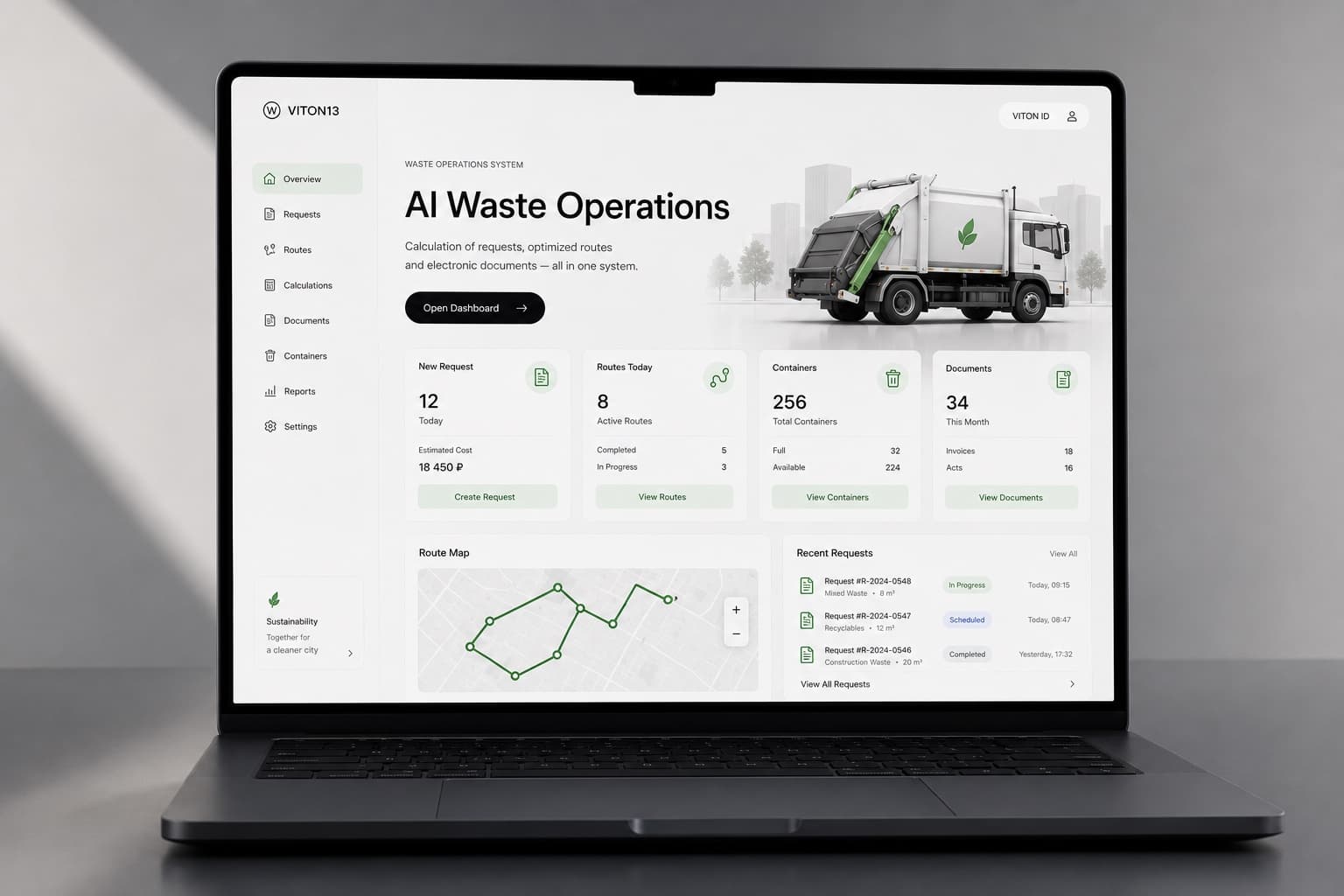
AI Waste Operations соединяет расчёт заявки, планирование вывоза, контейнерный парк, документы и подтверждение обработки для операторов отходов.
Waste Operators Manage Not Just Vehicles but Responsibility Chains
A waste pickup request seems simple until a dispatcher starts verifying composition, volume, container, access, timing, and destination. An incorrect category changes transport, documents, price, and permitted handling methods. Then a vehicle must be assigned, containers accounted for, actual volume confirmed, and documents returned to the client. Each step involves operational and environmental risk.
Automating a waste removal company isn’t just about routing the shortest path. An incomplete or misdirected request speeds mistakes if optimized routes push flows incorrectly. AI Waste Operations builds from classification and traceability: it helps gather data, calculate scenarios, assign resources, and preserve proof until acceptance.
The product links client, site, container, transport, driver, document, and processing facility. AI parses free-form descriptions, recognizes fields, and proposes solutions; doubtful flows, hazardous flags, or unusual conditions escalate to specialists. The dispatcher approves routes and sees reasons for every constraint.
VITON13 views Waste Operations as an industry operating system, not a generic logistics module. Waste specifics are central: codes and properties, permitted containers, compatibility, transport requirements, and final operation. This forms the basis for efficiency without losing accountability.
Request Calculation Starts with Questions That Prevent Wrong Dispatch
The system extracts address, contact, description, volume, desired time, container type, and access. Photos or documents preserve originals. Then it applies refinement scenarios based on the waste stream: origin, physical state, impurities, hazardous properties, loading conditions. AI Waste Operations does not fill missing information with averages when it affects safety or price.
Preliminary classification shows candidate categories and reasoning. Text matches alone are insufficient proof. Confirmation may require passports, analyses, contracts, or competent employees. High-risk cases block automatic calculations. This principle protects clients and operators from false legal realities created by convenient interfaces.
Prices are derived from approved elements: container, transport, distance, loading, weight or volume, processing, waiting time, and extra requirements. Each value has a source and date. If actual weight differs, recalculation rules apply and are reflected in proposals. Staff approve nonstandard discounts and contractual terms.
The output is more than a total: it’s an execution plan detailing needed containers, permitted transport, flow destination, required documents, and client obligations. Such calculation reduces empty or repeated dispatches by verifying operational readiness before commitment.
Container Fleet Must Be Linked to Site, Stream, and Condition
Each container receives a persistent identifier, type, volume, allowed streams, owner, and condition. Movements link to requests and sites. The system knows where containers should be, when delivered, and when maintenance is due. This reduces losses and manual list searches.
Fill sensors can provide useful signals but aren’t absolute truth. AI Waste Operations checks freshness, spikes, and history. Anomalies generate inspection or client confirmation tasks. Planning uses ranges and alternative data to avoid dispatching trucks to empty containers or missing overflows.
Container condition impacts safety and service. Damage, contamination, or mislabeling are recorded with photos and tasks. Containers under repair aren’t assigned; replacements update links to sites and contracts. Clients receive confirmed statuses.
Turnover analytics reveal downtime and shortages by type. Problems may stem from return delays, poor distribution, or weak tracking rather than container scarcity. Pilots help distinguish investment needs from informational gaps.
Routes Optimize by Waste Constraints and Processing Points
Plans consider vehicle type and capacity, permits, stream compatibility, container, time windows, access, shift, and destination. Inadmissible combinations are excluded before optimizing mileage and load. The shortest path isn’t best if it leads to wrong sites or mixing risks.
Dispatchers see alternatives and explanations. They can choose shorter mileage, reliable windows, or reserves for urgent requests. Changes are logged. Local knowledge—roadworks, complex access, actual loading times—is incorporated after verification. The system learns from facts, not unexplained habits.
Dynamic replanning occurs upon confirmed events: new requests, delays, site refusals, or volume changes. The product highlights affected tasks and notifications. It doesn’t silently reorder shifts if duties or driving modes change.
Post-execution plans compare to actuals. Mileage, onsite time, weight, deviation causes, and returns are analyzed. These data refine norms and tariffs. However, exceptional days don’t automatically rewrite models; changes require stable samples and dispatcher involvement.
Driver Mobile Tasks Collect Proof Without Extra Burden
Drivers receive addresses, contacts, containers, stream info, instructions, documents, and completion criteria. Interfaces show only current versions. Pre-trip checks verify vehicle readiness and mandatory items. Interactions avoid complex input while driving; actions occur safely at stops or confirm automatically.
Site records capture arrival, container status, actual volume or weight, photos, and notes. Recognition aids field completion, but drivers verify critical values. If waste deviates from requests, rejection scenarios trigger rather than routine completion.
Rejection records include start time, reason, and confirmation. Clients may receive notifications; commercial calculations update per rules after review. This reduces disputes since context and timing are recorded during events.
Transfer to processing links acceptance, weight, and documents to original requests. Discrepancies escalate immediately. Trips close not by button press but upon sufficient confirmations.
Electronic Documents Create Traceability from Generation to Processing
Each document has type, version, participants, stream, quantity, and operation. AI Waste Operations extracts fields, compares them to trips, and flags mismatches. Originals are preserved; structured data support exchange and reporting. Signatures and legal status depend on agreed processes.
In May 2026, the European Commission launched DIWASS for digital waste transport document exchange across the EU. It supports electronic submission, exchange, and status tracking, enhancing transparency. This does not imply automatic EU regulation application elsewhere but signals the trend: structured data and traceability become regulatory elements.
Operators benefit from stable models independent of particular platforms. Shipper, carrier, receiver, stream, quantity, and operation must agree between requests and documents. If one entity has five notations, electronic exchange won’t remove manual reconciliation.
Reporting derives from events and documents, not separate assemblies. Aggregated values link back to trips and acceptances. This simplifies audits and error detection without layering extra tables atop operational systems.
Traceability Requires Statuses Confirmed by Real Events
Chains can include request accepted, container assigned, transport dispatched, loading done, cargo en route, received, processed, and document finalized. Each status requires confirmation. Scheduled times alone do not advance statuses. Clients see only verified information.
If actual flows differ from requests, corrections are not hidden by backdated fixes. Deviations, resolutions, and new versions are created. This clarifies who and why reclassified or changed quantities. The history protects operators and clients and feeds incoming calculation improvements.
Interim sites maintain responsibility transfer records. Documents, times, and quantities link participants. The system signals if cargo arrives but acceptance is unconfirmed. This is more important than formal trip completion percentages.
Traceability does not mean public data. Access is distributed: clients see their requests, drivers their tasks, sites their acceptances, operators the full chain, and regulators predefined subsets. Minimizing access remains integral to architecture.
Exceptions and Claims Preserve Facts Before Interpretation
Mismatches, rejections, spills, container damage, overloads, or missing documents trigger distinct scenarios. The system gathers time, location, photos, testimonies, and participants. First actions depend on safety and regulations, not commercial convenience.
AI Waste Operations prepares timelines and lists of missing evidence. It can draft notifications but does not assign liability or legal conclusions. Authorized personnel assess documents and applicable rules.
When resolved, root causes are classified. Frequent client errors prompt form or instruction changes. Regular site refusals lead to route revision. Late document returns improve mobile scenarios.
Claims link to economics: downtime, returns, extra processing, risk. Managers see recurrence and decide on process or contractual fixes. Analytics aim at prevention, not just fast dispute responses.
Economic Impact Is Not Just About Kilometers Reduced
Baselines include calculation time, calls, manual entries, planning, container searches, and document collection. Measured metrics cover mileage, load, downtime, empty trips, returns, and closure time. Comparable regions and streams are used for valid contrasts since averages may hide complexity.
Post-pilot evaluation examines classification accuracy, clarification rates, manual route edits, timely statuses, and document mismatches. Mileage reduction is not success if overloads, risks, or shift times increase. Metrics reflect the system as a whole.
Financial value comprises recovered hours, higher loads, fewer repeated trips, container control, and fast document flow. Models include sensors, integrations, communications, training, and support. Sometimes prevention of mismatches is the main benefit rather than continual savings.
Calculators estimate potential resource costs but audits confirm volumes and exceptions. Operators have diverse tariffs, streams, and territories. Promising universal optimization percentages lacks rigor compared to focused pilots with real trips.
AI Risk, Ecology, and Safety Require Rights to Halt Automation
Classification errors can cause environmental and legal issues. Risk levels define control depth. Low-risk standard requests proceed faster; suspicious or hazardous flows block pending specialist review. Model confidence does not replace expertise and mandatory documents.
NIST AI RMF advises mapping context, measuring behavior, and managing risk. For Waste Operations, control sets cover rare forms, mixed streams, and poor images. Errors and near-misses are logged. Updates undergo testing before deployment to routes.
Systems must maintain manual modes. In communication, telemetry, or integration failures, operators follow clear procedures and data sync with oversight. Dependence on a single algorithm must not halt critical operations.
Decision transparency includes classification source, applied rules, and confirming staff. Clients understand data needs. Drivers see restrictions. Managers can investigate. This verifiability outweighs demonstration autonomy.
Pilot on One Stream and Territory Reduces Risk and Delivers Precise Economics
Select a frequent, well-documented stream and a limited area. Collect requests, routes, documents, and actual outcomes. Experts create classification rules and exceptions. Baseline workloads are measured. Clients, sites, and containers are normalized at this stage.
Shadow mode runs calculations and plans alongside dispatchers. Solutions and deviations are compared. The system then drafts requests and routes for confirmation. Hazardous and nonstandard cases remain outside automation.
After approval, mobile tasks and documents connect. Communication faults, volume changes, faulty sensors, site refusals, and weight discrepancies are tested. The product escalates and preserves chains. Every function has metrics and manual fallback.
Outcomes include scale decisions, reference data owners, and support budgets. New streams add only after requirements analysis. Low-effect pilots yield data maps and preclude deploying weak models to riskier operations.
Practical Start for Waste Removal and Recycling Operators
Gather twenty completed requests of one type and trace each through acceptance. Where was composition clarified? Who recalculated prices? Why was a route changed? When did documents return? Time and exceptions tracked. This builds a pilot foundation stronger than a generic logistics automation brief.
AI Waste Operations suits operators, carriers, sorters, and recyclers ready to appoint classification, transport, and document owners. Perfect data isn’t required, but critical rules must be formalized and verifiable.
VITON13 audits industry, designs data models, integrations, and role interfaces. Pilots limit streams and territories to measure results without risking entire operations. After proving benefits, containers, points, documents, and analytics connect.
Good systems make chains visible: clients understand calculations and statuses; dispatchers manage exceptions; drivers receive safe tasks; sites confirm acceptance; managers see economics and traceability. AI accelerates discipline but doesn’t replace environmental, professional, and legal responsibilities.
Before scaling, companies verify material and digital flows. Selected trips align actual containers, weights, routes, documents, and system records. Discrepancies classify by input errors, exchange delays, wrong IDs, or process breaches. This test reveals whether analytics can be trusted or require further proof before automation.
Next maturity level involves regular data quality and incident councils. Operational managers, ecologists, specialists, dispatchers, and product owners review rare cases, requirement changes, and model quality. This keeps deployments from bureaucratizing while ensuring routing speed never eclipses proper handling and accountable transfers.
For clients, maturity appears in simple ways: calculations are explainable, time windows realistic, changes timely communicated, documents accessible, questions don’t get lost between departments. Product acceptance criteria should include these alongside technical performance. Operators implement advanced models not for their own sake but to enhance reliable service. If new circuits don’t improve experience and traceability, expansion should be postponed—even if internal dashboards show more automation.
Practical checklist
- Select one waste class and define mandatory data for safe calculation and transport.
- Link client, site, container, transport, driver, and processing point with persistent IDs.
- Record tariff rules, restrictions, allowances, and cases requiring manual review.
- Measure mileage, dispatcher time, downtime, document returns, and plan-vs-actual discrepancies.
- Define events confirming each status from request acceptance to processing.
- Launch shadow calculation and routing in a limited area before automatic task dispatch.
Questions and answers
Can AI Waste Operations determine waste type from description or photo?
The system can suggest probable categories and request missing attributes, but regulated classification and hazardous cases require confirmation by a qualified specialist and documents.
How does the product optimize garbage truck routes?
It accounts for requests, volume, container type, permitted transport, time windows, access, capacity, shifts, and suitable processing points. The dispatcher sees constraints and can modify the plan.
Does the system work with container fill level sensors?
Yes, if reliable telemetry is available. Readings are checked for freshness and anomalies; critical decisions do not rely on a single faulty sensor without additional signals.
Can waste transport documents be automated?
The product can generate, extract, verify data, support electronic exchange, and prepare packages. Requirements and legal validity depend on waste type, route, and applicable regulations.
What metrics show implementation effects?
These compare calculation time, clarification rate, mileage, vehicle utilization, downtime, missed requests, document return speed, and traceability discrepancies.