
Answer in brief
Loewe Antares turns modular TV design into an interior decision, combining adaptable mounting, restrained materials and an upgradeable entertainment system.
Why modular TV design has become an interior question
Modular TV design is moving beyond a technical checklist and into the language of interiors. Loewe Antares is a useful case because the screen is presented not as an anonymous black rectangle but as a configurable object whose frame, support, sound and position can respond to a room. That shift matters more than another incremental specification race.
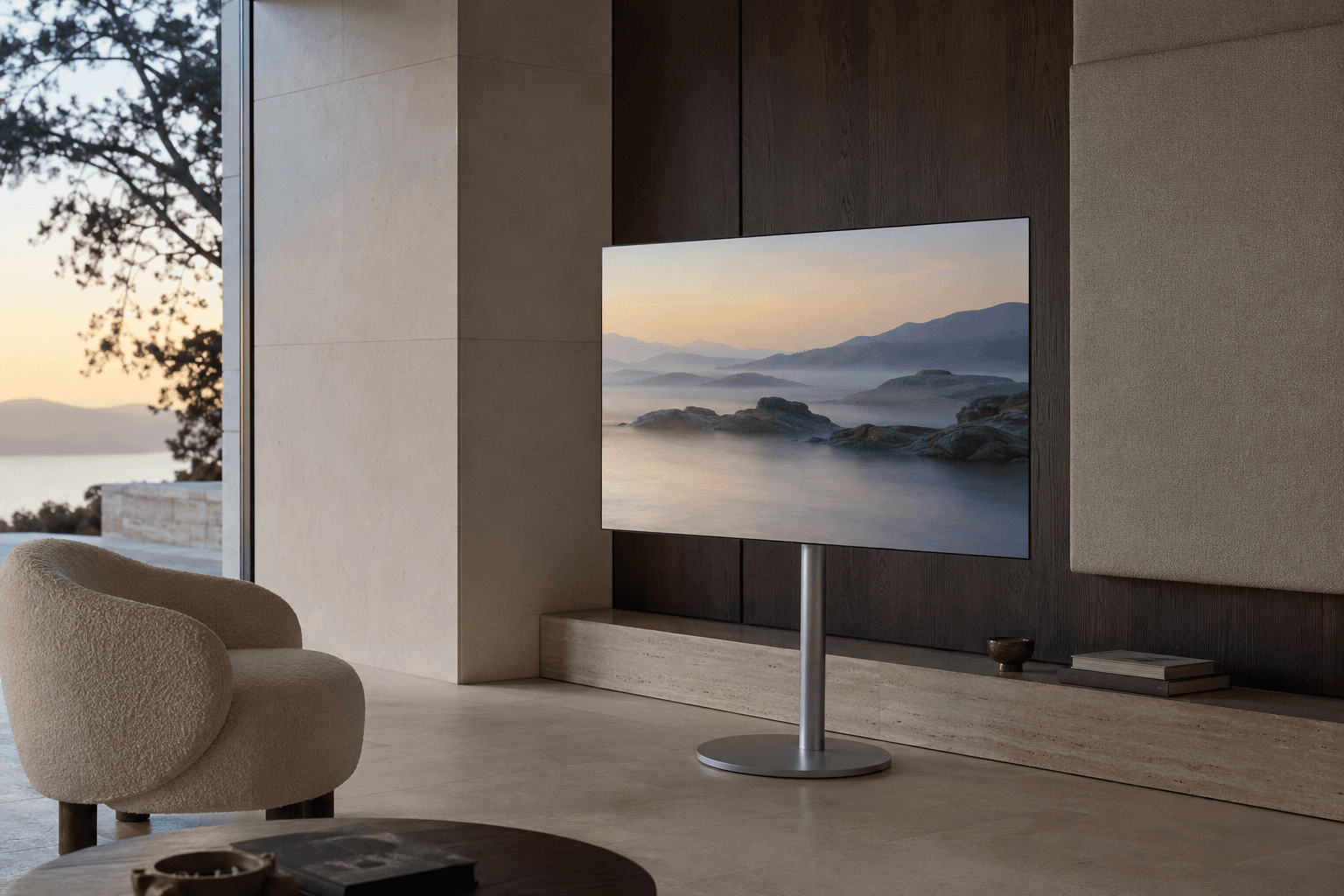
Reports published by Loewe's press network, Forbes and Inside CI describe Antares as a premium OLED platform developed and assembled in Kronach, Germany. The range combines interchangeable aluminium details with wall mounts, rotating floor stands and a floor-to-ceiling support. Certain stands add remote-controlled motorised rotation, allowing orientation to become part of daily use rather than a fixed installation decision.
The factual proposition is therefore straightforward: Loewe has launched a television family in several sizes with multiple physical configurations, integrated or optional audio, current connectivity and individually calibrated OLED modules. The larger editorial question is what this configuration model says about premium product design when electronics increasingly occupy carefully composed living spaces.
VJOURNAL reads Antares less as a decorative television than as evidence of a broader design correction. Premium technology can no longer depend on a polished front surface while ignoring cables, supports, speakers, maintenance and the view from the side. The product must make sense as a complete spatial system, including the moments when the screen is off.
What the launch establishes and what remains a claim
The source record supports a defined set of details. Antares is offered in 42, 48, 55 and 65-inch versions. Its optional aluminium onlays come in silver and black, while installation choices include wall mounting, several floor stands and a floor-to-ceiling solution. Forbes and Inside CI also report that selected supports use Loewe's Magic.Motion system for motorised adjustment.
The OLED modules are engineered for the range and individually calibrated at the company's Kronach facility before shipment. Published specifications include 4K Ultra HD resolution, support for Dolby Vision IQ and HDR10+, HDMI 2.1 connectivity, refresh rates up to 144Hz, variable refresh rate and automatic low-latency switching. Those facts describe capability; they do not by themselves prove superior picture quality in every room.
Audio follows the same configurable logic. The chassis contains discreet integrated speakers, while buyers can add an Antares soundbar or connect external Loewe components. Inside CI reports that the television can serve as a centre channel in a multichannel installation. This allows a system to begin simply and expand, although the practical result will depend on the room and installation quality.
Loewe OS9 supplies streaming, recording and connected-home functions, with reports listing AirPlay, Matter compatibility and voice control among the available features. VJOURNAL has not independently laboratory-tested the display, its software or its acoustics. Our analysis concerns the verified product architecture and its design implications, not a verdict on performance or value.
The television becomes furniture without pretending to be furniture
Many attempts to integrate electronics into interiors rely on disguise. Screens imitate framed art, speakers hide inside cabinetry and cables disappear behind built surfaces. Antares takes a different route: its monitor-like silhouette remains recognisably technological, but the supports, finishes and proportions are treated with the precision expected from furniture. That honesty gives the object a clearer identity.
A freestanding screen changes room planning. It need not claim an entire wall or force seating into a rigid axis. A rotating support can serve a conversation area and then a viewing position. The floor-to-ceiling option creates a deliberate vertical line without the mass of a conventional media unit.
This flexibility should not be confused with visual neutrality. Every stand and finish makes a statement, and a large dark surface still has weight. Good integration therefore begins with sightlines, daylight, reflections, circulation and acoustic behaviour. Selecting a premium screen after the room has been designed is often less convincing than considering architecture, furniture and technology together from the first plan.
The strongest lesson is restraint. Antares does not need ornamental complexity to appear luxurious. Material junctions, a thin profile, controlled geometry and a coherent support system do the work. For brands building premium digital products, the parallel is clear: confidence comes from resolved relationships between parts, not from adding visual effects to every available surface.
Personalisation works when choices share one grammar
Customisation can easily become a catalogue of unrelated options. A successful modular system instead defines a limited grammar: components may change, but proportions, materials and interaction remain recognisable. Antares uses a restrained set of frame treatments, stands and audio paths. The choices are visible enough to matter without turning the product into an exercise in endless decoration.
This is an important distinction for luxury. Personalisation should help an object belong to a particular home, not merely demonstrate that the buyer selected an expensive option. A silver detail may connect with metalwork in a cool stone room; a darker treatment may recede into timber panelling. The value lies in contextual fit rather than in novelty alone.
A coherent option system also supports dealers, interior designers and installers. They can discuss placement, viewing angle, sound and finish as one brief instead of treating each as a separate purchase. That conversation is closer to specifying a kitchen or lighting system than buying a conventional appliance, and it gives the brand more responsibility for the total outcome.
For digital teams, the same principle applies to configurable services. Choices need clear boundaries, predictable consequences and a shared visual language. If customers cannot understand compatibility or imagine the finished result, flexibility becomes friction. Premium personalisation requires excellent guidance, not simply a larger number of controls.
A product platform can age more gracefully than a sealed object
Inside CI characterises the Antares construction as service-friendly and intended to support a longer lifecycle. That ambition is particularly relevant for premium electronics, where furniture-grade materials may outlast software standards and display components. A system that acknowledges maintenance and component relationships is better positioned for care than one designed as a sealed visual monolith.
Modularity does not automatically guarantee sustainability. Replacement parts must remain available, repairs must be economically realistic and software support must continue. Materials and transport also matter. The launch information does not provide enough evidence for a broad environmental claim, so it would be irresponsible to translate serviceability into a complete sustainability verdict.
It does, however, establish a more useful design direction. When audio can expand separately, supports can suit a new room and visible finishes can be changed without discarding the central product, ownership becomes less binary. The object can adapt through stages rather than moving directly from new to obsolete because one aspect of the original setup no longer fits.
Premium brands should treat this capacity as part of experience design. Documentation, spare-part logic, installation records and support interfaces are not administrative details after the sale. They are the infrastructure that determines whether an expensive object continues to feel considered several years later. Longevity is delivered operationally as much as aesthetically.
The off-state is now a core product interface
A television may display extraordinary images for a few hours and remain a dark plane for the rest of the day. Interior-aware design therefore has to solve the off-state. Proportion, edge treatment, cable routing and the relationship between screen and support become more visible when content is absent. This is where superficial styling often loses conviction.
Antares addresses that condition through a deliberately horizontal silhouette and a family of mounting options. Its reported gallery mode offers another response, but software imagery cannot substitute for physical resolution. An art mode may soften the blank-screen problem; it cannot correct a heavy stand, awkward wiring or a product positioned without regard for the architecture.
The same idea applies to premium apps and connected products. Empty states, loading moments, permissions, updates and error recovery occupy real portions of the customer journey. Designing only the ideal active moment creates a beautiful demonstration rather than a durable experience. Mature products remain composed when nothing exciting is happening.
Art direction should therefore include silence. What does the product look like without content? How does the interface behave before setup is complete? What remains visible from a doorway or adjacent seat? These questions seem modest, yet they often separate genuinely integrated design from a collection of individually attractive components.
What architects, brands and product teams can take from Antares
Architects can begin by treating audiovisual equipment as part of the spatial brief rather than a late technical package. Viewing height, rotation, glare, power, data and acoustics should be mapped alongside furniture and lighting. A flexible stand is useful only when the room preserves enough clearance and the cables remain controlled through its full movement.
Brands can study the way a physical platform connects product, installation and service. A premium promise is strongest when every handoff supports it: online configuration, showroom explanation, delivery, calibration, mounting, software onboarding and future maintenance. Any weak transition can make precise industrial design feel like surface theatre.
Product teams should define which dimensions deserve choice and which should stay fixed. Antares varies finishes, supports and audio pathways while keeping a recognisable central form. That hierarchy protects identity. In digital products, an equivalent approach might offer adaptable workflows and content modules while preserving navigation logic, typography and behavioural consistency.
Customers should resist choosing from images alone. Room geometry, reflections, sources, sound expectations, upgrade plans and installation all matter. A modular object earns its value when the selected configuration solves these conditions with less compromise, not when it carries the longest accessory list.
Conclusion: modular TV design as quiet infrastructure
Loewe Antares arrives at a moment when domestic technology is being asked to behave with greater cultural intelligence. The verified launch details show a screen platform with configurable finishes, multiple supports, scalable audio and individually calibrated OLED modules. Together, those elements make the physical installation part of the product rather than an afterthought.
The more important contribution is conceptual. Modular TV design reframes luxury as the quality of relationships between object, room, interface and service. It replaces the isolated hero product with a system that can be specified, installed and potentially adapted over time. That is a demanding promise because every component must sustain the same level of discipline.
Antares should still be judged in person for picture, sound, software behaviour and build quality. No press specification can determine how it will perform in a particular home. Yet as a design case, it offers a credible alternative to both invisible technology and attention-seeking gadgetry: an electronic object that accepts its presence and works carefully with it.
For premium creators, the final lesson is calm but exacting. Design does not end at the front elevation, the launch image or the first successful interaction. It continues through placement, cables, inactive states, maintenance and change. When those conditions are treated as one composition, technology can become quiet infrastructure for the life around it.
Practical checklist
- Map viewing angles, daylight reflections and circulation before choosing a screen size or stand.
- Plan power, data and cable routes for every intended position of a rotating display.
- Compare integrated, soundbar and external audio options against the actual room and listening habits.
- Confirm installation, calibration, warranty and spare-part support with the authorised retailer.
- Evaluate the television while switched off as carefully as its active picture and interface.
- Choose only the modular options that solve a real spatial or functional requirement.
Questions and answers
What makes Loewe Antares a modular television?
The published configuration includes interchangeable aluminium details, several wall and floor mounting systems, a floor-to-ceiling option and different audio paths. These components allow the central display to be specified for different interiors without changing its core visual identity.
Which Loewe Antares sizes have been announced?
Forbes and Inside CI report 42, 48, 55 and 65-inch OLED versions. Availability and exact configurations may differ by market, so buyers should verify current local stock, compatible supports and pricing with an authorised retailer.
Does a configurable television automatically last longer?
No. Modular construction can make adaptation and service easier, but useful longevity also depends on spare parts, repair economics, software support and component compatibility. The launch supports a serviceability discussion, not a complete sustainability guarantee.
Is the Antares picture quality independently proven?
The sources confirm individually calibrated OLED modules and support for major HDR and gaming formats. VJOURNAL has not laboratory-tested the television, so those specifications should not be read as an independent performance verdict for every viewing environment.
Why does modular TV design matter to interior designers?
It expands the design brief from selecting a screen to coordinating placement, support, sound, sightlines, materials and future service. That can produce a more resolved room when the system is planned early rather than added after the architecture is complete.