
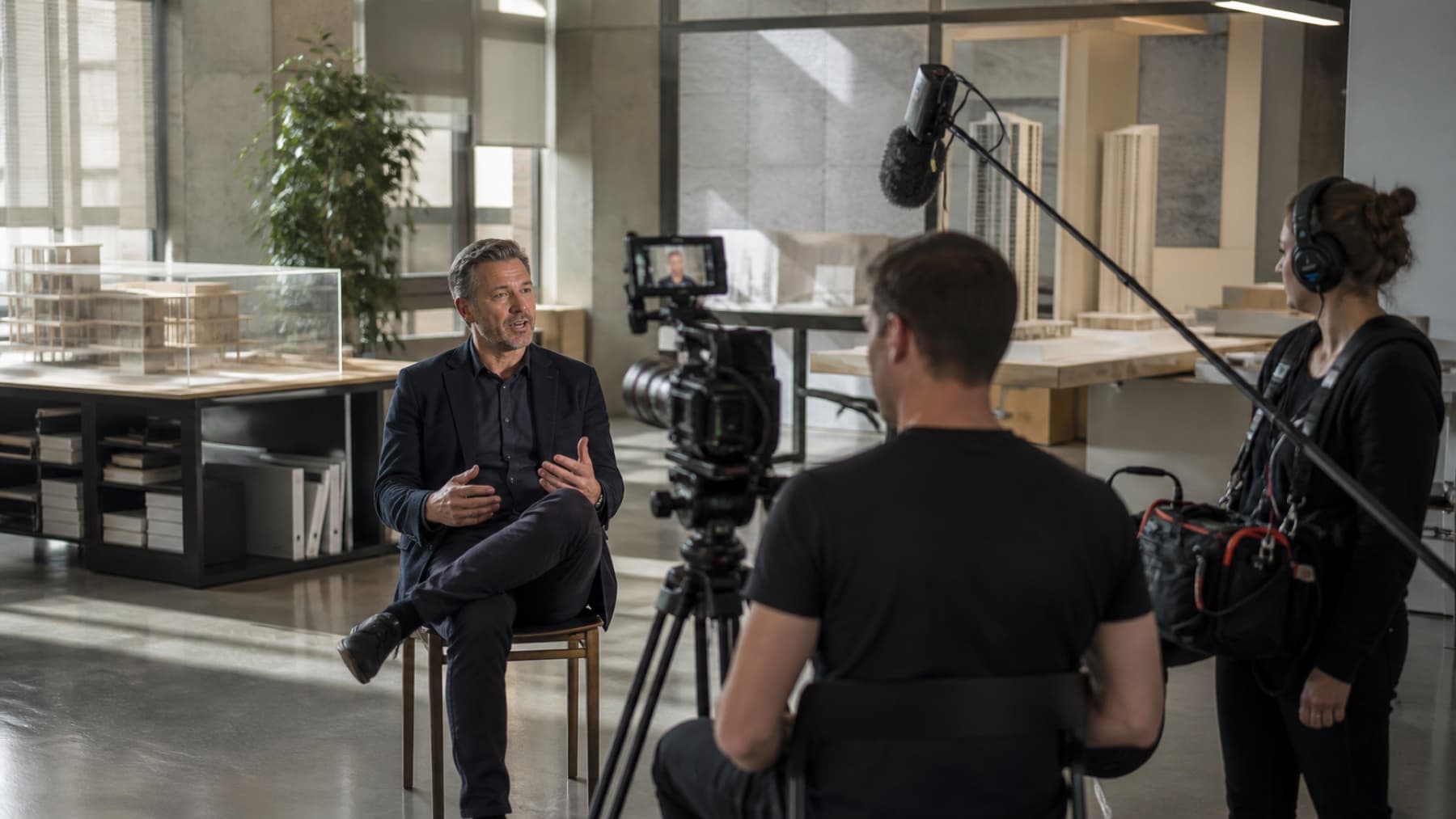
Answer in brief
Corporate video must serve customers, candidates or partners deliberately instead of forcing one neutral film to address everyone. Turn leadership, operations and proof into a credible company story without scripted corporate clichés.
Verified facts
- Source review
- Sources were checked on 29 August 2026.
- Reader need
- corporate video production with executive interviews and real operations
The viewing decision — Corporate video
Corporate video starts with a viewing decision, not a camera list. The team must define who is watching, what that person already knows and which next action the film is allowed to ask for. For this commission the working focus is one credible promise, visual evidence, stakeholder approval and the moment the viewer should act. The exact search need is “corporate video production with executive interviews and real operations”. The service answer is specific: Turn leadership, operations and proof into a credible company story without scripted corporate clichés. Corporate video must serve customers, candidates or partners deliberately instead of forcing one neutral film to address everyone.
A quotable scope connects Narrative and interview plan, Directed filming, Company film and cutdowns. It also names duration, aspect ratios, locations, cast, revisions, music, usage territory and the person who can approve the story before expensive production begins. This pass is recorded under “The viewing decision” so a later reviewer can trace the decision to the named service and its real source material.
A useful brief records the viewing environment as carefully as the audience: sound on or off, handheld or large screen, paid placement or owned channel, first contact or returning customer. Those conditions change pacing, typography, framing and the amount of context the opening must carry. They also provide an honest reason to reject a fashionable format that cannot support the promised outcome: Turn leadership, operations and proof into a credible company story without scripted corporate clichés.
Evidence before aesthetics — Corporate video
Bring one real customer situation, current footage and the exact claim that needs support. Narrative and interview plan is useful only when it preserves source truth and shows why the chosen scene belongs in this film rather than in a generic showreel.
Work moves from a decision-ready brief into Narrative and interview plan, then through Directed filming and finally Company film and cutdowns. Reviews happen at script, representative frame or rough-cut gates; comments arrive by timecode and one owner resolves contradictions. This pass is recorded under “Evidence before aesthetics” so a later reviewer can trace the decision to the named service and its real source material.
Evidence is selected before the shot list. Product claims need a demonstrable action; human testimony needs a specific event; an abstract service needs a visual cause-and-effect sequence. The producer keeps the source beside the proposed scene, records what cannot be claimed, and asks whether Narrative and interview plan remains truthful when the viewer sees only a short extract without the surrounding explanation.
A boundary that can be quoted — Corporate video: Corporate video: Narrative and interview plan; Directed…
A quotable scope connects Narrative and interview plan, Directed filming, Company film and cutdowns. It also names duration, aspect ratios, locations, cast, revisions, music, usage territory and the person who can approve the story before expensive production begins.
The material failure to test is that cinematic polish hides an offer the audience still cannot understand or believe. A small representative scene should expose that risk before the full batch, shoot or render. If it fails, the team changes the claim, treatment or boundary instead of polishing the wrong answer. This pass is recorded under “A boundary that can be quoted” so a later reviewer can trace the decision to the named service and its real source material.
The boundary distinguishes creative choices from production dependencies. A new location may change permits, travel and lighting; a new speaker changes preparation, sound and release rights; another aspect ratio can change art direction and coverage. Writing these consequences down gives the buyer a comparable proposal and prevents an apparently small request from becoming an invisible reshoot or a compromised export. The article applies that principle to a defined result: Corporate video must serve customers, candidates or partners deliberately instead of forcing one neutral film to address…
Production and review — Corporate video
Work moves from a decision-ready brief into Narrative and interview plan, then through Directed filming and finally Company film and cutdowns. Reviews happen at script, representative frame or rough-cut gates; comments arrive by timecode and one owner resolves contradictions.
Handover is more than one final file. It records edit versions, captions, masters, music and talent rights, source ownership, archive rules and platform checks. Acceptance means the team can verify message recall, usable proof scenes and a documented approval trail. This pass is recorded under “Production and review” so a later reviewer can trace the decision to the named service and its real source material.
Approval is divided by decision. The treatment confirms the idea, the pre-production gate confirms people and logistics, the rough cut confirms story, and finishing confirms technical quality. A consolidated reviewer returns comments by the agreed deadline. Unresolved feedback is logged instead of silently interpreted, so Directed filming does not move forward on contradictory instructions.
The failure to rehearse — Corporate video: Corporate video must serve customers, candidates or…
The material failure to test is that cinematic polish hides an offer the audience still cannot understand or believe. A small representative scene should expose that risk before the full batch, shoot or render. If it fails, the team changes the claim, treatment or boundary instead of polishing the wrong answer. The article applies that principle to a defined result: Corporate video must serve customers, candidates or partners deliberately instead of forcing one neutral film to address…
this commission is worth commissioning when the result changes a real audience or operating decision. Compare the complete service with a smaller pilot, ask who owns approval, and request a proposal where exclusions and acceptance are as visible as the creative promise. This pass is recorded under “The failure to rehearse” so a later reviewer can trace the decision to the named service and its real source material. For this case, the decision criterion is specific: Corporate video must serve customers, candidates or partners deliberately instead of forcing one neutral film to address…
A representative test should resemble the hardest part of the work, not the easiest beauty frame. It may be a speaking passage, reflective material, a synthetic character, a dense subtitle or a six-second cut. The test has a written pass condition and a named owner. That makes stopping or narrowing the commission a responsible production decision rather than a late creative argument. Here the practical constraint is equally important: Corporate video: Turn leadership, operations and proof into a credible company story without scripted corporate clichés.
Rights, versions and handover — Corporate video: Corporate video must serve customers, candidates or…
Handover is more than one final file. It records edit versions, captions, masters, music and talent rights, source ownership, archive rules and platform checks. Acceptance means the team can verify message recall, usable proof scenes and a documented approval trail. For the reader, the relevant outcome is concrete: Corporate video: Narrative and interview plan; Directed filming; Company film and cutdowns.
this commission starts with a viewing decision, not a camera list. The team must define who is watching, what that person already knows and which next action the film is allowed to ask for. For this commission the working focus is one credible promise, visual evidence, stakeholder approval and the moment the viewer should act. This pass is recorded under “Rights, versions and handover” so a later reviewer can trace the decision to the named service and its real source material.
Rights are checked against real distribution: organic social use is not automatically paid advertising, one territory is not worldwide use, and a music licence may not cover every cut or duration. The archive identifies sources, fonts, models, project versions and expiry dates. A future editor should be able to rebuild Company film and cutdowns without guessing which material is approved.
The buying decision — Corporate video
this commission is worth commissioning when the result changes a real audience or operating decision. Compare the complete service with a smaller pilot, ask who owns approval, and request a proposal where exclusions and acceptance are as visible as the creative promise. Here the practical constraint is equally important: Corporate video: Turn leadership, operations and proof into a credible company story without scripted corporate clichés.
Bring one real customer situation, current footage and the exact claim that needs support. Narrative and interview plan is useful only when it preserves source truth and shows why the chosen scene belongs in this film rather than in a generic showreel. This pass is recorded under “The buying decision” so a later reviewer can trace the decision to the named service and its real source material.
Compare suppliers through decisions rather than equipment lists. Ask what evidence changes the concept, who directs performance, how sound is protected, what a revision round means, which files remain editable and what happens when a dependency arrives late. A responsible estimate can then be smaller than the initial request, but it will not hide an essential production condition behind an attractive starting number. The article applies that principle to a defined result: Corporate video: Narrative and interview plan; Directed filming; Company film and cutdowns.
Practical checklist
- Corporate video: Narrative and interview plan.
- Corporate video: Directed filming.
- Corporate video: Company film and cutdowns.
- Corporate video: one credible promise, visual evidence, stakeholder approval and the moment the viewer should act.
- Corporate video: cinematic polish hides an offer the audience still cannot understand or believe.
- Corporate video: message recall, usable proof scenes and a documented approval trail.
Questions and answers
What should be ready before Corporate video starts?
Corporate video begins from one real audience situation because Corporate video must serve customers, candidates or partners deliberately instead of forcing one neutral film to address everyone. Bring current assets, the claim to prove, required formats and the person who can approve Directed filming.
How is the scope for Corporate video confirmed?
Narrative and interview plan anchors the proposal; it also fixes Directed filming, Company film and cutdowns, duration, locations, rights, revisions, formats, exclusions and acceptance before production.
Which risk should be tested first for Corporate video?
Directed filming must expose whether cinematic polish hides an offer the audience still cannot understand or believe. A representative scene or cut answers that question before the full production is committed.
What counts as acceptance for Corporate video?
Company film and cutdowns is accepted against evidence of message recall, usable proof scenes and a documented approval trail; visual polish without that evidence does not close this commission.
Can Corporate video begin as a pilot?
Corporate video can begin with one script, representative scene or destination format. That pilot tests “corporate video production with executive interviews and real operations” before the complete scope is commissioned.