
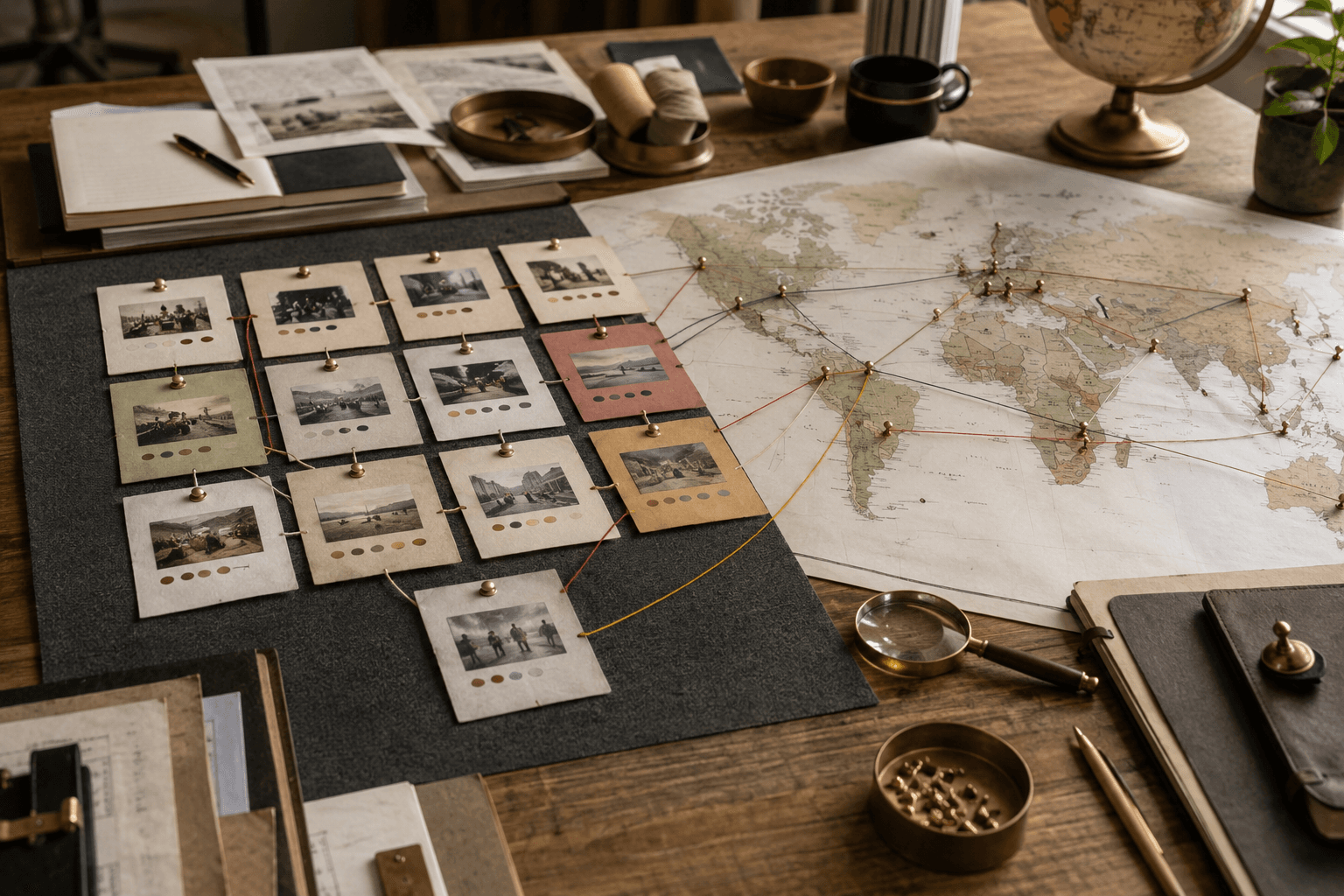
The VJOURNAL newsroom now uses 13 topic desks and eight regional desks. The useful change is not the count itself, but the ability to move through reporting by subject, geography or both.
A newsroom map built around two questions
A reader rarely arrives at a news site thinking in organizational charts. The practical questions are simpler: what is this story about, and where in the world does it matter? VJOURNAL’s current navigation answers those questions with two parallel route systems. The topic layer contains 13 editorial desks—Top News, World News, Company News, Business, People, Sport, Style, Beauty, Innovation, Design, Marketing, AI and Travel. The regional layer adds eight desks: Global, USA, Dubai, Russia, Spain, Japan, China and India. That creates a map that can be entered by subject or geography without forcing every story into one browsing pattern.
The distinction matters because topic and place are different kinds of context. A design story from Barcelona may belong to Design while also being useful to a reader following Spain; an AI policy story can be global in consequence while originating in one national market. The VJOURNAL editorial desks therefore work less like isolated publications and more like intersecting labels. The useful test is not whether every article fits a single box perfectly. It is whether the routes help a reader move from one relevant story to the next with a reasonable understanding of why that next link is there.
What the 13 topic desks actually do
The 13-topic taxonomy is broad enough to cover the publication’s existing editorial range without turning the navigation into a list of hundreds of micro-tags. Top News and World News function as high-level news routes; Company News isolates reporting about VITON13 itself; Business, People and Sport cover conventional newsroom beats; Style and Beauty separate consumer and cultural coverage; Innovation, Design, Marketing and AI divide adjacent professional subjects; Travel provides a destination and hospitality route. The names are visible on the journal hub and topic URLs use human-readable paths, such as the Top News route, rather than opaque identifiers.
That structure also establishes boundaries that editors can test. An AI-assisted advertising story might plausibly sit in AI or Marketing, but the primary route should reflect the article’s main mechanism rather than every term it mentions. A new hotel opening could be Travel, Business or Design depending on whether the article is about the trip, the commercial model or the architecture. This is an editorial judgment, not an automated truth. The value of a stable set of desks is that the judgment happens against a known map, making adjacent coverage easier to discover and reducing the temptation to invent a new category for each trend.
Eight regional desks add a second way in
Geographic routes solve a different discovery problem. The current regional set spans Global plus seven named market desks: USA, Dubai, Russia, Spain, Japan, China and India. A Global desk can collect stories whose relevance is not usefully limited to one country or city, while the named desks let readers follow coverage tied to a market they work in, visit or monitor. The hierarchy is intentionally small. It does not imply that countries outside those seven are excluded from coverage; it means those are the regional desk routes currently published in the navigation system as of August 25, 2026.
This is especially useful for subjects that behave differently by market. Retail rules, sports calendars, platform availability, tourism seasonality and business practices can all change with geography. A regional route gives an editor a place to preserve that local context instead of flattening every article into generic global advice. The limitation is equally important: a desk label is not evidence that every statement in an article applies across that region. Readers still need dates, jurisdictions and source attribution inside the story. Navigation can point to a context; it cannot replace reporting that defines the context precisely.
Topic routes and region routes are more useful together
The practical gain appears when the two systems are treated as coordinates rather than rival menus. Someone reading a Spain travel piece can stay in Travel to compare destinations, move to the Spain desk to see business or design developments in the same market, or return to the journal hub for a wider scan. That creates several legitimate next steps from one article. It also makes archives more intelligible: instead of one endless chronological feed, readers can narrow the surface according to the question they are actually trying to answer.
For editors, the same model encourages a disciplined related-story strategy. A related link should have an explainable relationship—same topic, same region, a direct update, or a useful counterpoint—not merely share a keyword. The World Wide Web Consortium’s accessibility guidance on link purpose is relevant here: link text and surrounding context should help users understand where a link will take them. That principle is broader than accessibility compliance alone. In editorial navigation, meaningful destination labels reduce the cognitive cost of deciding whether another click is worth the reader’s time.
Clear labels are a reader-service decision
W3C guidance also recommends informative page titles, headings and meaningful link text. Those practices align with a simple newsroom objective: let readers form a correct expectation before they navigate. A button labeled Spain Desk is more informative than a generic More link; a route named AI tells the reader what class of reporting sits behind it. The current VJOURNAL map benefits from familiar nouns rather than invented internal terminology. That does not make the taxonomy perfect, but it makes it legible without requiring a manual.
Legibility matters on small screens as much as on desktop. Long menus can become difficult to scan, so the editorial problem is to maintain enough categories to be useful without producing navigation overload. Thirteen topics and eight regional routes are still a meaningful set of choices, which makes consistent ordering and naming important. If the publication later adds desks, the threshold question should be whether a new route represents a durable reader need with enough coverage behind it. A category that exists only for one article creates more navigation work than context.
There is also a discovery benefit, but no ranking promise
Search systems use links to discover pages, and Google’s Search Central documentation notes that descriptive anchor text helps both people and its systems understand linked destinations. That makes a well-linked topic and region architecture technically sensible as well as reader-friendly. A dedicated topic page can expose a coherent set of articles, while a region page can provide another crawlable path to the same reporting. None of that guarantees indexing, ranking, traffic or citation by any search or answer system. Those outcomes depend on many factors outside a navigation map.
The more defensible benefit is operational: a route architecture gives the publication explicit places to connect coverage. When an older article remains relevant, it can stay reachable from a durable desk rather than disappearing as the homepage feed advances. When a new story updates an earlier one, editors have a natural cluster in which to connect the record. Search visibility may be a secondary effect of coherent linking, but the editorial reason comes first—readers should be able to recover context without knowing the exact headline or publication date they saw before.
Where a taxonomy can go wrong
Any desk system can become misleading if labels are assigned mechanically. Over-tagging makes every route look the same; under-tagging strands useful stories. A category can also drift in meaning as coverage changes. Innovation, AI and Design, for example, can overlap heavily unless editors keep a working distinction between a technology’s capabilities, a product or industry change, and the design decisions that shape how people use it. Regional classification has similar edge cases when a company is based in one country, announces something in another and affects customers globally.
The remedy is governance rather than more labels. Editors should periodically review whether desk pages contain coherent coverage, whether names still match reader expectations and whether links lead to genuinely adjacent reporting. Dates and update markers remain essential because a well-organized old story can still be outdated. The navigation should also avoid implying geographic completeness: eight regional desks are a published selection, not a claim of worldwide bureau coverage. Those limitations are part of a trustworthy map because they keep structure from being mistaken for reporting capacity.
A practical way to use the new map
For a reader with a specific question, start with the narrowest stable route that matches the decision. Follow a topic desk when the mechanism matters—for example, Marketing when comparing campaign practice or Travel when planning around a destination. Follow a regional desk when local market conditions are likely to change the answer. Use Global when the subject is cross-border or when no named regional desk is a sensible fit. From an article, treat related links as invitations to change one coordinate at a time: same subject in another market, or same market through another subject.
For VJOURNAL, the editorial test is similarly concrete: each new story should have a primary topic, a justified region and at least one meaningful path onward when relevant context exists. That does not require filling every possible combination. It requires making the visible choices consistent enough that readers learn the map through use. The 13-topic and eight-region structure is useful precisely because it is finite. Its success should be judged by whether people can move from a question to evidence and related reporting with less guessing—not by how many labels the publication can display.
Practical checklist
- Choose a topic desk when the mechanism matters most.
- Choose a regional desk when local conditions can change the answer.
- Use related links that preserve an explainable topical or geographic relationship.
- Check publication and update dates before relying on older context.
- Treat desk coverage as a navigation aid, not a claim of geographic completeness.
Questions and answers
How many VJOURNAL topic desks are published now?
The journal hub currently exposes 13 named topic desks when the general All view is excluded: Top News, World News, Company News, Business, People, Sport, Style, Beauty, Innovation, Design, Marketing, AI and Travel. The count describes the published navigation on August 25, 2026, not a promise that the taxonomy will never change. Individual stories can touch more than one subject, so the primary desk is best understood as an editorial route rather than an exclusive classification.
What are the eight VJOURNAL regional desks?
The current regional map consists of Global, USA, Dubai, Russia, Spain, Japan, China and India. Global is counted as a regional route because it is the published destination for reporting whose useful frame is cross-border or not confined to one named market. The seven named market desks do not imply that VJOURNAL covers only those locations. They are the dedicated regional navigation routes currently visible, and stories from elsewhere can still appear in topic coverage or global reporting.
Does the new taxonomy improve Google rankings?
A coherent internal linking system can make pages easier for people to navigate and can give search crawlers clearer paths to discover URLs. Google documents both crawlable links and descriptive anchor text as useful technical practices. That is not a ranking guarantee, and VJOURNAL should not treat a taxonomy as one. Content quality, relevance, technical accessibility, competition, freshness and many other factors affect search visibility. The defensible benefit of the desk map is clearer reader navigation and more durable connections between related reporting.