
Answer in brief
"Make the product photos with AI" describes at least three separate jobs with different prices and different risks. This is where the line runs between a generated setting and a generated product, and why crossing it is expensive.
What generation actually does today
The request "make product photos with AI" currently means three very different things, and confusing them is the source of most disappointment. It is worth separating them before discussing budget or timing.
The first is creating an image from nothing but a description. The model draws a scene that never existed: an interior, a background, light, tableware around a dish. The product is not in that scene; a plausible imitation of it is.
The second is building around a real photograph. You have a shot of the object and the model draws the surroundings: a table, fabric, a shadow, more background beyond the edges of the frame. The object itself stays photographed.
The third is processing: removing the background, cleaning dust, correcting perspective, raising resolution. Formally that is also machine learning, but the task is old and only the tool got faster.
Where it already saves money
Extending a background into different formats is the most honest win. One vertical shot has to work in a wide banner, a square listing tile and a story. That used to be manual work; now it takes minutes.
The second case is rough visualisation before a shoot. Showing a client five moods, choosing one and then shooting for that one specifically costs less than shooting three times and picking afterwards.
The third is backgrounds and underlays with no product in them at all: a section cover, a newsletter header, a field behind text. Nobody buys anything from those, and the demand for accuracy is low.
The fourth is high-volume identical items. With two hundred articles on white, tidy automatic cropping and alignment save more than any creative idea will.
Where generation costs money
The first place is the product itself. If the buyer sees a generated version of an object and receives the real one, the difference reads as deception even when nobody intended to deceive.
The second is anything the buyer will measure, count or compare: size, fit, quantity per pack, the shade of a fabric. A model draws the plausible rather than the exact, and in those fields plausible is not the same as true.
The third is people. Generated faces in reviews, in "our team" and in "our clients" are a fast way to lose trust, because they are recognised more easily every month and there is no way to explain them.
The fourth is categories where accuracy is regulated: food, children's goods, cosmetics, hardware with stated specifications. There the image carries legal weight, and a drawn version will not hold it.
The product has to stay itself
A practical rule settles most of the argument: the object is photographed, the surroundings may be generated. The boundary runs along the edge of the product, not the edge of the frame.
That means shooting does not disappear. Its volume changes: instead of ten scenes you shoot one careful set-up, and the other nine are built around that same object.
It is worth watching separately that generation does not quietly "improve" the product. Models like to straighten seams, symmetrise logos and remove small irregularities, and the buyer then looks for them in the box.
So acceptance should always place the original photograph next to the final image. If the object differs by more than the lighting, the work was done wrong.
Rights: what you get and what you do not
Rights in generated images work differently from rights in photography, and the difference usually surfaces once the picture is already on the packaging.
A photograph has an author, and rights transfer by contract. An image created entirely by a model may have no author in the usual sense, in which case there is nothing to transfer and no exclusive right arises for anyone.
The practical conclusion is simple: do not put a generated image anywhere you intend to defend against copying. A mark, packaging and a campaign's key visual need clear authorship.
And check the terms of the service you use separately. Some allow commercial use only on a paid tier; some reserve the right to show your results to other people.
Do you have to say an image was generated
The question sounds ethical and is settled practically. A label is needed wherever its absence could mislead a buyer about what they will receive.
A newsletter background needs no label — nobody buys a background. A listing where the product sits in a generated scene deserves one: a single line in the description, without apology and without advertising the technology.
Platforms are gradually introducing labelling requirements of their own, and they differ from each other. If you sell through marketplaces, the platform's rules outrank your internal agreements.
The safest approach is deciding in advance which kinds of image you label and writing that rule down. Then the decision is not made from scratch by every employee at the moment of publishing.
Turning this into a process
A one-off experiment almost always produces a beautiful result and no benefit: repeating it a month later fails, because nobody recorded how it was obtained.
A process starts with a library of descriptions. The wording that produced the right light and mood is stored alongside examples of the result, and the next batch does not begin from zero.
Then come fixed formats. The list of sizes the image must exist in is settled once: listing tile, banner, cover, preview. Generation works to that list rather than the other way round.
And finally storage. Originals, finals and descriptions live in one place under names that make sense. Without that, six months later nobody can find what a listing was assembled from when it needs a correction.
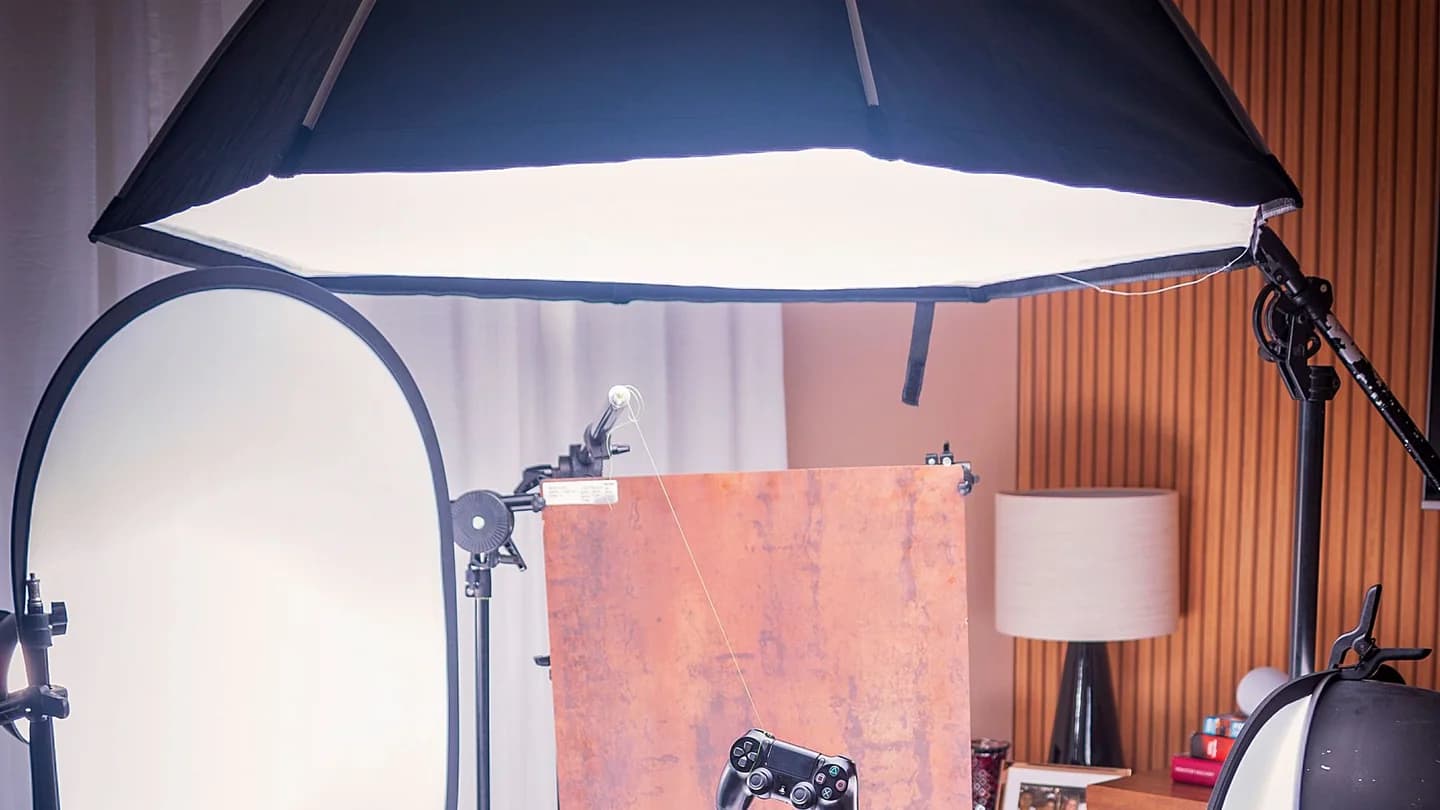
How to accept the work: The line runs along the edge of the product: the object…
Accepting generated images differs from accepting photography in one respect: besides "I like it" you have to check "it matches".
Start by opening the result next to the original photograph of the product at full size. Shape, proportion, the text on the packaging and the colour must match; light and background may differ.
Then look at the details models handle worst: text, hands, reflections, repeating patterns and the places where the object meets a surface. The errors almost always live there.
And last, check the image at the size the buyer will see. A flaw invisible on a large screen can look like a defective product in a tile the size of a thumbnail.
What it really costs
The sense that generation is free lasts exactly until the first batch. A subscription to a service really does cost little, but it is the smallest line on the invoice.
The main expense is time. Getting one accidentally beautiful image is easy; getting forty that match each other in light and style is work, and it is measured in hours exactly as retouching is.
The second line is the shoot you still need. The product has to be photographed carefully, or there is nothing to build around, and saving at that stage comes back as defects at the end.
The third is checking. Somebody has to open every file next to the original and compare. At two hundred items that is a job of its own, and it cannot go to the same person who generated them.
What to ask a supplier
The first question is what exactly will be generated and what will be shot. "We'll do it all with AI" means nobody has drawn the line for you, and you will be drawing it during acceptance.
The second is which files you receive. You need final images in every format and the sources they can be rebuilt from, not only pictures in a messenger thread.
The third is which service the work runs on and what its terms say about commercial use. That is not pedantry: responsibility for publishing sits with you, not with the supplier.
The fourth is who is accountable for the likeness. There has to be a person who signs off that the object in the picture is the object in the box, and their name should be known before the start.
How this connects to the rest of the design
Images do not live on their own. They land in a listing, a banner, a newsletter and a deck, where a typeface, a colour and a grid already exist and have to be accommodated.
In practice that means generation starts after the formats and the space for text are settled. A beautiful scene with no empty field for a headline gets remade from scratch.
The second joint is colour. Models happily produce saturated backgrounds that fight the brand palette. A list of permitted backgrounds is easier to set in advance than to filter one by one.
And the third is consistency across a series. Twenty images made from one description on different days will still drift in light. They have to be reviewed together, in a row, not one at a time.
First-month mistakes
The most common is comparing the result with your imagination rather than with the job. An image gets judged on how striking it is, when its work will happen in a feed beside twenty neighbours.
The second is generating for a specific idea rather than for a list of formats. A week later it turns out there is no horizontal version, and the whole series is redone.
The third is not saving the descriptions. A month later nobody remembers how the right light was obtained, and the next batch looks different although the product is the same.
The fourth is letting the author do the checking. Somebody who spent a day on an image physically sees its flaws less well; a fresh pair of eyes finds them in minutes.
Practical checklist
- Split the request into three: creation from nothing, scene extension, and processing.
- Forbid generating the object itself wherever the buyer will measure or compare.
- Place the original photograph beside the final image at every acceptance.
- Check the service's commercial-use terms before the first publication.
- Write down which kinds of image you label, and stop deciding it case by case.
- Keep the descriptions that worked alongside examples of the result, in one shared place.
Questions and answers
Can generated images be used commercially at all?
Yes, but not everywhere. Backgrounds, underlays and a setting extended around a real photograph cause no trouble. The product itself, people, and anything the buyer will measure or compare should not be generated: a gap between the picture and the box reads as deception.
Will generation replace photography completely?
No, it changes its volume. Instead of ten scenes you shoot one careful set of frames of the object, and the other variants are built around it. Shooting stays the source of truth about how the product actually looks.
Who owns the rights to a generated image?
An image created entirely by a model may have no author in the usual sense, in which case no exclusive right arises for anyone and there is nothing to transfer. That is why marks, packaging and a campaign's key visual are not made this way: they have to be defensible against copying.
Do such images have to be labelled?
Wherever the absence of a label could mislead the buyer, yes. A newsletter background needs none; a listing showing the product in a generated scene deserves one. If you sell through a marketplace, the platform's rules outrank your internal agreements.
What does this cost at VITON13 for “AI Generated Product Photos: Where They Work and Where They Cost You”?
Image work sits inside the design packages: Brand Sprint at $120 over 1–2 working days with two revision rounds on the chosen direction; Launch Landing at $290 over 3–5 working days with two rounds after the first full layout; Product Identity System at $540 over 5–8 working days with three rounds across the system. Photography and copywriting are the exclusion named on Brand Sprint; Launch Landing excludes development and Product Identity System excludes printed production. For this case, the decision criterion is specific: A fully generated image may leave no exclusive right with anyone, so marks and packaging are not made this way.