
Answer in brief
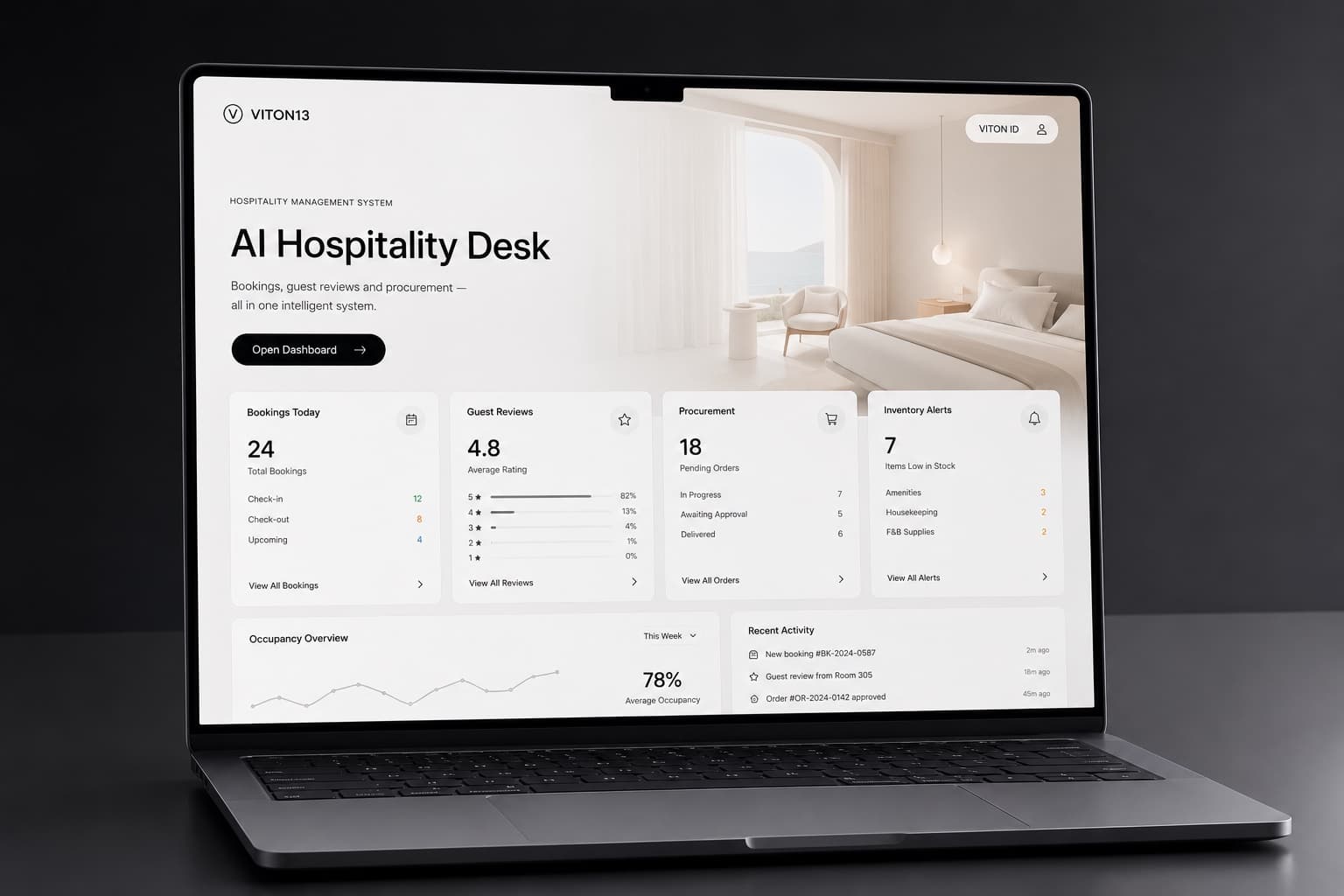
AI Hospitality Desk объединяет входящие обращения, бронирования, отзывы, закупки и сервисные сигналы, освобождая команду для работы с гостем.
Hospitality Automation Should Refocus Attention on the Guest, Not Remove the Human Element
Hotels and restaurant groups receive a stream of repetitive inquiries: availability, early check-in, dish composition, parking, transfers, tables, bills, and forgotten items. Staff must search multiple systems while maintaining a calm tone. During peak times, response speed drops, context is lost, and guests perceive organizational gaps as a lack of care.
AI-powered hotel automation is useful when it eliminates searching and data transfer but does not erase hospitality. AI Hospitality Desk answers calls or messages, understands intent, checks confirmed data, and prepares actions. If a request falls outside rules, contains emotion, or risk, it is passed to staff with a brief context.
The product integrates bookings, guest profiles, internal tasks, reviews, and procurement. It is not just another chatbot alongside PMS and telephony. Its role is to carry interactions from question to resolution, preserving an auditable history. Teams see what was promised, who is responsible, and which event confirms completion.
VITON13 views automation as operational design. In a good scenario, a guest doesn’t notice the technology: they receive a quick, accurate answer, don’t repeat preferences, and can easily connect with a human. The hotel gains manageability and staff stop spending shifts on repetitive clarifications.
Calls and Messages Become Unified Guest Requests
AI Hospitality Desk recognizes language, intent, dates, guest count, property, and special conditions. Original recordings or messages are stored per policy. The system does not guess names or dates if audibility is poor, instead asking for confirmation. Critical fields are repeated to the guest before booking to avoid costly voice interface errors.
Typical questions are answered from a managed database: breakfast times, parking, accommodation rules, menu, or address. Each piece of information has an owner and update date. The model does not use general internet as a source of promises for a specific property. If a rule changes, one record is updated and all channels answer consistently.
Complex requests are escalated to staff with a concise summary: who is contacting, what was checked, and what action is needed. Guests don’t repeat the conversation from scratch. Language and competency can be considered in routing. If staff are unavailable, the system honestly provides a response time rather than simulating resolution.
Incoming topic analytics help improve the product. If guests repeatedly ask the same question, the information may be poorly visible before arrival. Frequent requests may indicate the need to adjust offers or operational processes. Thus, automation not only serves demand but highlights guest journey areas needing design.
Booking Requires Synchronization of Availability, Price, and Promise
The system checks availability from an authoritative source and applies rate rules. Responses distinguish confirmed price, taxes, cancellation policies, and extras. If data between channels conflicts, AI Hospitality Desk blocks automatic confirmation and escalates the task.
For restaurants, details include table, duration, group size, area, and specific needs. For hotels: category, accommodation type, availability, and restrictions. AI can suggest alternatives but will not promise upgrades not backed by rules. Staff have authority to create exceptions and record them.
Once confirmed, related tasks are created: room preparation, transfer, crib, allergy handling, or special occasion. Each request has an owner and status. Guests don’t have to remind staff separately, and teams see task lists before arrival. Changes in bookings update impacted tasks with checks.
Conversion rates are evaluated alongside quality. Fast automated responses are useless if they generate more cancellations, errors, or compensations. Pilots compare timings, share of completed bookings, manual corrections, and mismatches with expectations. This protects business from optimizing one appealing metric.
Personalization Starts with Confirmed Preferences and Consent
A useful guest profile stores specific facts: chosen language, confirmed allergies, pillow type, preferred contact channel. It doesn’t infer hidden data on income, character, or sensitivities. Each record has a source, date, and scope. Guests can review or delete data per policy.
Before use, preferences are checked for currency. Last year’s crib request doesn’t become a permanent feature. The system may ask if it remains relevant. This creates attentiveness without frightening guests about data stored.
Staff see only data necessary for their roles. Housekeeping sees room prep; restaurant staff see dietary restrictions; drivers see addresses and times. Commercial notes and documents do not spread across teams. Minimal access both protects guests and reduces cognitive load.
Personalization should not affect fairness of basic service. Algorithms do not deny or worsen conditions based on opaque profiles. Offers are based on explicit requests and availability, with significant decisions governed by clear rules and human review.
Service Recovery Should Not Be Handed Over to a Generic Script
Complaints differ from informational questions: they contain emotion, harm, and expectations for acknowledgment. AI Hospitality Desk identifies topic and urgency, collects facts, and immediately notifies an owner. Automated replies are limited to receipt confirmation and the next clear step. They do not argue, blame, or promise compensation without authority.
Staff receive histories: bookings, past contacts, related tasks, and recovery standards. The system may suggest options within an approved framework, but humans assess context and tone. Special routes exist for security threats, discrimination, health, or public escalations.
Post-resolution, cause, action, and guest confirmation are recorded. Compensation is linked to the case so management can see cost and root cause. Recurring problems within shifts, rooms, or processes become operational signals.
Recovery quality is measured by time to human contact, number of repeated explanations, and actual resolution. Automation should reduce guest effort. Long dialogues before human contact worsen service despite formal handling.
Reviews Are Turned into Operational Maps, Not Just Average Ratings
The system collects authorized reviews from internal surveys and platforms, extracts topics, and links them with property, date, and service. Average sentiment is not useful without context. Mentions of cleanliness, wait times, breakfast, or noise are sent to process owners and compared with internal events.
AI drafts responses considering brand voice and facts. Public texts are verified by staff, especially when disputing or involving personal data. Responses do not disclose stay details or falsely personalize without case review. Speed matters, but accuracy is paramount.
Clusters show recurrence. Several similar comments might indicate a supplier change, occupancy shift, or service standard breach. Managers get hypotheses with examples and related metrics, not just word clouds. After changes, processes are tracked to see if signals vanish.
Positive reviews are valuable too. They highlight parts of the experience worth preserving during optimization: personal greetings, quick resolutions, specific dishes. Automation should not accidentally eliminate elements guests value simply because they’re hard to measure.
Hotel and Restaurant Procurement Link Demand, Stock, and Quality Standards
AI Hospitality Desk connects bookings, sales, seasonality, norms, and inventory to prepare order recommendations. For restaurants, menus and write-offs matter; for hotels, occupancy, consumables, and delivery schedules. The system presents calculations and deviations from norm. Managers confirm quantities considering events, weather, or offer changes.
Quality and compatibility are rules. The cheapest substitute may break room or recipe standards. Approved analogues have features and decision owners. Non-standard replacements require approval; their impact on complaints and write-offs can be analyzed.
Suppliers are rated by delivery times, completeness, quality, and problem response, not just price. The system prepares orders, matches confirmations, and warns of risk. If delivery is delayed, affected teams see scenarios rather than learning of shortages during shifts.
Procurement automation reduces manual calculations but shouldn’t cause large inventories just for formal availability. Models consider expiration, storage space, and frozen capital cost. Pilots start with limited categories where sales and write-off data are reliable.
Data and Tourism Analytics Are Useful Only When Data Quality Is Known
UN Tourism materials emphasize identifying available data, detecting errors, setting KPIs, and only then designing AI and advanced analytics models. For Hospitality Desk, this is a direct practical principle. You cannot reliably forecast occupancy or needs if bookings are duplicated, channels update with delays, and cancellations are inconsistently tagged.
Each metric has definitions and owners. Occupancy, cancellations, no-shows, inquiries, and complaints must be uniformly counted across reports. Pilots include source reconciliation and control samples. Models show ranges when data does not allow exact forecasts.
Historical periods are not always comparable: renovations, room stock changes, new restaurants, or major events alter baselines. The system stores such contexts and avoids automatically repeating past patterns. Humans may exclude outlier periods or add known events.
Good analytics lead to decisions. Growth in questions triggers info updates; clustered reviews generate operational tasks; occupancy forecasts guide staffing and procurement. Dashboards without owners remain observations, not management tools.
Economic Impact Cannot Be Separated from Guest Experience
Before pilots, measure response times, missed calls, manual data entry, incomplete bookings, repeat contacts, and hours spent analyzing reviews. For procurement, add write-offs, shortages, and rush orders. These provide a base for calculating reclaimed resources.
Post-launch, accuracy, conversion, correction counts, and escalations are assessed. A faster automated channel is useless if guests often seek other communication paths. Satisfaction, complaints, and guest effort are measured alongside.
Financial value may include more handled inquiries, fewer errors, lower write-offs, and faster service recovery. This is not guaranteed upfront. Integrations with PMS, telephony, POS, and procurement carry costs, and knowledge bases require ownership. Audits verify which layers truly pay off.
Calculators show potential reclaimed hours’ cost. These hours don’t necessarily reduce headcount. Often, they translate into more attentive service during peaks, upselling, and the ability for teams to work without constant system switching.
Privacy and AI Risks Are Especially Pronounced Where Brands Know Guests Personally
Booking, payment, document, location, and preference data require strict minimization. Organizations define legal bases, retention periods, roles, and external processors. Call recordings and text analyses are done transparently. Sensitive fields are not used for unjustified personalization.
NIST AI RMF helps establish governance: describing context, mistake consequences, measurement, and response. Critical risks for Hospitality Desk include incorrect pricing, double bookings, inappropriate replies, missed allergies, and profile leaks. Each risk has tests, owners, and kill switches.
The system distinguishes advisory recommendations from service promises. City info may be a hint, but confirmation of transfers or tables needs system events. Users see data sources. Models do not present generalized probabilities as specific facts.
Staff need transparency too. The tool assists, not secretly evaluates every conversation. Metrics relate to process and quality; individual conclusions follow clear rules and human review. Team trust is essential for quality data and sustainable deployment.
Pilot Starts with One Guest Journey and Expands with Evidence
The initial flow might include evening booking calls or pre-arrival messages. Real requests, rules, and errors are collected, creating response bases and escalation matrices. The system operates alongside staff; teams verify intent understanding, facts, and tone.
After crossing quality thresholds, the product prepares responses and bookings with confirmation. Tests include poor signals, foreign languages, unavailability, special requests, and irritated guests. Escalations must be quick and contextual. Only later are confirmations and standard internal tasks automated.
Reviews or procurement modules connect separately due to different data and risk models. Each module has baselines. Project success is not declared by overall activity; decisions rely on guest and operational metrics.
As a result, companies get a manageable function with ownership, knowledge updates, and quality logs — not just a demonstration bot. If a flow lacks effect, conclusions are documented. Sometimes it’s better to improve website information or staffing than automate symptoms.
How Hotels or Restaurant Groups Can Start Without Brand Risk
Select one repetitive route where teams lose time and mistakes are reversible. Trace it from guest question to resolution, counting handoffs and repeats. Note promises requiring system access and cases needing human attention. This forms an honest pilot scope.
AI Hospitality Desk suits properties or groups ready to assign ownership of content, operations, and data. The strongest model won’t fix outdated breakfast times or inconsistent rates. Rollout involves knowledge discipline because accuracy depends on source precision.
VITON13 conducts audits, designs voice and digital scripts, integrations, and human controls. Product marketing shows an attractive system, but real value lies in invisible transitions between request, promise, and execution.
Good results preserve service warmth. Guests get facts quickly; staff spot exceptions earlier; managers see causes; procurement bases orders on demand. AI doesn’t become hospitality’s face; it holds operational memory so people have more time to be its true face.
Before launch, teams may conduct service rehearsals. Staff simulate normal bookings, late check-ins, availability errors, allergies, and emotional complaints. They observe not just response correctness but escalation timing, context completeness, and ability to cancel automation. Such rehearsals uncover weak points more safely than initial real guests and translate brand standards into concrete product requirements.
Post-launch, weekly reviews of small dialogue and task samples help. Operations managers, service reps, and knowledge owners flag outdated facts, extra questions, and failed escalations. This editorial rhythm beats occasional large audits: menus, rules, and offers change constantly; answer quality depends on how quickly the system learns updates.
Practical checklist
- Choose a single inquiry channel and collect real questions, answers, errors, and escalations.
- Fix rates, booking rules, availability, and staff authority for exceptions.
- Identify sensitive guest data, consents, retention periods, and access roles.
- Create a dictionary of service standards and situations always routed to humans.
- Connect review categories with operational owners and response times.
- Measure response speed, conversion, manual corrections, repeat contacts, and guest satisfaction.
Questions and answers
Can AI Hospitality Desk accept phone bookings?
It can recognize the request, check availability, prepare an option, and guide the guest through an approved script. Payment, non-standard rates, special conditions, and unclear requests require explicit human confirmation.
Does the product replace administrators or concierges?
No. It handles repetitive questions, information lookups, and data transfers so staff can focus more on complex requests, guest emotions, and service recovery.
Can reviews from different platforms be analyzed?
Yes, with authorized access. The system groups topics, sentiment, and mentioned objects; staff verify significant findings and respond following platform and brand policies.
How does the product help restaurant groups with procurement?
It combines sales, bookings, inventory, standards, and supplier deadlines, then prepares order recommendations and alerts to deviations. The responsible manager confirms the final quantity.
What risks are especially important in a hotel AI project?
Incorrect availability or price, guest data leaks, inappropriate automated responses in conflicts, discriminatory personalization, and unspoken promises of services an entity cannot provide.