
Answer in brief
AORA's Sephora debut brings plastic-free beauty packaging to a larger prestige audience. VJOURNAL examines the materials, retail logic and cultural design behind the move.
Why plastic-free beauty packaging matters now
Plastic-free beauty packaging has usually lived at the experimental edge of prestige cosmetics, admired as an intention but rarely tested at the scale of a major specialist retailer. AORA's arrival at Sephora changes the visibility of that question. Refinery29 reports that the Mexico City color cosmetics company entered the retailer on July seventeenth as its first fully plastic-free beauty brand. AORA's own packaging page describes cases made from tin, aluminum and wood, with paper used for secondary packs. Those are the reported facts and company claims; the design and business interpretation that follows is VJOURNAL analysis.
The significance is larger than replacing one tube. Makeup packaging is an intimate interface: it opens and closes repeatedly, travels in bags, collects traces of pigment and must protect a formula while remaining pleasant to handle. Removing plastic therefore changes engineering, weight, sound, closure, decoration, shipping and price at once. A prestige shelf provides an unusually clear test. The object must communicate pleasure before the customer reads its environmental argument, yet its material logic must remain legible after the first impression. Sustainability cannot be a footnote attached to an otherwise conventional product experience.
What the Sephora debut actually establishes
Refinery29 identifies six AORA products offered through Sephora, spanning lip color, lip liner, primer and eye shadow. The publication also reports that founders Nour Tayara and Rodrigo Peñafiel built the company around Mexican color, ingredients, craft and bilingual communication. Its article is the independent source for the launch and retail context. AORA is the primary source for construction details, so statements about recyclability, material selection and impact programs should be read as brand-reported unless supported by separate certification or assessment. That distinction does not weaken the design story; it makes the evidence hierarchy visible.
What the launch establishes with confidence is retail access. A shopper can now encounter the range alongside established prestige cosmetics rather than inside a sustainability-only edit. That adjacency matters because it removes the easy excuse that responsible packaging belongs to a separate visual category. AORA must compete through shade, texture, ritual and object quality while explaining why its cases feel different. Sephora, in turn, becomes part of the interface: search filters, product photography, descriptions, staff knowledge and delivery packaging all influence whether the material proposition survives from brand story to actual purchase.
Metal changes the language of the makeup object
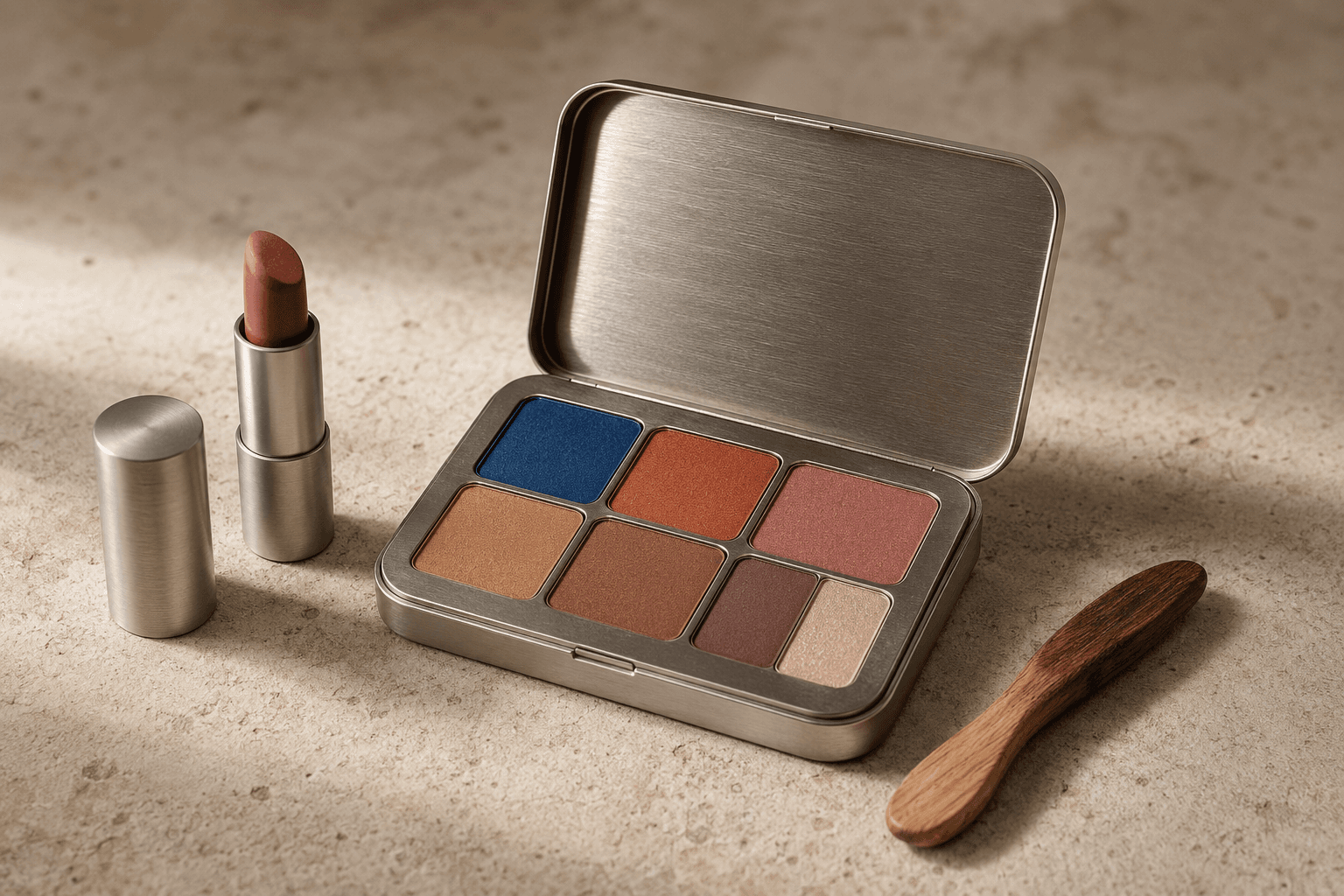
Tin and aluminum bring associations that molded plastic cannot imitate exactly. They can feel cool at first touch, produce a distinct sound when closed and acquire small marks that reveal use. In luxury, those qualities can suggest permanence rather than disposability. The supplied VJOURNAL cover uses an unbranded metal palette and lipstick to make that material argument without copying AORA's products or campaign composition. Brushed surfaces catch warm daylight, while the visible pigment remains the emotional center. The image proposes an object one might keep, not a package designed to disappear from attention after checkout.
Material romance, however, is not proof of lower impact. Metal extraction, forming, finishing and transport have consequences, and a heavier pack may change shipping efficiency. Recycling access also varies by place, collection system, component size and contamination. This is where editorial precision matters. AORA says it favors mono-material structures and avoids combinations that can complicate sorting. VJOURNAL reads that as a promising design principle, not a universal environmental verdict. A beautiful metal compact becomes credible when the brand explains each component, separation step and local disposal route in language that remains useful outside a campaign.
Mono-material design is an information system
AORA presents mono-material construction as central to its approach and says it avoids black plastic, metallization, excess components and magnets. The practical appeal is clarity. Mixed packages can look seamless while concealing several materials bonded too tightly for an ordinary user to separate. A mono-material object narrows the decision: identify the material, empty the product and follow an available collection route. Yet the term should never become decorative vocabulary. Brands need diagrams or plain descriptions that show what the hinge, mirror, pan, label and adhesive are made from, because small exceptions can determine the fate of the whole object.
Good information design can make this explanation feel premium rather than punitive. A product page might show an exploded view, a concise material list and region-specific end-of-life guidance. The carton can prioritize the one action that matters most instead of filling every panel with abstract claims. Retail staff can demonstrate how a component separates. Customer service can answer what to do when local recycling does not accept a small metal item. This is the deeper lesson of plastic-free beauty packaging: changing the object is only half the work. The other half is designing the knowledge required to use and release it responsibly.
Mexican identity is built into the product system
Refinery29 describes AORA's Spanish and English packaging, its Mexico City perspective and the founders' intention to place Mexican creativity inside prestige beauty rather than treat it as seasonal decoration. The distinction is important. Cultural identity becomes durable when it shapes naming, color, sourcing conversations, typography, retail voice and who is presented as an expert. It becomes fragile when it is reduced to a bright palette without context. AORA's strongest opportunity at Sephora is therefore not simply visibility for a Mexican label, but proof that a local design language can organize a global product experience on its own terms.
For international shoppers, bilingual packaging also changes the conventional hierarchy of luxury. English does not have to stand alone as the language of authority while Spanish appears as compliance copy. When both are treated as design material, the object acknowledges how many customers naturally move between languages. Execution must be exact: translations need equal care, type sizes should remain readable and names should not be flattened for convenience. Premium identity is carried by such decisions. It is felt in whether a pack invites recognition without turning a living culture into an exotic mood board.
The retail shelf is the real sustainability test
A direct-to-consumer brand controls the order in which its story appears. It can lead with a manifesto, explain materials, then introduce color and price. A multi-brand retailer reverses that comfort. The shopper may first see a thumbnail, a shade name or a recommendation among dozens of alternatives. The plastic-free proposition must survive comparison without overwhelming the cosmetic purpose. Product imagery should reveal scale and construction. Descriptions should separate verified attributes from broad ambition. Search and category pages should make the difference discoverable while avoiding a badge that reduces a complex object to a single green signal.
Fulfilment is part of the same test. A carefully designed compact arriving inside unnecessary film or an oversized parcel creates an immediate contradiction, even when retailer logistics sit outside the brand's direct control. Returns, damaged goods, testers and samples create further material questions that a launch article rarely answers. VJOURNAL's assessment is that prestige sustainability becomes believable through operational continuity. The product, tester, shelf display, ecommerce page, shipping method and disposal guidance should tell one compatible story. Any gap between them becomes more visible when the central promise is the absence of a familiar material.
How to read plastic-free claims without cynicism
A useful shopper response is neither automatic applause nor suspicion. Begin with scope. Does plastic-free describe the primary container, every component, the carton, the shipping materials or the brand's entire assortment? Then look for specificity: named materials, separation instructions and acknowledged limitations are more useful than a perfect-sounding adjective. Check whether recyclability is technically possible or practically supported where you live. Consider durability and whether the object is likely to be finished, reused or kept. Finally, separate packaging performance from formula performance; a responsible case does not independently prove that a cosmetic will suit every person.
The same discipline applies to impact programs. AORA describes a partnership that funds plastic-waste recovery connected to sales. That is a company-reported initiative and should be assessed through public methodology, partner reporting and clear boundaries rather than treated as a substitute for reducing material at source. Recovery and reduction can coexist, but they answer different questions. The most credible brand explains both without converting distant cleanup into permission for unchecked consumption. This article concerns design, retail and beauty literacy. It does not provide medical advice, diagnose skin concerns or evaluate ingredient suitability.
Conclusion: plastic-free beauty packaging after the novelty
AORA's Sephora debut is compelling because it moves an ambitious packaging proposition into ordinary prestige comparison. The confirmed event is straightforward: Refinery29 reports the July launch, while AORA details its use of tin, aluminum, wood and paper and its preference for simpler material structures. VJOURNAL's analysis is that the real achievement will be measured after the announcement, through durable closures, clear component information, consistent retail execution and objects that customers actually finish and release through available systems. A launch creates attention; repeated use reveals whether design has earned trust.
Plastic-free beauty packaging should not become another visual code that asks shoppers to infer virtue from brushed metal and earthy light. Its future depends on material honesty, cultural specificity and operational detail. AORA has created a vivid object lesson: sustainability can enter prestige beauty through color and pleasure rather than beige restraint. Sephora gives that lesson a larger stage. The next standard is more demanding and more useful — show what every part is, explain what happens next and make the cosmetic experience desirable enough that responsibility is not presented as a sacrifice.
Practical checklist
- Check exactly which package components are covered by a plastic-free claim.
- Look for named materials and clear instructions for separation and disposal.
- Confirm whether local collection systems accept small metal cosmetic items.
- Assess durability, refill potential and the likelihood that the product will be completely used.
- Separate packaging credentials from cosmetic performance and personal suitability.
- Review impact partnerships through their methodology rather than a headline number.
Questions and answers
What did AORA launch at Sephora?
Refinery29 reports that AORA introduced a six-product color cosmetics selection at Sephora, including products for lips, eyes and complexion.
What makes AORA packaging plastic-free?
AORA says its packaging uses materials including tin, aluminum, wood and paper while avoiding plastic throughout its product and shipping system.
Does plastic-free automatically mean recyclable everywhere?
No. Practical recycling depends on local collection rules, item size, contamination and how easily every component can be identified and separated.
Why is the Sephora launch significant for beauty retail?
It places a fully plastic-free proposition beside conventional prestige cosmetics, where design, desirability, information and operational consistency can be compared directly.
Is VJOURNAL evaluating AORA formulas or making health claims?
No. This story analyzes packaging, culture and retail strategy. It does not test formulas, diagnose concerns or recommend products for individual health needs.