
Answer in brief
Science-led skincare is moving from a laboratory credential to a complete language of design, trust and consumer choice. Neutrogena's new platform makes that shift visible.
Why science-led skincare needs a new visual language
Science-led skincare has become one of beauty's most persuasive phrases, yet its meaning is often compressed into white packaging, clinical vocabulary and a quick promise of authority. Neutrogena's new Break the Rules platform arrives inside that tension. Kenvue presents it as a brand mission that places dermatologist-backed development and consumer clarity ahead of online noise. Marketing Dive independently confirms the launch and its rollout across television, social, creator and experiential channels. Those are the reported facts; the interpretation that follows is VJOURNAL's editorial analysis, not product or medical advice.
The interesting move is not simply that a heritage skincare company invokes science. Beauty brands have done that for decades. The shift is that evidence is being asked to function as a cultural language: something warm enough for social media, clear enough for a crowded shelf and disciplined enough to resist the speed of a viral claim. That creates a demanding design problem. A brand must communicate confidence without pretending certainty, explain a product without turning a routine into a diagnosis, and make expertise visible without making the customer feel excluded from the conversation.
What Neutrogena actually launched
Kenvue announced Break the Rules in mid-July as a broad Neutrogena platform, with the first campaign centered on its Rapid Wrinkle Repair retinol line. The company says the creative responds to social listening around a familiar consumer conflict: interest in the results associated with retinol alongside concern about irritation. It also says the campaign begins across television and digital media, followed by creator partnerships and an activation at Lollapalooza. These details describe the brand's strategy and claims; they do not constitute independent testing of the featured formula or a recommendation for any individual skin concern.
Marketing Dive's account places the launch within a wider competitive pattern. Large beauty brands are combining expert-led education with entertainment, social formats and physical experiences. The publication also reports that Publicis handled strategy, creative, design, commerce, influencer, social and media work for the launch. That integrated remit matters because the platform is not being treated as a single advertisement. It is designed as a system in which packaging, campaign film, creator scripts, retail context and live interaction all need to express the same hierarchy of trust.
The real competitor is not another serum
In the contemporary beauty market, a product competes with more than adjacent bottles. It competes with saved videos, search snippets, ingredient rankings, creator routines and advice exchanged between friends. Each of those formats removes context in a different way. A dramatic before-and-after image can make time disappear. A short ingredient list can make formulation disappear. A confident recommendation can make individual tolerance disappear. The result is not a lack of information but an excess of fragments, all arriving with different standards of proof and almost identical visual confidence.
Break the Rules is strategically sharp because it identifies this fragmentation as part of the product environment. The platform does not only advertise a jar; it attempts to reorganize how the customer reads the surrounding conversation. For VJOURNAL, that is the strongest beauty-business insight in the launch. Brands can no longer assume that education sits in a separate help page while desire lives in the campaign. If explanation is visually dull, it will be ignored. If desire is detached from limits and context, it will erode trust. The two functions must be art-directed together.
Evidence must work like an interface
A good interface shows what matters first, what can be explored next and where uncertainty remains. Beauty communication should do the same. The product name and intended cosmetic role need to be legible. Directions and cautions should not be treated as typographic residue. Ingredient stories should explain why a component is present without implying that one fashionable molecule defines an entire formula. Comparative language needs a visible basis. When a claim originates with the brand, editorial and retail surfaces should identify it as such rather than allowing a polished layout to simulate independent consensus.
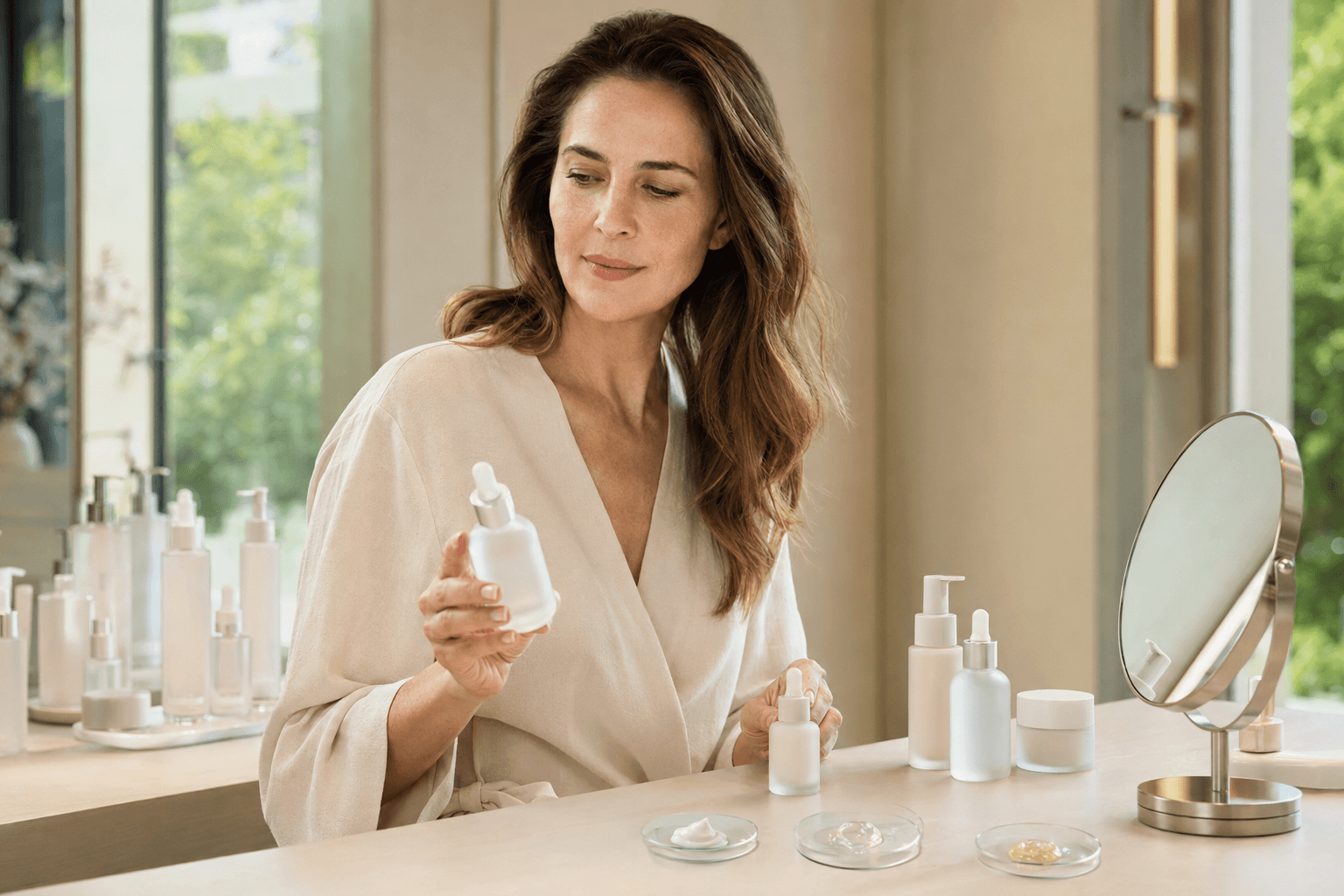
This approach does not make beauty less emotional. It makes emotion more durable. Tactile packaging, graceful photography and a satisfying texture can coexist with clear information because they answer different questions. One helps a person imagine a ritual; the other helps them decide whether the object belongs in it. The supplied VJOURNAL cover expresses that distinction through an unbranded scene: an adult woman calmly compares several containers rather than receiving a miraculous reveal. Choice is the focal point. The image refuses both clinical coldness and transformation theatre, leaving room for judgment.
Aging language is part of product design
The first Break the Rules creative addresses familiar restrictions attached to aging, expression and appearance. Marketing Dive describes a campaign film that stages common beauty instructions before rejecting their authority. The editorial opportunity is larger than a slogan. Language about age determines who feels welcomed, corrected or erased by a product. When every line, spot or change in texture is framed as failure, a routine becomes a disciplinary system. When all efficacy language is abandoned, however, customers lose the practical information they use to compare products. Mature communication must hold aspiration and dignity at once.
That balance begins with verbs. A cosmetic can support, soften the appearance of, add comfort, cleanse or protect within its stated use. It should not promise a new identity or imply that visible age is a personal mistake. Models should look like adults rather than digitally neutral surfaces. Retouching should preserve texture, and styling should communicate care without prescribing one acceptable face. These are aesthetic decisions, but they are also commercial ones: people recognize when a brand's idea of confidence depends on making them anxious first.
The retinol conversation needs proportion
Retinol gives the launch a highly recognizable subject, but VJOURNAL treats it as a case study in communication rather than a universal routine. The Kenvue release links the campaign to consumer interest and concern about irritation; that is the company's framing. Individual suitability, frequency and response depend on the person and product, and health questions belong with an appropriately qualified professional. An editorial article can help readers assess wording, evidence and design. It cannot diagnose a skin condition, prescribe a regimen or convert a campaign into personalized guidance.
Proportion is the useful principle. A single ingredient should not eclipse the complete formula, directions, packaging stability, sensory experience and the rest of a person's routine. Nor should popularity be mistaken for necessity. A disciplined shopper asks what problem the product claims to address cosmetically, what evidence is supplied for that specific claim, how the maker explains use, and whether the routine already contains overlapping steps. This slows the decision just enough to distinguish a coherent product from an ingredient trend wearing premium typography.
From campaign film to festival ground
Kenvue says Break the Rules will extend through creators and a festival activation, while Marketing Dive notes the combination of television, social platforms and experiential work. Each channel changes what clarity looks like. Television establishes the central emotional proposition. Short video must make a single point without turning brevity into overstatement. Creators need enough freedom to remain credible and enough disclosure to make the commercial relationship obvious. A physical activation must translate the message into useful hospitality rather than a photogenic queue with no meaningful product understanding.
Consistency does not require identical content. It requires a stable editorial spine. The same claim should not become stronger as it moves from a package to a creator caption. The same caution should not vanish when the format becomes entertaining. The same representation of age and skin texture should survive across stills, moving image and live documentation. When that spine holds, a platform can feel expansive rather than repetitive. It also becomes easier for customers to recognize what the brand stands for when they encounter only one fragment of the campaign.
What premium beauty brands should learn
The first lesson is that authority must be designed, not declared. A clinical adjective, a person in a white coat or a metallic pack cannot carry trust alone. Brands need a traceable chain from product development to claim language, retail education and customer care. The second lesson is that social listening is most valuable when it reveals confusion, not merely popularity. Kenvue says its listening identified a tension around desired results and irritation. Used responsibly, that kind of insight can improve explanations and product experience instead of simply feeding a louder media plan.
The third lesson concerns restraint. Premium communication often mistakes density for sophistication, covering a page with diagrams, percentages and proprietary terms. True confidence edits. It gives each piece of evidence a clear job and leaves room for the user to decide. The fourth lesson is organizational: when creative, commerce, social and experience share one platform, governance matters as much as aesthetics. Someone must protect the meaning of every claim across formats, markets and translations. Otherwise an elegant global idea can fracture into local exaggerations at the speed of a caption.
Conclusion: science-led skincare as informed choice
The lasting value of Break the Rules will not be determined by one film or one product cycle. It will depend on whether Neutrogena can make its promise of clarity tangible across formulas, labels, retail pages, creator partnerships and customer questions. The sources establish the launch, its retinol focus and its multichannel plan. VJOURNAL's analysis is that the platform succeeds conceptually when it treats trust as a complete experience rather than a scientific costume placed over familiar beauty advertising.
For readers, science-led skincare should mean neither automatic belief nor reflexive suspicion. It should invite a more composed sequence: identify the cosmetic goal, read the exact claim, locate its source, understand the directions, consider the wider routine and seek professional advice when a health concern enters the picture. That sequence is not glamorous in the conventional campaign sense, yet it is the basis of modern beauty literacy. The most premium gesture a brand can offer now is not another rule. It is enough clarity for a person to choose without pressure.
Practical checklist
- Identify the exact cosmetic goal before adding another product to the routine.
- Separate claims made by the brand from evidence assessed by an independent source.
- Read directions, cautions and the complete formula context rather than following one trending ingredient.
- Check whether a creator relationship or retail recommendation includes clear commercial disclosure.
- Avoid routines built around shame, urgency or promises of a transformed identity.
- Seek an appropriately qualified professional when a skin question becomes a health concern.
Questions and answers
What is Neutrogena Break the Rules?
It is a new Neutrogena brand platform announced by Kenvue, beginning with a retinol-focused campaign and extending across television, digital media, creators and experiential activity.
Is this article recommending a retinol product?
No. VJOURNAL is analyzing campaign strategy, beauty literacy and claim design. It does not test the featured formula or recommend a product for an individual concern.
What does science-led skincare mean here?
It means communication that makes a product's intended cosmetic role, evidence, directions and limitations understandable, while clearly separating company claims from independent assessment.
Why are creator partnerships important to the platform?
Creators can translate technical subjects into familiar language, but the commercial relationship, claim boundaries and consistency with official product information must remain visible.
How can shoppers evaluate a beauty claim responsibly?
Look for the exact wording, who produced the evidence, whether it concerns the finished product, how use is explained and when a personal health question requires professional advice.