
Answer in brief
Pilling is usually a layer-management problem, not proof that sunscreen “doesn’t work.” Protect the sunscreen step first, then change timing, rubbing, product order or makeup technique.
Protect the sunscreen step before fixing the makeup step
When little rolls, flakes or crumbs appear as foundation goes on, the instinct is often to reduce the sunscreen. That is the wrong priority. The FDA and American Academy of Dermatology both emphasize adequate application and repeat application as part of sun protection. A cosmetic routine should be adapted around that public-health requirement, not the other way around. If the surface is unstable, change timing, unnecessary layers or application technique first.
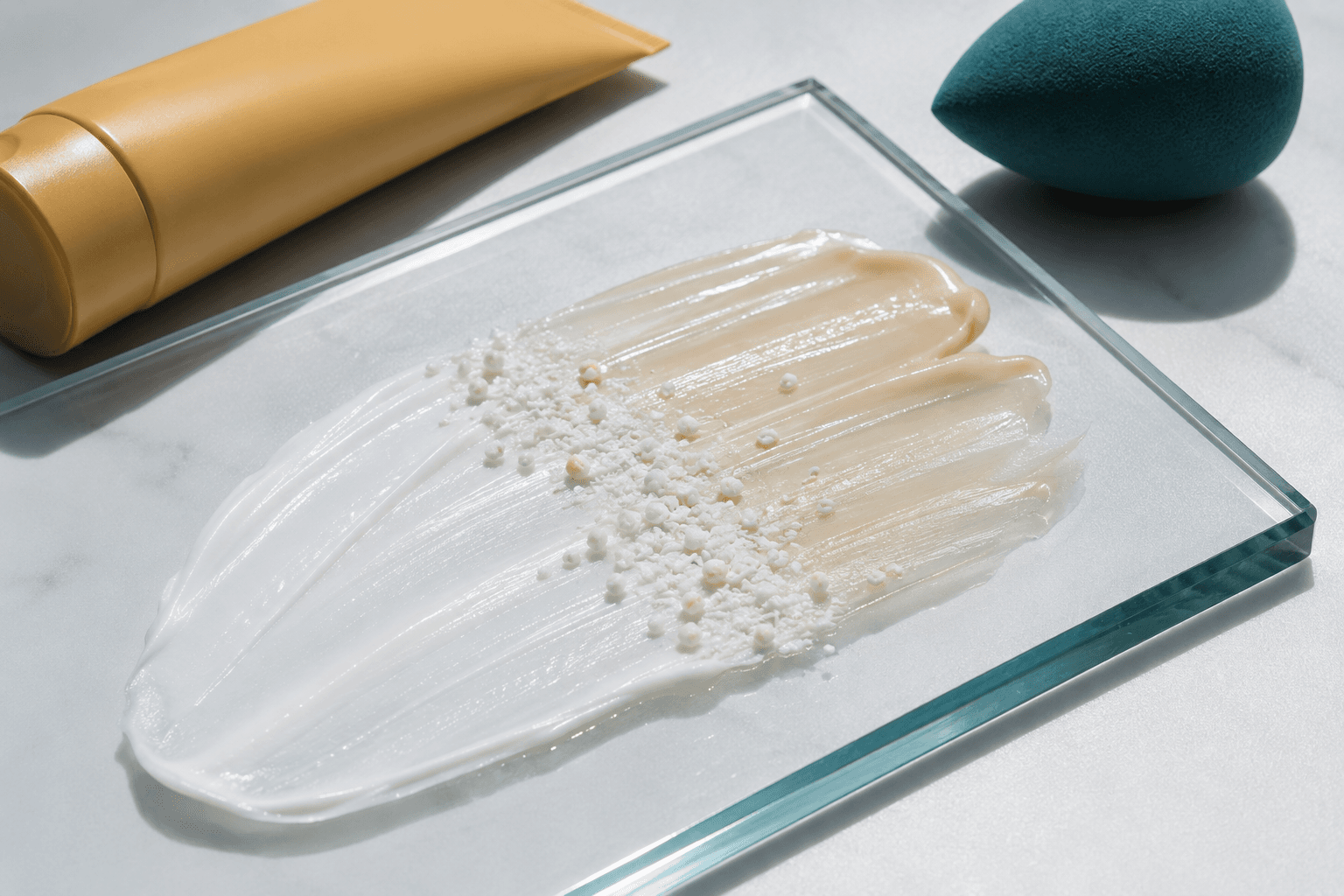
Pilling describes a visible mechanical event: material on the skin gathers into small particles under movement. It can involve sunscreen, moisturizer, primer, makeup or a mixture of them. It is not the same as dry skin flaking, although the two can look similar. Nor is it proof of an allergy. Burning, swelling, hives, intense itching or a spreading rash are different warning signs and should not be dismissed as ordinary pilling.
The most useful troubleshooting method is controlled subtraction. Keep sun protection consistent, then remove one optional layer at a time. If the routine works without primer, the conflict may be there. If it fails only when a particular foundation is added, test a different application method before replacing the sunscreen. One-variable changes reveal more than switching four products together and hoping the problem disappears.
Sunscreen is designed to become a film
A sunscreen is not simply active ingredients suspended in a cream. The full formulation has to spread and leave a film containing UV filters on the skin. Research on sunscreen formulation continues to examine how film-forming components influence measured protection. That matters for makeup because every stroke of a sponge, brush or finger occurs on top of a layer whose distribution is part of how the product is intended to function.
Film formation does not mean the surface becomes indestructible. Before the vehicle has settled, additional liquid can remix it; after it settles, repeated rubbing can still move or abrade material. Pilling can appear when a later layer grips the surface and rolls part of it into particles. The visible crumbs may contain more than one product, which is why blaming the sunscreen alone can be misleading.
Treat the film gently. Spread sunscreen according to the label, cover exposed areas, and avoid polishing it into the skin indefinitely. Once it has settled, apply makeup with minimal friction. Pressing a damp sponge, patting complexion product or using a light single-direction spread can be more compatible than repeatedly circling over the same area. Technique is often the cheapest variable to change.
Too many layers create more interfaces that can fail
A morning routine may contain toner, essence, serum, moisturizer, sunscreen, primer, color corrector and foundation before powder. Each layer brings solvents, oils, humectants, polymers, powders and surfactants that must coexist on a very small surface. Even when every product behaves well alone, the stack can become thick enough that rubbing shifts the upper layers before lower ones have stabilized.
Simplification is diagnostic rather than ideological. If your skin is comfortable with moisturizer plus sunscreen, test makeup over that pair. If it works, add back one optional product on another day. If moisturizer is not needed under a sufficiently moisturizing sunscreen for your skin, omitting it may remove a conflict. If you rely on a prescribed or dermatologist-recommended topical product, do not discontinue it merely for makeup convenience; ask the prescriber how to integrate it.
Quantity matters differently for different layers. Sunscreen has a protection-related application requirement, while primer or serum usually has no reason to be applied in a thick visible coat. Excess optional product can remain mobile and increase rolling. The troubleshooting principle is therefore asymmetric: preserve the sunscreen amount directed for protection and reduce nonessential layers that are contributing only cosmetic or comfort functions.
Dry-down is about stability, not a magic stopwatch
People often ask for one exact interval between sunscreen and foundation. Formulas, humidity, skin oil, moisturizer and application amount vary too much for a universal timer. Instead, observe the surface. If touching lightly leaves a wet trail or causes the layer to slide, foundation is likely to remix it. Give it more time. If the product remains persistently tacky by design, use an application technique that deposits makeup with less shear.
The FDA advises applying sunscreen before sun exposure, and product labels may give specific directions. Keep that protection timing separate from cosmetic troubleshooting. You can apply sunscreen sufficiently before leaving home, allow it to settle while doing hair or dressing, then add makeup. Building the interval into another part of the routine is more reliable than standing at the mirror waiting impatiently.
Earlier layers need time as well. A rich moisturizer applied immediately before sunscreen can remain mobile underneath it. Try a thinner amount if appropriate for your skin, apply it earlier, or choose a texture that absorbs more predictably. If pilling disappears when the moisturizer is removed, that result is more informative than any generic rule about which ingredient family is supposedly incompatible.
Rubbing method can turn a stable stack into pills
A 2024 study indexed in PubMed examined sunscreen pilling in volunteers and found associations with product and application-related factors, including rubbing method, alongside individual skin characteristics. One study does not create a universal formula, and product-specific results should not be generalized to every sunscreen. It does, however, support the practical observation that mechanical handling matters.
Try reducing the number of passes over each area. Apply foundation in small zones rather than dotting a full face and then blending for a long time. With a sponge, press and lift. With fingers, spread once and pat edges. With a brush, use light strokes and avoid scrubbing. If pilling starts, stop rubbing; continuing usually makes the particles larger and removes more of the underlying layers.
Powders can also catch on tacky films. If loose or pressed powder is part of the routine, use a small amount and press rather than buff at first. Once the base is set, additional blending may be safer. Again, the objective is not a prescribed makeup style. It is reducing shear on the sunscreen film while still achieving the finish you want.
Ingredient-list shortcuts are less reliable than pair testing
Online advice often says never to mix “water-based” and “silicone-based” products. Real formulations are not that binary. A water-continuous emulsion can contain silicones; a silicone-rich primer can also contain water, oils and multiple polymers. The behavior of the finished product depends on concentrations, film formers, powders, emulsifiers and how much is applied, not the first ingredient someone recognizes.
Instead of classifying bottles into two camps, make a small compatibility test. Apply your normal sunscreen amount to one cheek or jaw area, let it settle, then add the intended makeup using your normal tool. On another day, change only the makeup or primer. This is not a medical patch test and tells you nothing about allergy; it is simply a practical wear test for texture and movement.
If a particular pair repeatedly pills despite simplified layering and gentle application, accept that the combination may be operationally poor for you. Keeping a sunscreen you will use correctly is more important than forcing it to cooperate with one foundation. Replace the cosmetic layer that is easiest to change, or test another sunscreen that still meets your protection needs and labeling requirements.
Distinguish pilling from dryness, peeling and irritation
True pilling often appears immediately when layers are rubbed and can form little uniform rolls. Dry skin tends to show flakes that were present before makeup or become visible around textured areas regardless of rubbing. Peeling from an irritating skincare routine may appear as sheets or scales and may come with tightness, redness or stinging. The distinction matters because technique fixes a film problem but will not repair an inflamed skin condition.
If the skin is irritated, prioritize comfort and medical safety. Stop newly introduced products that seem to trigger significant symptoms and seek guidance from a qualified clinician when reactions are severe, persistent, blistering, swollen or involve the eyes or breathing. Do not repeatedly exfoliate visible flakes simply to make foundation smoother; more abrasion can intensify irritation and make subsequent sunscreen application uncomfortable.
For ordinary dryness without red flags, a simpler moisturizing routine may improve the surface, but there is no need to diagnose the cause from appearance alone. Sunscreen remains part of sun protection. Choose formats that are comfortable enough to apply as directed, and remember that shade and protective clothing are also components of sun-safety strategies described by dermatology and regulatory authorities.
Use a five-run troubleshooting sequence
Run one: sunscreen alone. Confirm that it spreads and settles without rolling on clean skin. Run two: add the skincare you actually need and identify whether the surface changes. Run three: add foundation without primer using low-friction application. Run four: add primer only if it solves a defined problem. Run five: test powder or setting products. Keep the amount and technique consistent enough that each comparison means something.
Record which step creates the first visible pills. If sunscreen pills by itself, the formula may be interacting with residue, application method or skin surface; test on freshly cleansed skin and follow its directions. If the problem appears only after makeup, adjust that interface. If it appears after hours rather than during application, oil, sweat and movement may be contributing, so a wear test is more relevant than more dry-down time.
The final routine should be boringly repeatable: an appropriate sunscreen application, enough settling time, only necessary layers and makeup applied without excessive friction. Pilling is frustrating because it happens at the end of a routine, but its solution is usually systematic rather than mysterious. Protect the film first, change one surrounding variable at a time, and treat skin symptoms—not cosmetic crumbs—as the signal for medical evaluation.
Practical checklist
- Apply sunscreen in the amount and frequency directed by the product label and public-health guidance.
- Reduce optional leave-on layers beneath sunscreen one at a time to identify the conflict.
- Give moisturizer and sunscreen time to settle before adding the next layer.
- Press or lightly spread foundation instead of repeatedly rubbing the same area.
- Test the full routine on one area before an event rather than changing several products at once.
Questions and answers
Does sunscreen pilling mean the sunscreen is ineffective?
Not necessarily. Pilling shows that material is rolling or flaking on the surface, but it does not by itself measure the protection left on the skin. Because sunscreen performance depends on an adequate, reasonably even film, however, heavy rubbing or visible removal is a reason to correct the application technique. Reapply if you have rubbed off a meaningful amount, and follow the product label and sun-protection guidance rather than assuming the remaining layer is sufficient.
Should I use less sunscreen so makeup sits better?
That is the wrong first fix. The FDA and American Academy of Dermatology emphasize applying sunscreen generously and reapplying as directed. If the recommended application creates cosmetic problems, simplify moisturizer or primer, allow more dry-down time, change the sunscreen or makeup formula, and reduce rubbing. The goal is to find a compatible routine around an appropriate sunscreen application, not to trade reliable sun-protection behavior for a smoother foundation finish.
How long should sunscreen dry before makeup?
There is no universal minute count that works for every formula, climate and skin surface. The product label is the first reference. In practice, wait until the sunscreen has formed a stable surface and no longer moves easily under a light touch before applying makeup. If pilling continues, extend the interval and simplify earlier layers. The FDA separately advises applying sunscreen before sun exposure, so cosmetic dry-down should not replace following the labeled timing for protection.
Can silicone and water-based products never be layered together?
That rule is too simplistic. Cosmetic formulas contain mixtures of water, oils, silicones, polymers, powders and emulsifiers, and their behavior depends on the complete formulation and amount applied. Two products with different marketing labels can layer well, while two apparently similar products can pill. Test the actual pair. If a conflict appears, change one variable at a time—amount, order, dry-down, rubbing method or product—rather than diagnosing compatibility from one ingredient category.