
Answer in brief
The Keely Hodgkinson collection is more than a coordinated product drop: it is a precise study in how performance clothing can carry identity without sacrificing purpose.
Why the Keely Hodgkinson collection matters now
The Keely Hodgkinson collection arrives at a moment when running clothes are expected to work across more than one visual world. Nike introduced the range as the middle-distance champion's first signature athlete pack, combining apparel and footwear around her speed, focus and understated style. The official release presents a complete running system rather than a single trophy product. The Bolton News independently confirms the launch and describes the same apparel, footwear and personal design details. Those are the verified facts; the larger cultural reading belongs to VJOURNAL.
That reading begins with a useful shift in authorship. Performance wardrobes have often been communicated through abstract claims about speed, intensity or innovation. Here, the organizing idea is an athlete's specific working rhythm and visual restraint. The collection does not ask technical clothing to masquerade as eveningwear, nor does it treat style as decoration added after engineering. It suggests that repeated training, race-day concentration and personal taste can shape one coherent design language. That proposition matters well beyond one launch because it makes the wearer, not the campaign spectacle, the center of the system.
A signature model built as a wardrobe
The familiar signature formula tends to isolate one object and load it with biography. A wardrobe works differently. It has to manage transitions: warm-up and effort, outdoor exposure and indoor recovery, focused training and ordinary movement through a city. Nike's source material identifies the range as its first signature athlete pack for Hodgkinson, which makes the pack structure important. It allows distinct garments and shoes to share a point of view while retaining separate jobs. The result can be read as an edited rail rather than a souvenir cabinet.
VJOURNAL sees discipline in that decision. A strong capsule does not need every category or every possible color. It needs a clear hierarchy, reliable combinations and enough variation to respond to different sessions. Athlete-led design becomes credible when biography is translated into choices the wearer can feel: where storage sits, how a layer holds the torso, which silhouette remains calm at speed, and how footwear is assigned to different forms of work. Personality is present, but it is encoded in proportion and use instead of printed as a loud narrative.
The apparel architecture: close, clean and purposeful
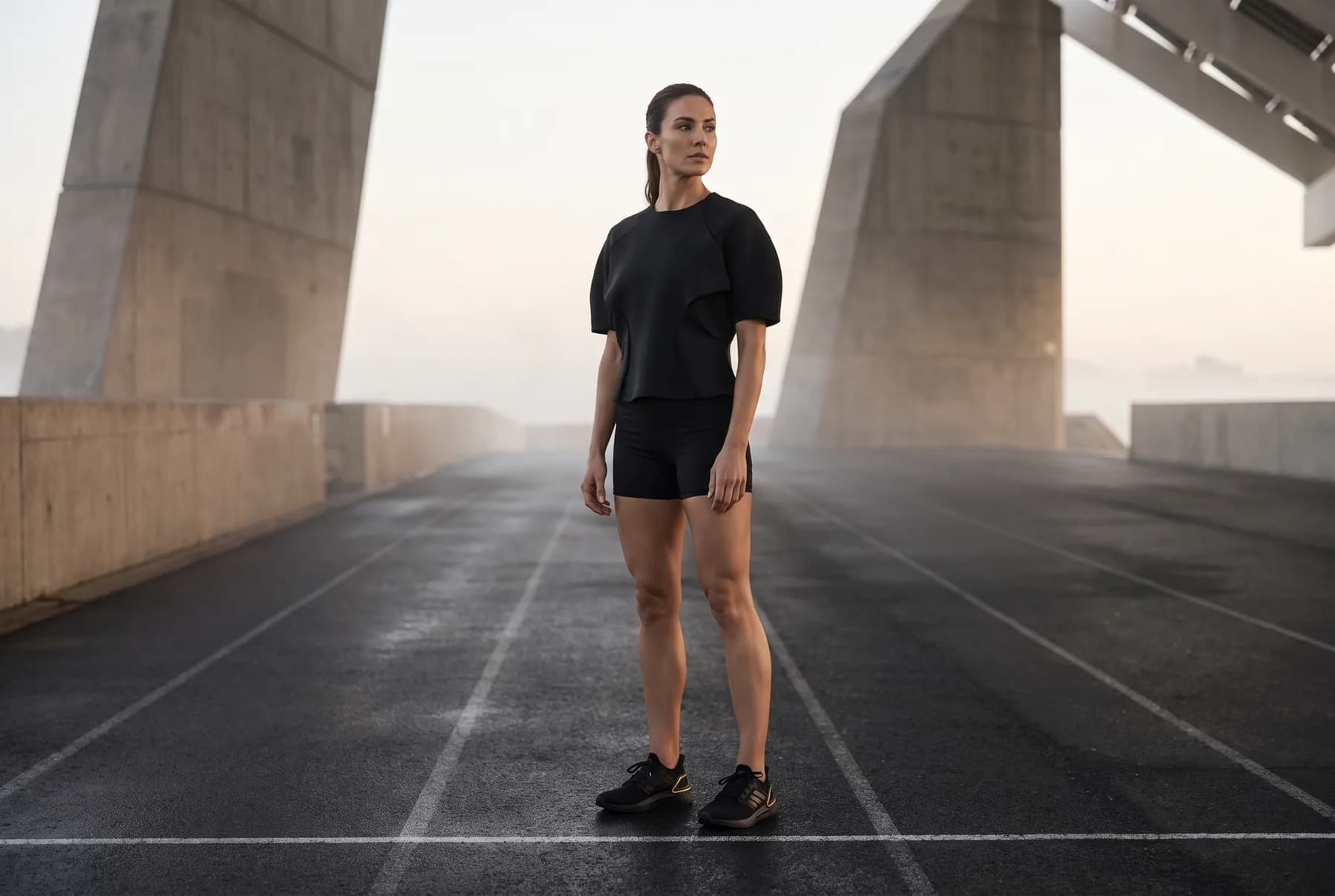
Nike lists an AeroSwift pocket crop top, an AeroSwift tight five-inch short, a Nike Pro Sculpt long-sleeve top and a matching five-inch short. The Bolton News adds that the performance pieces include storage, secure fits and cooling-oriented fabric technology. These descriptions come from the sources and should be understood as product positioning, not independent laboratory testing. What can be assessed editorially is the architecture: a small set of close layers, a controlled shoulder line and compact lengths that avoid loose fabric competing with movement.
This is where technical sportswear and fashion share a serious concern: proportion. A cropped running top changes how the torso and waist are read; a close long sleeve creates a continuous line from shoulder to wrist; a short with a stable rise determines whether the outfit feels athletic, casual or over-styled. Good performance fashion does not require a body to conform to one ideal silhouette. It requires the garment to make its intended fit legible. The practical question is not whether the wearer resembles a campaign image, but whether each line stays comfortable, secure and visually coherent in motion.
Four shoes, four different forms of work
The official lineup names the Vomero Plus, Pegasus 42, Vaporfly 4 and Victory 2. Nike describes them as road, race and track silhouettes forming a system for training and competition. The Bolton News maps them more specifically to recovery running, daily training, faster work and race day. VJOURNAL does not treat that sequence as a universal prescription; runners differ in experience, fit and preference. Its editorial value is the clarity of the range. One visual story is carried across tools that are not pretending to do the same job.
That distinction is a mature style principle. A wardrobe becomes more useful when visual continuity does not erase functional difference. Black uppers and gold details can connect a cushioned daily shoe to a track spike, but color cannot make their construction interchangeable. For shoppers, this is a reminder to begin with the session and surface, then consider the palette. A beautiful system should help people choose more precisely, not encourage them to buy duplicates. The most convincing luxury in performance design is not excess; it is the feeling that every object has earned its place.
Black, gold and the value of a restrained code
The independent report describes black footwear, gold detailing, detachable initials and a personal tornado symbol. It also notes tonal graphics and satin-finish details on the apparel. These are unusually compact identity codes. Black gives the technical shapes a continuous base, while gold acts as punctuation rather than an all-over theme. Detachable elements allow the most literal sign of authorship to remain optional. The palette therefore communicates ownership without asking every wearer to become a billboard for someone else's story.
Restraint is especially effective in running clothing because the environment already supplies visual energy: repeated lane markings, changing weather, reflected light and the movement of the body. A crowded garment can fight that setting. A quieter one lets construction, surface and pace become visible. The black-and-gold scheme is not inherently new, and the collection does not need it to be. Its strength lies in editing familiar codes into a stable identity. Style is often less about inventing a color than deciding exactly where that color should stop.
What athlete-led design can contribute
Nike says Hodgkinson worked with its researchers and designers, and the independent account repeats that collaborative framing. A brand statement cannot by itself prove how much influence any participant held at every stage. It does, however, establish the intended method: athlete experience moving through research and design teams into a consumer range. The useful test is visible specificity. Are choices connected to real training behavior? Do garments acknowledge storage, distraction and layering? Does the footwear assortment recognize that one runner may need several kinds of tool rather than one universal answer?
Athlete authorship is most valuable when it narrows decisions. The athlete can identify small frictions that a mood board misses: a pocket that interrupts stride, a waistband that demands attention, or an embellishment that feels wrong once speed rises. Designers then translate that evidence without treating personal preference as universal truth. This tension produces better work. The collection can carry Hodgkinson's codes while still leaving space for different bodies, paces and styling habits. Collaboration becomes a design practice rather than a celebrity label when the final product remains useful after the launch story fades.
How to read performance style before buying
A considered purchase begins by separating image from requirement. Decide whether the piece is for a track session, an easy road run, travel, strength work or daily layering. Check the garment in the positions it will actually encounter: arms driving, torso turning, waistband under a pocket and fabric moving against another layer. Review care instructions and pocket construction. With footwear, confirm intended surface and fit with a knowledgeable retailer when possible. Product names and athlete association can orient a search, but they cannot replace the wearer's own evidence.
Then assess the wardrobe relationship. A signature piece is strongest when it works with clothing already owned rather than forcing an entirely new costume. Black can make coordination easy, but similar colors may conceal very different fabric weights and heat behavior. Gold details can provide focus, yet removable or subtle accents will usually travel further across contexts. VJOURNAL recommends choosing the item that solves a repeated need first. If the visual code still feels compelling after that test, style and utility are reinforcing one another instead of competing for attention.
Conclusion: the Keely Hodgkinson collection makes precision visible
The verified launch is concise: a first signature athlete pack, a focused apparel group, four footwear silhouettes and a global release through Nike and selected retailers. Its broader interest comes from how those elements are edited. The Keely Hodgkinson collection treats performance as a wardrobe problem, giving different tools one restrained visual grammar. It shows that personal style can live in fit, finish, repetition and the confidence to leave parts of a garment quiet. None of that guarantees performance, and no editorial should confuse design language with athletic outcome.
What it does offer is a useful standard for modern sportswear. Begin with real movement, assign every piece a clear role, let identity emerge through consistent details and resist the pressure to turn an athlete's life into surface decoration. For runners, the practical response is equally measured: buy for the work you actually do, test fit honestly and allow style to support routine. The best performance wardrobe does not make the wearer look like someone else. It makes preparation simpler, movement less distracted and personal taste more precise.
Practical checklist
- Define the exact training, racing or everyday context the new piece needs to serve.
- Test the garment through realistic arm, torso and waistband movement before deciding on fit.
- Check pocket placement, fabric weight, care requirements and compatibility with existing layers.
- Choose footwear for its intended surface and session before considering the color treatment.
- Prefer one item that solves a repeated need over buying an entire coordinated range at once.
- Assess whether signature details express your own style or merely reproduce a campaign image.
Questions and answers
What is included in the Keely Hodgkinson signature range?
Nike lists four apparel pieces and four footwear silhouettes. The clothing includes AeroSwift and Nike Pro Sculpt tops and shorts, while the footwear group includes the Vomero Plus, Pegasus 42, Vaporfly 4 and Victory 2.
When did the collection become available?
Nike's official release states that the range became available globally on July 16 through nike.com and selected retail locations. Local availability and sizing can vary, so shoppers should check the relevant regional store.
Is every shoe in the collection intended for racing?
No. The sources present the footwear as a system spanning recovery, daily training, faster sessions and competition. A shared color treatment connects the models visually, but their constructions and intended uses remain different.
How should shoppers evaluate athlete-designed running clothing?
Start with fit, movement, fabric weight, storage and the conditions in which the garment will be used. Athlete authorship can add relevant insight, but it does not replace an individual's own comfort and practical requirements.
Why is this launch relevant to fashion as well as sport?
The range applies one controlled visual language across distinct performance tools. Its proportions, tonal surfaces, restrained palette and optional personal details demonstrate how technical purpose and recognizable personal style can coexist.