
Answer in brief
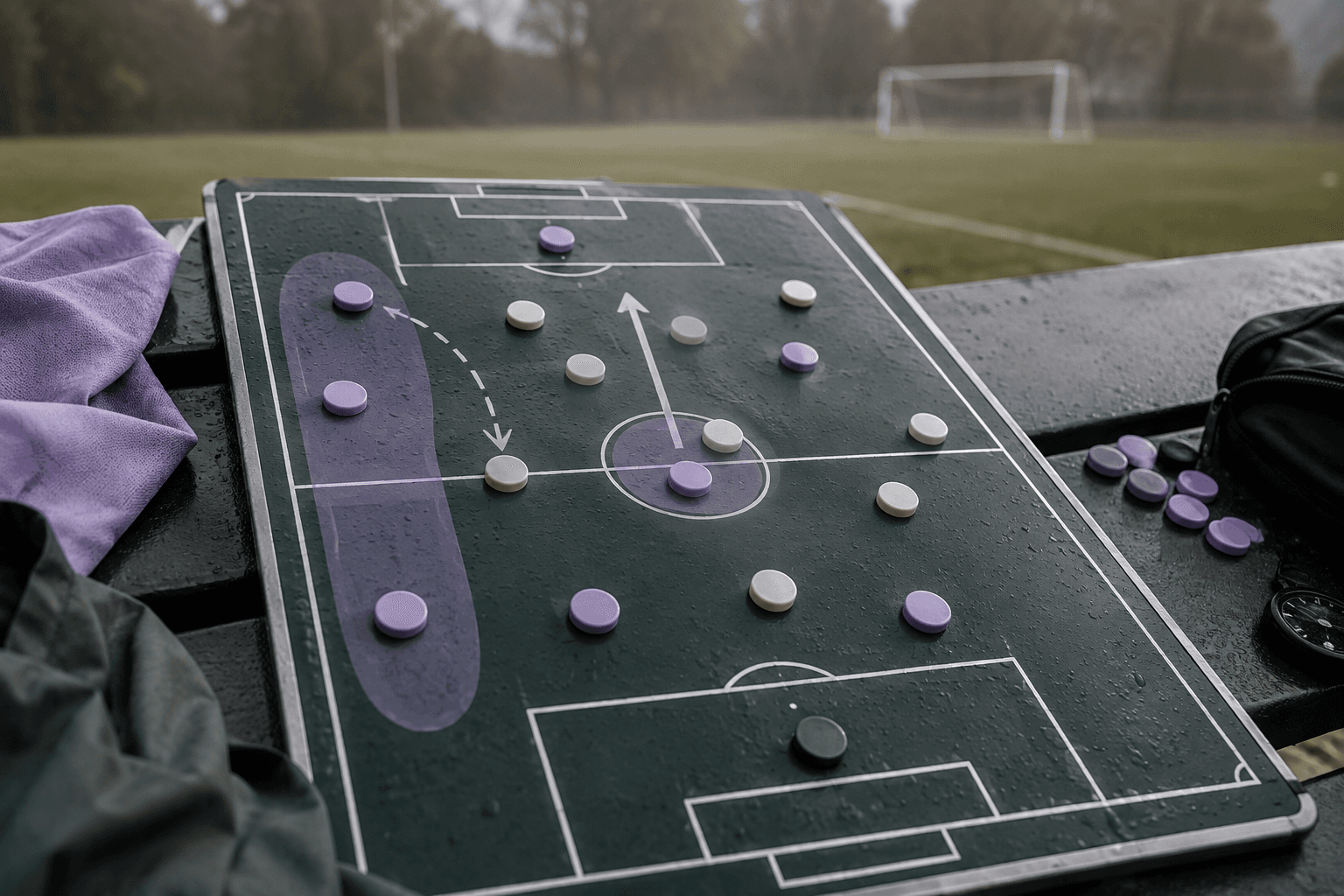
Mbappé’s position debate is not a choice between two fixed zones. Central and left-sided starts redistribute how he reaches shots, presses defenders, attacks transition space and coordinates with teammates.
Position labels hide a fluid role
Real Madrid lists Kylian Mbappé as a forward, which is accurate but not very descriptive. “Number nine” and “from the left” are better treated as starting references than fixed coordinates. In a modern attack, a player can begin centrally, drift left to receive, run beyond from the inside channel and finish on the opposite side within the same possession. The useful question is therefore not where his icon appears on a team sheet, but which spaces he is asked to occupy before and after the ball moves.
The distinction matters because Mbappé’s highest-value actions often end centrally regardless of where they start. His 2025/26 production—25 league goals in 31 matches according to Real Madrid and 15 goals in 11 Champions League appearances according to UEFA—shows the scale of his finishing role. Those totals do not identify an optimal position. They provide the context for a tactical trade-off: how does a team preserve his access to central shots while also using the acceleration and isolation advantages of a left-sided start?
As a nine, the first job is to occupy centre-backs
When Mbappé starts as the nominal number nine, he begins closer to the two central defenders. That can pin the back line and create immediate depth: if a centre-back steps into midfield, Mbappé can threaten the space behind; if both centre-backs stay attached, midfielders may receive with less direct pressure. The central start also shortens the route to the penalty area, which is valuable for a player whose most dangerous actions are final-third accelerations and shots rather than long sequences of build-up touches.
The cost is that central defenders can share responsibility more easily. Mbappé may receive with his back to goal, in traffic, or with less space to reach full speed. A classic target nine might welcome repeated aerial duels, hold-up contacts and back-to-goal combinations; those actions are not necessarily the best use of Mbappé’s comparative advantages. Tactical inference: a central role works best when the surrounding attack creates rotation around him, allowing him to leave the centre after initially fixing the defenders rather than making him a static reference point.
From the left, he can see the game differently
A left-channel start changes the picture. Mbappé can face the pitch more often, receive outside a centre-back’s immediate pressure and choose between carrying inside, combining or sprinting behind. FIFA’s movement framework highlights out-to-in runs as a distinct way of attacking space behind the line. For a right-footed forward, the left side can also provide a natural route toward central finishing positions while keeping the ball on the stronger foot.
But “left wing” can be misleading if it implies a touchline-bound creator. Tactical inference from his movement profile is that the value comes from starting wide enough to stretch a defender and then arriving inside. If he stays outside permanently, the attack can lose a central finisher. If he comes inside too early on every possession, he can occupy the same spaces as the striker or left-sided midfielder. The role therefore depends on timing: width at one moment, depth or centrality at the next.
Shot location is the key output variable
The cleanest way to compare the roles is not by counting touches on the left or in the centre. It is by asking where Mbappé is receiving his final passes and taking his shots. A left-sided starting role is successful if it still produces entries into central or inner-channel shooting zones. A central role is successful if it creates high-quality shots without forcing him to spend too much of the match wrestling in low-value back-to-goal situations.
Public UEFA goal totals demonstrate output but do not provide a complete public shot-location model for every Real Madrid possession. Any detailed claim about which role produced a higher expected-goal value would therefore require event or tracking data beyond the official sources used here. Tactical inference should remain labeled as such. The practical analysis is to watch the path into the shot: did he start wide and arrive centrally, start central and run into a channel, or remain in a crowded lane? The end location often tells more than the lineup label.
Teammate spacing changes with the starting point
A central Mbappé asks someone else to provide left-side width. That may be a winger, an attacking full-back or a midfielder rotating outward. In return, his presence between centre-backs can open pockets for a left-sided teammate to receive inside. When he starts from the left, the spacing requirement reverses: a central teammate must occupy or move the centre-backs so that Mbappé’s diagonal route does not collapse into the same lane. The best structure creates complementary, not duplicate, movements.
FIFA’s attacking analysis repeatedly shows how counter-movements create space: one player moves toward a defender while another attacks the area that movement opens. That principle is especially relevant to Mbappé. If a teammate pins the near centre-back, his left-to-inside run becomes harder to hand off. If the central player also drifts left, both can make the defence more compact without threatening depth. The role choice therefore cannot be evaluated in isolation from the profiles and instructions of the other forwards.
Pressing responsibilities also move
Without the ball, a number nine normally begins closer to the opponent’s centre-backs and goalkeeper, which makes him a natural first presser. The role is not simply to sprint at the ball carrier. A forward can curve the press to close a passing lane, use a cover shadow to discourage the switch and trigger teammates to step behind him. Starting from the left changes the first reference: Mbappé may press an outside centre-back or full-back and then recover into a wider defensive position.
Tactical inference: the central role can make the team’s pressing map simpler because the first line has an obvious middle reference, but it can also demand more repeated central pressing actions from Mbappé. A left-sided role can preserve him for transition if the team’s defensive scheme allows a different player to lead the first pressure, yet it may leave the far-side build-up outlet easier to access. The correct choice depends on the coach’s pressing triggers and the amount of defensive work allocated across the front line.
Transition football favors access to open grass
Mbappé’s acceleration is most damaging when the game becomes stretched. From the left, he can begin outside the densest central traffic and attack diagonally into the space behind. From the centre, he can threaten both channels and force centre-backs to retreat before the pass is played. Neither role owns transition value; the difference is which defender he begins against and which supporting runner can occupy the lane he leaves.
FIFA’s analysis of France’s rest-attack patterns has shown Mbappé positioned high and wide in transition structures, with his presence drawing defenders and opening movement for teammates. That is useful evidence for the broader mechanism, even though national-team behavior cannot simply be copied onto Real Madrid. Tactical inference for Madrid is that keeping access to a high, explosive outlet matters more than preserving a rigid label. A nominal nine can drift left in transition; a nominal left forward can become the central runner within seconds.
What changes for the opponent
Against a central Mbappé, centre-backs must decide whether to hold a higher line and risk the run behind or drop and concede space between the lines. Full-backs can stay wider because the main depth threat begins inside. Against a left-starting Mbappé, the opposing right-back becomes part of the containment problem and the nearest centre-back must be ready to cover the diagonal. That can narrow the defence and create room for the other flank or for an overlapping teammate.
The defensive reaction can therefore be a useful clue to the attacking role’s success. If the opponent repeatedly sends two players toward the left channel, Real Madrid should be able to exploit the space that coverage sacrifices. If the central role pins both centre-backs deep, midfielders should find room ahead of them. Tactical roles create value not only through the player’s own touches but through the defensive resources they consume. A role that produces fewer receptions can still be strategically useful if it reshapes the opponent.
The best answer is usually a rotation
There is no universal verdict that Mbappé is “better” as a nine or “better” from the left. The answer depends on opponent, teammates, match state and what the team needs from its first line of pressure. His scoring record shows that Real Madrid can obtain elite output from him, but the positional debate is really about distribution of tasks. Central starts maximize immediate access to the goal; left starts can maximize facing play, separation and diagonal acceleration. Both become weaker when treated as rigid zones.
A sensible match analysis should track four things: where he begins the possession, where he receives the ball, where he finishes the action and who occupies the space he leaves. Add the pressing reference when Madrid loses possession. If those elements remain coordinated, the lineup label matters less. The most difficult version for a defence is not a permanent winger or a permanent striker; it is a forward who can pin the centre like a nine, escape to the left for separation and still arrive in central scoring zones before the defence can reassign him. That flexibility also keeps the opponent from solving one repeated reference point.
Practical checklist
- Record where Mbappé starts each possession rather than relying on the lineup graphic.
- Track where he receives and where the final shot or chance occurs.
- Identify which teammate occupies the central space when he starts or moves left.
- Watch his first pressing reference immediately after possession is lost.
- Label conclusions about role efficiency as tactical inference unless supported by event or tracking data.
Questions and answers
Is Mbappé officially a number nine at Real Madrid?
Real Madrid’s official squad page classifies Mbappé broadly as a forward rather than defining his entire role through one fixed position label. In match analysis, “number nine” is most useful as a starting reference: it means he begins centrally and often occupies centre-backs, but he can still drift into the left channel or run behind from either side. Modern attacking roles are fluid, so the more informative questions are where he receives, where he shoots and how teammates fill the spaces around him.
Why can starting from the left suit Mbappé?
A left-sided start can give him more opportunities to face play, isolate a wide defender and accelerate diagonally toward central space. As a right-footed forward, it can also create a natural route toward the middle for shots or combinations. The trade-off is structural: another teammate must occupy the centre and the team must preserve width after Mbappé moves inside. If he stays wide too long, the team can lose his finishing presence; if he comes inside too early, attacking spacing can become crowded.
Which role is better for Real Madrid’s pressing?
That depends on the pressing scheme rather than the position name alone. A central forward is naturally placed to press centre-backs, block central lanes and set the direction of the first pressure. A left-sided forward may press an outside defender and recover wider, while another teammate leads centrally. The key variables are the team’s triggers, cover shadows, support distances and how much repeat sprinting is assigned to each attacker. Without match-specific tracking and tactical instructions, it would be misleading to declare one role automatically better.