
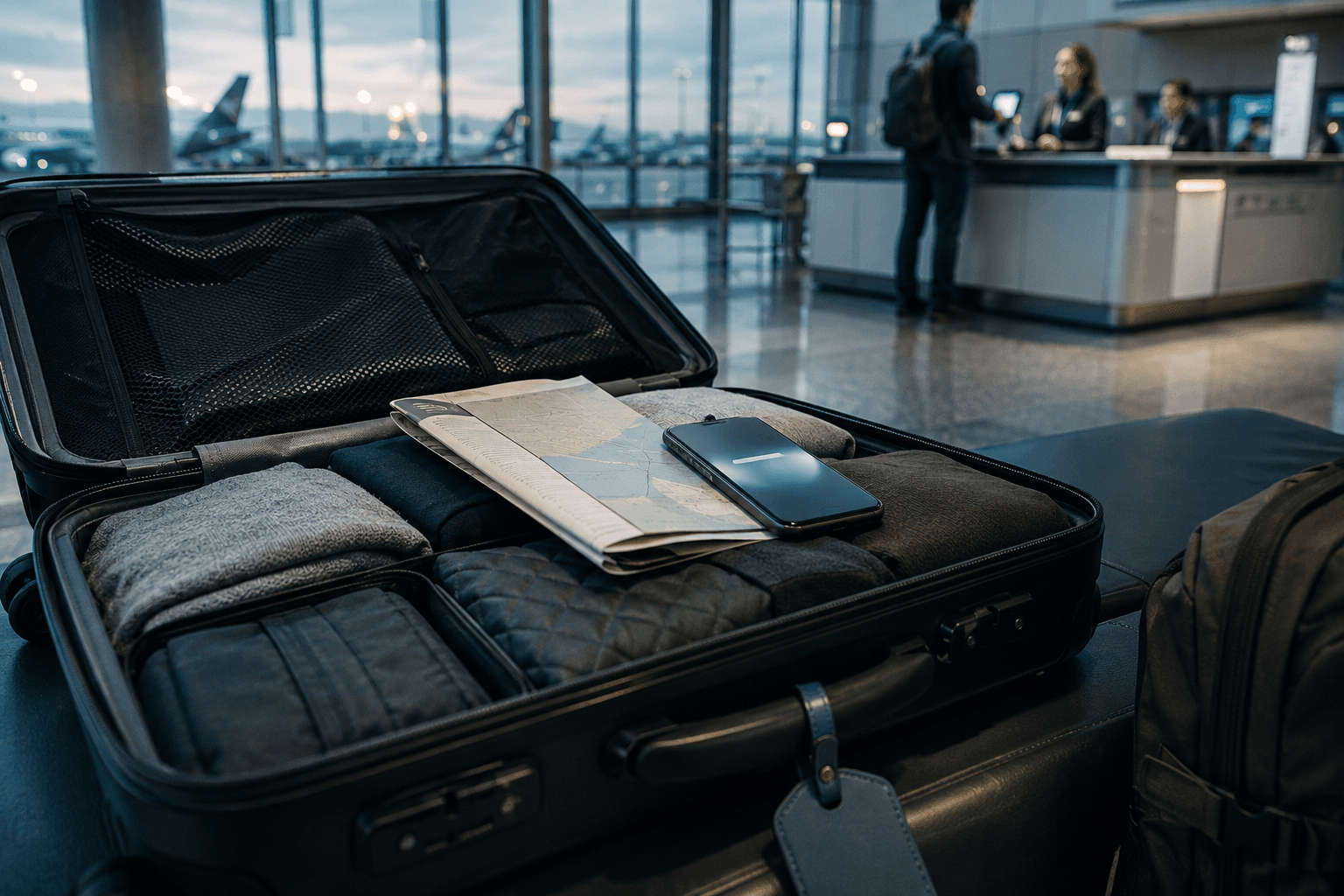
Premium travel is judged most sharply when plans change. Reliability, recovery, and clear ownership matter more than a long inventory of amenities.
The central idea: Premium travel is judged most sharply when plans change.…
Premium travel is judged most sharply when plans change. Reliability, recovery, and clear ownership matter more than a long inventory of amenities.
Amenity lists are easy to publish and easy to compare, which is why they dominate premium travel marketing and why they predict satisfaction so poorly. A traveller whose plans hold rarely notices the operation at all. A traveller whose flight is cancelled at ten in the evening, in a country where they do not speak the language, discovers the whole product at once and forms a durable opinion of it inside twenty minutes.
What changed, and why it matters now: Track handoff failures, recovery time, repeated…
The failures cluster at handoffs rather than inside them. Airline to ground transfer, transfer to property, property to activity provider, activity to return leg: each organisation performs its own segment competently and none of them owns the seam. The traveller becomes the integrator by default, repeating preferences and reconstructing context at every boundary. Count how many times a returning guest has to state a known preference across a single trip, and the number is reliably higher than any internal team believes it to be.
Build the operating model: Review ten recent disrupted journeys and locate the…
Map the journey from planning to return, define who owns every handoff, and design recovery standards for delay, cancellation, missed preference, and unavailable inventory.
Recovery standards have to be written before they are needed, because they will be invoked at the worst possible moment by whoever happens to be on shift. Define, for each failure type, who is authorised to spend, up to what limit, without escalation. The authority matters more than the amount: an agent who must ask permission at ten in the evening will produce a slow and apologetic non-answer, and the guest will correctly read the delay as an absence of ownership rather than an absence of budget.
Measure what the decision produced: Premium travel is a promise about what happens when the…
Track handoff failures, recovery time, repeated preference capture, customer effort, and the share of issues resolved before the traveler asks twice.
Customer effort is the number that most closely tracks whether the promise survived contact with reality. It is measurable: contacts required per issue, information repeated per handoff, and time from first report to confirmed resolution. The share of issues resolved before the traveller has to ask twice is the sharpest version of it, because the second ask is the exact moment a guest stops trusting the system and starts managing it themselves.
Where execution breaks: Premium travel is judged most sharply when plans change.…
A polished booking layer can hide fragmented operations. The customer receives luxury language while coordinating providers and repeating information personally.
The specific danger is that a polished booking layer masks fragmentation for precisely as long as nothing goes wrong. Investment flows to the booking experience because it is measurable, demonstrable, and owned by one team. The recovery experience is owned by nobody, invoked rarely, and impossible to demonstrate. So the gap between the promise and the operation widens quietly, and it is revealed only to the guests least likely to forgive it.
What this looks like in practice: Premium travel is judged most sharply when plans change.…
What this produces operationally is unglamorous and specific. A named owner per seam, written into the itinerary rather than held informally. A preference record that travels with the guest, so the third provider knows what the first was told. A recovery playbook per failure type with a spending limit attached, and staff who have read it before the night they need it. Guests never see any of this when it works, which is the difficulty with funding it, and they experience all of it at once on the one evening that determines whether they book again.
The strongest argument against this: Premium travel is judged most sharply when plans change.…
There is a real argument that this over-indexes on failure. Most trips do not go wrong, and a business that pours its budget into recovery infrastructure is optimising for the exception while competitors invest in the experience the majority actually receives. That is a legitimate allocation question. It resolves on lifetime value rather than on incident rate: the guests who experience a recovered failure and return are disproportionately the ones who tell other people why they returned.
The allocation argument also has a threshold that is easy to miss. Below a certain volume the recovery infrastructure genuinely cannot pay for itself, and a small operator is better served by a single competent person with authority than by a documented system nobody has time to maintain. The model described here starts earning its cost when handoffs cross organisational boundaries the operator does not control, because that is the point at which good intentions stop being sufficient.
A 30-day implementation sequence: Track handoff failures, recovery time, repeated…
Review ten recent disrupted journeys and locate the first moment when the organization knew more than the customer but failed to act.
Week one, map one real itinerary end to end and mark every handoff and every point where the traveller supplies information the operator already held. Week two, assign a named owner to each seam. Week three, write recovery standards and spending authority for the four most common failure types. Week four, run a deliberate failure, a simulated delay, and measure how long the recovery actually took from the guest side.
Rehearse the seam, not the ideal itinerary
A useful rehearsal begins by breaking one handoff on purpose: delay the inbound flight, remove the booked room type, make the driver unreachable, or close the activity after the guest has departed. Start the clock when the organisation first knows, not when the traveller complains. Observe who sees the same context, who has authority to spend, how many times the guest repeats information, and whether the replacement respects the original purpose of the trip. A simulation that ends when an internal ticket is closed is incomplete; it ends when the traveller has a confirmed plan they can understand without coordinating the providers personally.
After every real disruption, write a seam report with the first detectable signal, the owner at that moment, the action taken, the authority that was missing, the messages the guest received, and the time to confirmed recovery. Review reports across providers rather than by department, because a transfer team and a property can each meet their target while the shared journey fails. Rehearse the highest-cost seam each quarter and a newly added provider before live use. Remove steps that exist only to protect internal reporting. The premium outcome is not a perfect dashboard; it is a traveller who does not become the operations manager of their own trip. Feed the result back into supplier selection, staffing, itinerary design, and the wording of the promise sold before departure.
Editorial conclusion: Premium travel is a promise about what happens when the…
Premium travel is a promise about what happens when the plan breaks, and everything else is inventory. The operators who understand this invest in seams rather than in surfaces, and they become recognisable to guests within a single disrupted evening. Reliability does not photograph well, which is exactly why it remains available as a differentiator. It is also the rare advantage a competitor cannot copy from a brochure, because the visible artefacts, the playbooks and the ownership map, are worthless without the authority and the staffing standing behind them. That is why so few operators hold it, and why the ones that do tend to keep it for years rather than for a season.
Practical checklist
- First move — Review ten recent disrupted journeys and locate the first moment when the organization knew more than the customer but failed to act.
- What to measure — Track handoff failures, recovery time, repeated preference capture, customer effort, and the share of issues resolved before the traveler asks twice.
- Failure mode to watch — A polished booking layer can hide fragmented operations.
- Assign a visible owner and a review date. — Premium travel is a promise about what happens when the plan…
- Separate evidence from interpretation. — Premium travel is judged most sharply when plans change.…
- Capture a baseline before changing the process. — Premium travel is judged most sharply when plans change.…
Questions and answers
Where should a team start for “The premium travel experience is a reliability system, not a list of perks”?
Review ten recent disrupted journeys and locate the first moment when the organization knew more than the customer but failed to act.
What should leaders measure for “The premium travel experience is a reliability system, not a list of perks”?
Track handoff failures, recovery time, repeated preference capture, customer effort, and the share of issues resolved before the traveler asks twice.
What is the main execution risk for “The premium travel experience is a reliability system, not a list of perks”?
A polished booking layer can hide fragmented operations. The customer receives luxury language while coordinating providers and repeating information personally.
How long should the first pilot run for “The premium travel experience is a reliability system, not a list of perks”?
Four weeks is usually enough to expose the workflow gaps without turning the pilot into permanent ambiguity. Judge the pilot on the measure that matters here. Track handoff failures, recovery time, repeated preference capture, customer effort, and the share of issues resolved before the traveler asks twice.
Who should own this in travel?
A named operator owns the workflow, and the accountable business leader owns the decision and the review cadence. The workflow itself is the one described in the article. Map the journey from planning to return, define who owns every handoff, and design recovery standards for delay, cancellation, missed preference, and unavailable inventory.