
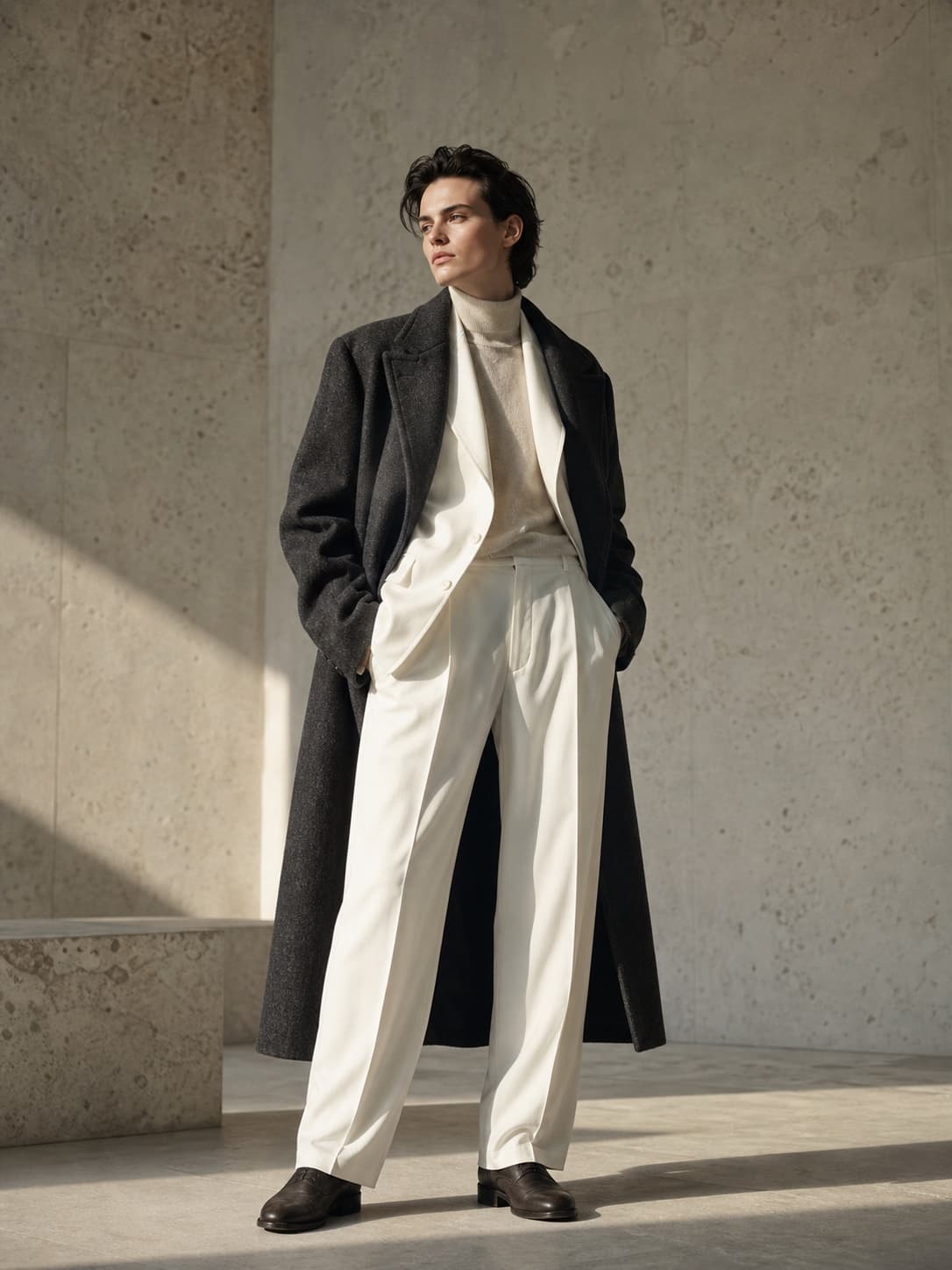
Answer in brief
The packages and the prices do not change for men: a Look Audit is $30 for 1 working day, a Capsule Wardrobe is $70 for 1-2 working days. The emphasis does change. The silhouette range is narrower, fit carries more of the result, and the capsule runs shorter.
What actually changes when the client is a man
The short answer is that the packages, the prices and the timelines do not change at all. A Look Audit is $30 and takes 1 working day; a Capsule Wardrobe is $70 and takes 1-2 working days. What shifts is the emphasis inside the same work.
The first difference is that the range of silhouettes is narrower. Menswear works from a limited set of base constructions, so a stylist spends less effort choosing a shape and more effort tuning a known shape to a specific body.
The second is that fit carries a larger share of the result. When the available silhouettes sit close together, the gap between put-together and careless comes down to the shoulder line, the sleeve length and how the trousers meet the shoe.
The third is that a men's capsule comes out shorter and turns over more slowly. That changes the planning horizon rather than the process: the shopping list stretches across seasons instead of closing with a single order.
A narrower silhouette range: what is genuinely variable
Menswear holds fewer variables than it appears to: shoulder and lapel width, how a jacket sits across the chest, the volume of a trouser through hip and leg, the rise, and the length of the garment. Almost everything else follows from those.
Because of that, two garments with the same purpose can look alike on the hanger and behave differently on a person. A catalogue photograph rarely shows that difference, so the decision is made from measurements rather than from a model shot.
A stylist responds by narrowing the field to the few constructions that match your proportions, then naming the marker that separates them. From there it works as a selection rule you can reuse, not as a one-time recommendation.
There is a practical consequence. With fewer variables in play, an error in any one of them is more visible. A sleeve that runs long reads clearly in a wardrobe where the silhouette itself is not doing the expressive work.
Fit: where it actually shows
The shoulder line is the anchor. When the seam sits past the edge of the shoulder, the sleeve drags the silhouette down and a fold forms under the armhole; when it sits inside the edge, the cloth gathers across the back on any arm movement.
Sleeve length is the second checkpoint: the shirt cuff should stay visible with the arm at rest. That is a rule you can verify from a photograph, which is why it survives a remote format without losing accuracy.
Trouser fit is described by three quantities: the rise, the volume through the hip, and how the hem falls onto the shoe. The same pair reads differently over different footwear, so the shoes are named in advance.
Length closes the list. A jacket, a field coat or an overcoat sets the proportion between the upper and lower half of the body, and that proportion is changed by picking a different model, because a tailor can move body length only so far.
What a tailor can move, and what stays put
Alterations are not included in any VITON13 package — not in the $30 Look Audit and not in the $70 Capsule Wardrobe. You choose and pay the tailor yourself, so their turnaround belongs on your plan as a line of its own.
Sleeve and trouser length, the waist, the side seams and the leg width move with few constraints. These are straight-seam operations, they are quoted quickly, and their timing is predictable enough to schedule around.
The shoulder, the armhole and the chest of a jacket are a different matter and cost accordingly, because the tailor is rebuilding the upper part of the garment. That is why a jacket is chosen on the shoulder first and adjusted everywhere else.
From this comes the selection rule a stylist builds into the list: buy on the dimension that cannot be changed, and leave to the tailor whatever moves along a straight seam.
Look Audit: where a men's wardrobe starts
A Look Audit is $30 and takes 1 working day. It covers a review of your current wardrobe, image notes and priority recommendations, and it includes one round of revisions on the written notes themselves.
The clothing budget itself is not included. The audit answers what already works and what is getting in the way; it does not turn into an order, because the buying stays on your side of the line.
The audit separates two problems that are easy to confuse: not owning enough, and owning garments that do not sit correctly. The second looks like a gap in the wardrobe, but it is repaired by a tailor or a replacement rather than by volume.
The practical output is a short list of priorities. It tells you what is worth sending to a tailor, what to replace outright, and what simply should not be worn together any more.
Event Look: the occasion and the dress code
An Event Look is $55 and takes 2 working days. It is one complete look for a named occasion, built from your own wardrobe first, plus a shopping list with links and sizes. One round of revisions is included.
Purchases, alterations and dressing on the day are not part of it. For a men's look the alteration line matters in particular: a shirt or a trouser for one fixed date often passes through a tailor, and you book that slot yourself.
A dress code works here as a constraint rather than a decoration. A named formulation — business, cocktail, the specific casual of a venue — removes a set of constructions immediately and simplifies the choice inside a narrow range.
So the occasion is described in one line: date, venue, format, and what you will physically be doing there. Standing all evening and sitting at a table place different demands on trouser fit and on footwear.
Capsule Wardrobe: why the list runs shorter
A Capsule Wardrobe is $70 and takes 1-2 working days. You get a capsule structure, a shopping list and look combinations, together with two rounds of revisions on the capsule list itself.
Neither the clothing budget nor any tailoring is included. Both are separate lines in your own plan, and it is worth costing them before the order goes in rather than after the parcels arrive.
A men's capsule comes out shorter for reasons of arithmetic. When tops and bottoms stay neutral in colour and close in silhouette, each added piece yields more working combinations, so a target number of outfits is reached with a smaller set.
The conclusion is not thrift for its own sake but a different admission test: a garment enters the capsule when it adds combinations, not when it appeals to you on its own.
Replacement rhythm: why the wardrobe turns over slowly
Replacement in a men's wardrobe is tied to wear rather than to the season. The base constructions move slowly, so a garment leaves rotation when it stops holding its shape, not when a new collection lands in the shops.
Wear concentrates at contact points: shirt collars and cuffs, the sole and heel counter of a shoe, elbows and hems on knitwear, the knee of a trouser. These are places you inspect by eye rather than on a calendar.
That rhythm changes the shopping list too. It stops being a single order and becomes a queue: what is bought now, what waits until the current piece wears out, and what is not bought at all.
For planning this is convenient. The budget spreads across months, and decisions get made on the evidence of a worn garment rather than under the pressure of a sale that ends on Sunday.
Styling Day and Express: when a session is the right tool
A Styling Day is $120. It is one session, scheduled within 3 days, and it covers occasion styling, look planning and visual continuity between the looks you are actually going to wear.
The format is remote by default. Travel is agreed and quoted separately, which means it belongs in the budget before the session rather than in a conversation on the day itself.
Styling Day Express is $180: 1 working day, booked within 48 hours, one round of revisions, and a written follow-up the same day. Purchases and alterations stay outside it, as they do in every other package.
The difference between the two is the calendar rather than the depth. Express is what you book when the date is already fixed and only a handful of days remain for a tailor to confirm a slot.
Cloth and texture instead of colour variety
When the palette is narrow, the material and the weight take on the job of differentiation. The same silhouette in a smooth cloth and in a textured one reads differently, and that difference survives a photograph.
Weight determines how a garment holds its shape. A light cloth follows the body and reports every imprecision in the fit; a heavier one holds its own line and forgives small deviations without looking sloppy.
This is why the notes record composition and weight alongside colour and size whenever the seller publishes them. It moves the choice out of taste and into parameters you can check before the order is placed.
The same principle governs combinations. Two garments in close shades but different textures read as a deliberate pair, whereas an inexact colour match reads as an attempt that missed its target.
Sizing: why the remote format holds up here
Men's sizing is written as quantities more often than as letters: neck and sleeve for a shirt, chest for a jacket, waist and inseam for a trouser. Those numbers travel between sellers better than a letter on a label does.
That makes a shopping list checkable. With a link and a size you compare the seller's own chart against your measurements before ordering, instead of discovering the mismatch when you open the parcel.
Measurements are taken once and written down. A tape, a straight stance and a second person give a steadier result than transferring a number off a garment you already own and have already stretched out.
Footwear is recorded separately: your usual size and your width, brand by brand. Width varies between lasts more than length does, and it decides whether a pair is actually wearable across a full day.
How to brief the work and how to accept it
The inputs for a men's wardrobe are short: measurements, daylight photographs of the garments, the shoes you genuinely wear, and the shape of your week — how many days go to work, to meetings and to time off.
State the constraints separately: what you will not wear on principle, where comfort has been a problem, which fabrics do not work for you. This protects the revision round, which in most packages you get exactly once.
Acceptance runs on fit rather than on taste. Check the shoulder line, the sleeve and trouser lengths, and how the garment behaves in movement; only then discuss whether the look as a whole appeals to you.
Keep the boundary in view from the start: VITON13 does not buy clothing and does not carry out alterations in any package. You receive decisions and a list, while the order and the tailor remain yours.
Practical checklist
- Take your measurements with a tape and write them down as one list.
- Photograph the garments in daylight, one piece per frame.
- Name the shoes you wear on working days and to meetings.
- Check the shoulder line before buying, since a tailor moves it only so far.
- Budget a separate cost and turnaround for the tailor before ordering.
- Collect your notes into one message and send the revision round whole.
Questions and answers
Does styling cost more for men?
No. The packages and prices are shared: Look Audit is $30 for 1 working day, Event Look is $55 for 2 working days, Capsule Wardrobe is $70 for 1-2 working days, Styling Day is $120 for one session, and Styling Day Express is $180. The emphasis inside the work changes, not the price list.
What is actually different about a men's wardrobe?
The silhouette range is narrower, so more weight moves onto fit and onto selection by measurement. The capsule comes out shorter through combination arithmetic, and replacement is tied to the wear of specific pieces rather than to the season.
Are alterations included?
No, not in any package. VITON13 does not buy clothing and does not carry out alterations. You choose and pay the tailor yourself, so their turnaround goes on the plan as its own line before any order is placed.
How many pieces will a men's capsule hold?
The number depends on the shape of your week and on what the wardrobe already holds. Capsule Wardrobe at $70 and 1-2 working days gives you a capsule structure, a shopping list and look combinations, and the two revision rounds apply to the capsule list itself.
Will the stylist come shopping with me?
Styling Day at $120 is remote by default: one session, scheduled within 3 days. Travel is agreed and quoted separately, so it is settled and costed before the session rather than on the day it runs.