
Answer in brief
Remote work changes who looks at the garment on your body, not who does the thinking. Styling Day costs $120 and is remote by default, while travel is agreed and quoted separately. Here is what genuinely needs a room, and what a document already covers.
The short answer: what remote actually changes: Styling Day costs $120 and is remote by default, with…
Working remotely changes who is looking at the garment on your body. It does not change who is doing the thinking. Analysis, priorities, capsule structure and a shopping list all survive a screen intact. Fit and the way fabric moves do not.
At VITON13 the Styling Day package costs $120 and is remote by default; travel is agreed and quoted separately. That split is useful in practice: the price of the work stays stable, and the journey becomes a separate decision rather than a hidden line.
One limit applies identically in both formats. VITON13 never buys the clothes and never does alterations. A stylist standing in your hallway adds neither a paid basket nor a tailor, so the clothing budget and the fittings stay on your side of the table.
The rest of this article works package by package. What genuinely needs a body in the room, what can be settled from photographs and measurements, and the point at which asking for a travel quote starts to make commercial sense.
Styling Day is remote by default: what that means in practice
Styling Day costs $120 and is described as one session, scheduled within 3 days. It covers occasion styling, look planning and visual continuity, and that last phrase means consistency between looks rather than one isolated outfit assembled in a hurry.
Travel is neither included nor refused: it is agreed and quoted separately. For an owner watching cash, that is a workable structure. You see the cost of the work first, then decide independently whether the journey earns its own quote.
Styling Day Express costs $180: 1 working day, booked within 48 hours, one round of revisions, plus a written follow-up on the same day. Purchases and alterations are not part of it, and each package on the page lists its own exclusions separately.
Read that literally. You are buying a session, a plan and a written record of the decisions taken. A person standing next to your wardrobe is a separate service with its own quote, not an assumed part of the fee.
What genuinely needs a body in the room: fit, drape, pins
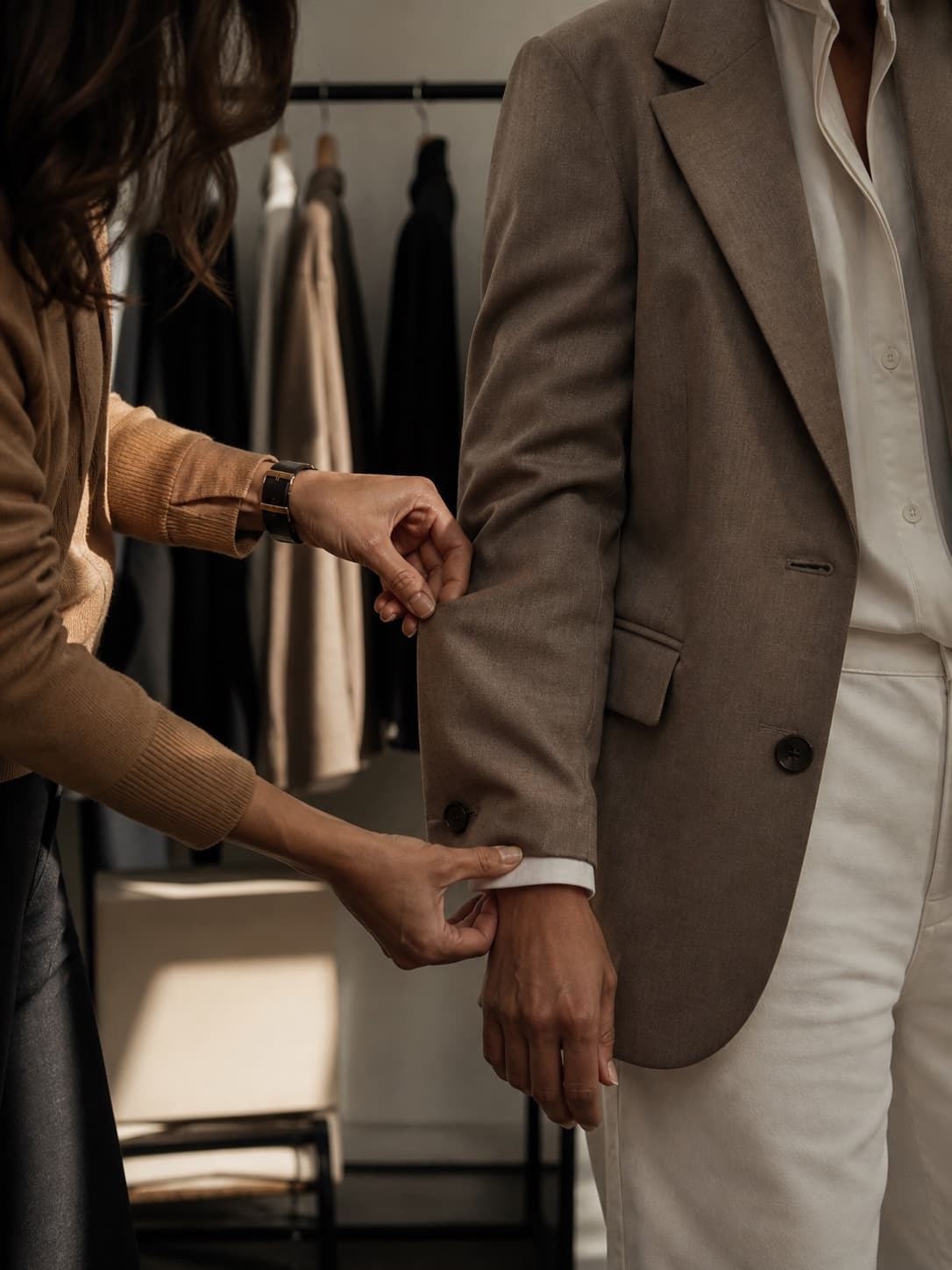
Fit is geometry against one specific body: where the shoulder ends, where the armhole sits, where your waist actually falls. A photograph compresses depth into a plane, so the contested centimetres read less clearly on a screen than in a room.
Drape is fabric behaviour. Heavier wool falls straighter, viscose and silk cling to the body, linen creases and keeps the crease. How a garment behaves when you walk or sit is invisible in a still frame and obvious in a short video.
Alterations need measuring and pinning on the body, and a tailor does that work in either format. VITON13 does not carry out alterations, and the package terms say so plainly. Presence helps you describe the job; it does not replace the fitting room.
So the honest list of things that need a room is short: the final judgement on fit, fabric in motion, and work with pins. Everything else in the service is decisions and documents, and neither of those loses quality over distance.
What the remote format does without loss
Look Audit costs $30 and runs 1 working day: a current wardrobe review, image notes and priority recommendations, with 1 round on the written notes. The clothing budget itself is not included and remains a separate line of spending for you.
Capsule Wardrobe costs $70 and runs 1-2 working days: a capsule structure, a shopping list and look combinations, with 2 rounds on the capsule list. The clothing budget and any tailoring are excluded from this package as well.
Event Look costs $55 and runs 2 working days: one complete look for a named occasion, built from your own wardrobe first, plus a shopping list with links and sizes. Purchases, alterations and on-the-day dressing are not included.
These three share a shape. The deliverable is a document and a sequence of decisions, and that travels by email intact, because the value sits in the reasoning behind each choice rather than in company at the bedroom mirror.
The five packages and what each price buys
Look Audit is $30, delivered in 1 working day, with 1 round on the written notes and no clothing budget included. It is a short way into the service: a reading of what you already own, plus an order of operations.
Event Look is $55, delivered in 2 working days, with 1 round. Purchases, alterations and on-the-day dressing are excluded. The package answers one question only: assemble a single look for a named occasion, starting from your own wardrobe.
Capsule Wardrobe is $70, delivered in 1-2 working days, with 2 rounds on the capsule list. Clothing budget and tailoring are excluded. What you pay for here is structure: what to buy, in what order, and how the pieces combine.
Styling Day is $120, one session, scheduled within 3 days, remote by default, with travel quoted separately. Styling Day Express is $180: 1 working day, booked within 48 hours, one round, and a written follow-up on the same day.
Timelines: how to read the wording
Working days and calendar days are different units. Two working days on Event Look, started on a Friday, land on Monday or Tuesday. When the occasion falls on Saturday, count backwards through the working calendar rather than from the event date.
Styling Day is phrased differently: one session, scheduled within 3 days. That is a window for fixing the appointment, not a production time. The session itself is a single meeting, and it is worth planning the week around it accordingly.
Express carries two separate clocks. One working day is the turnaround, while booked within 48 hours is the window in which the slot is held for you. Confusing the two is how a tidy schedule quietly falls apart.
Travel runs on its own calendar, because it is agreed and quoted separately and adds logistics on top of the work itself. Ask for that quote before you fix a date, not after the date has been promised to someone.
Revisions: how many rounds, and what they cover
Look Audit includes 1 round on the written notes. The wording matters: the round applies to the text of the recommendations, not to an open-ended re-reading of the wardrobe. Use it until the notes describe the life you actually lead.
Event Look includes 1 round. Capsule Wardrobe includes 2 rounds on the capsule list, meaning its composition and the order in which you buy. That is where a disagreement about a garment gets settled on paper instead of at a till.
For Styling Day the package terms state no revision count. Do not assume one on the provider's behalf. Agree in writing, before you book, how many clarifications the session includes and in what form you receive them afterwards.
Styling Day Express includes 1 round plus a written follow-up on the same day. The follow-up earns its place because it fixes the agreement while it is fresh; a week later, everyone's memory of the exact wording is softer than they expect.
The edges of the service: buying and tailoring stay with you
In none of the packages does VITON13 buy the clothes. Look Audit and Capsule Wardrobe exclude the clothing budget outright, and Event Look excludes purchases. The card and the spending decision stay yours, including the decision to buy nothing at all.
Alterations sit outside the service too. Capsule Wardrobe names tailoring as excluded, and Event Look, Styling Day and Styling Day Express exclude alterations. Plan a tailor as a separate budget line, with a separate lead time of its own.
Event Look also excludes on-the-day dressing. Even in the tense version of the job, with a named occasion and a fixed date, the service ends with a look, a list and sizes rather than with help at the zip before you leave.
That is worth holding in mind when you choose a format. Presence adds neither a paid basket nor a tailor's fitting room. It adds a trained eye on how a garment sits, and that eye is what a travel quote pays for.
What to send so the remote format works
Full-length photographs from the front, the side and the back, with shoes in frame and a plain wall behind you. Shoot in daylight near a window and hold the phone around chest height, which stops perspective from distorting your proportions.
Measurements in centimetres are more dependable than the size on the label, because numbering differs between brands and between markets. Chest, waist and hips, inseam, shoulder-to-shoulder and sleeve length cover most of what a stylist needs to reason with.
A short video in which you take a few steps, sit down and turn around shows drape and the way a garment behaves in motion. That one file answers the fabric questions a still image would leave you describing in words.
Then context: the occasion, the dress code, the climate, what is already in the wardrobe, links to anything you are considering, and the constraints — the budget you set yourself and the pieces you know you will not wear.
How to check fit yourself
The shoulder seam should finish at the edge of your shoulder. When it has slid down the arm, further judgement turns into guesswork: the armhole is already displaced, and everything below it hangs wrong regardless of the size on the label.
Check the closure standing and then seated. Lines radiating from a button or a zip describe the size and the cut, not a garment that needs pressing. An iron does not remove strain lines, and steam does not change a pattern.
A tailor can usually change sleeve and hem length without drama, while shoulder width and the armhole are considerably harder. So choose a garment on the measurements that cannot be reworked afterwards, and leave the lengths to the fitting.
Test yourself in motion: sit down, walk a few steps, raise your arms, then look again in daylight. Mixed lighting shifts how colour reads, and a phone screen adds its own white balance on top of whatever the room is doing.
How to read the service page and the documents you receive
The page at /services/styling lists what each package contains, its timeline, its revisions and its exclusions. Starting with the exclusions is sensible, because they mark where the provider's responsibility ends and yours begins: budget, purchases, tailoring and fittings.
The Schema.org vocabulary describes a service with the Service type and properties such as areaServed, availableChannel, providerMobility and offers. Those fields describe precisely this article's subject: where the service happens, through which channel, and whether the provider travels.
The W3C quick reference for WCAG 2.2 sets out the criteria a readable document meets: 4.5:1 contrast for normal text, text alternatives for images, a link whose purpose is clear in context, and text that survives being enlarged.
The practical conclusion is modest. Ask for the shopping list in a format that opens on your phone, with working links and sizes written out. A document you cannot read on the move returns only part of its value.
Choosing the format for the job in front of you
When the question is what you should own and in what order to buy it, remote is enough. That is work on priorities and structure, and it fits entirely inside notes, a shopping list and a set of combinations.
When the question is whether one specific jacket sits correctly on you, a shared room helps — or a fitting at a tailor, where the same visit also sets the alteration brief and puts a number on that work.
Do the arithmetic before booking: $30 for the audit, $55 for a look, $70 for a capsule, $120 for a session and $180 for the express version. Travel is quoted separately, so weigh that quote against the cost of the work.
Then choose the package that answers your nearest question rather than the broadest offer on the page. Each package's terms — contents, timeline, revisions and exclusions — are published at /services/styling and readable before you pay anything.
Practical checklist
- State the job as one question: what to buy, or whether a specific garment fits.
- Shoot full-length photographs from the front, side and back in daylight near a window.
- Take measurements in centimetres and record them next to the sizes on your labels.
- Film a short video in which you walk a few steps, sit down and turn around.
- Ask for the travel quote before you fix the date of the session.
- Agree in writing how many revision rounds your chosen package includes.
Questions and answers
How does remote styling differ from working in person?
The analytical part does not change: the wardrobe review, priorities, capsule structure and shopping list all work from photographs and measurements. Meeting in person adds a trained eye on fit and on how a fabric behaves when you move.
What does Styling Day cost, and does the price include travel?
Styling Day costs $120: one session, scheduled within 3 days, remote by default. Travel is not included in that price. It is agreed and quoted separately, so ask for the travel quote before you fix a date in the calendar.
Which package suits one specific occasion?
Event Look costs $55 and runs 2 working days: one complete look for a named occasion, built from your own wardrobe first, plus a shopping list with links and sizes, and 1 round. Purchases, alterations and on-the-day dressing are not included.
How many revision rounds does Styling Day include?
The package terms state no revision count for Styling Day, and there is nothing to assume in its place. Agree in writing before booking how many clarifications the session covers. Styling Day Express does state 1 round plus a written follow-up the same day.
Will the stylist buy the pieces or have them altered?
No. VITON13 never buys the clothes and does not carry out alterations in any package: the clothing budget and the tailor stay with the client. The stylist supplies a list with links and sizes, and frames the brief a tailor can work from.