
Answer in brief
The Telfar Baby Bag Charm arrived through a deliberately alarming downsizing reveal. VJOURNAL examines the product, the joke and the marketing discipline behind its impact.
Why the Telfar Baby Bag Charm became a marketing story
The Telfar Baby Bag Charm entered fashion through a message that looked much larger than the object. On July seventeenth, the brand resolved a deliberately alarming downsizing announcement by revealing a miniature version of its familiar Shopping Bag. HelloBeautiful documented the original social post and the reversal, while PAUSE reported the product release two days later. Telfar's own product page supplies the construction details. Those are the reported facts. The interpretation that follows, about attention, brand voice and commercial architecture, is VJOURNAL analysis rather than a claim about the company's internal results.
The idea works because the product and the language share one verb. Downsizing first suggests organizational contraction, then becomes literal scale reduction. That transfer compresses a full launch proposition into a single mental turn: the company is not becoming smaller, the bag is. Many campaigns attach a concept after a product exists. Here the concept explains the product immediately. Even a reader who never sees the full assortment can understand the miniature form, the tension and the release. The announcement is therefore not merely a joke around an accessory. It is an unusually economical piece of product positioning.
What Telfar actually released
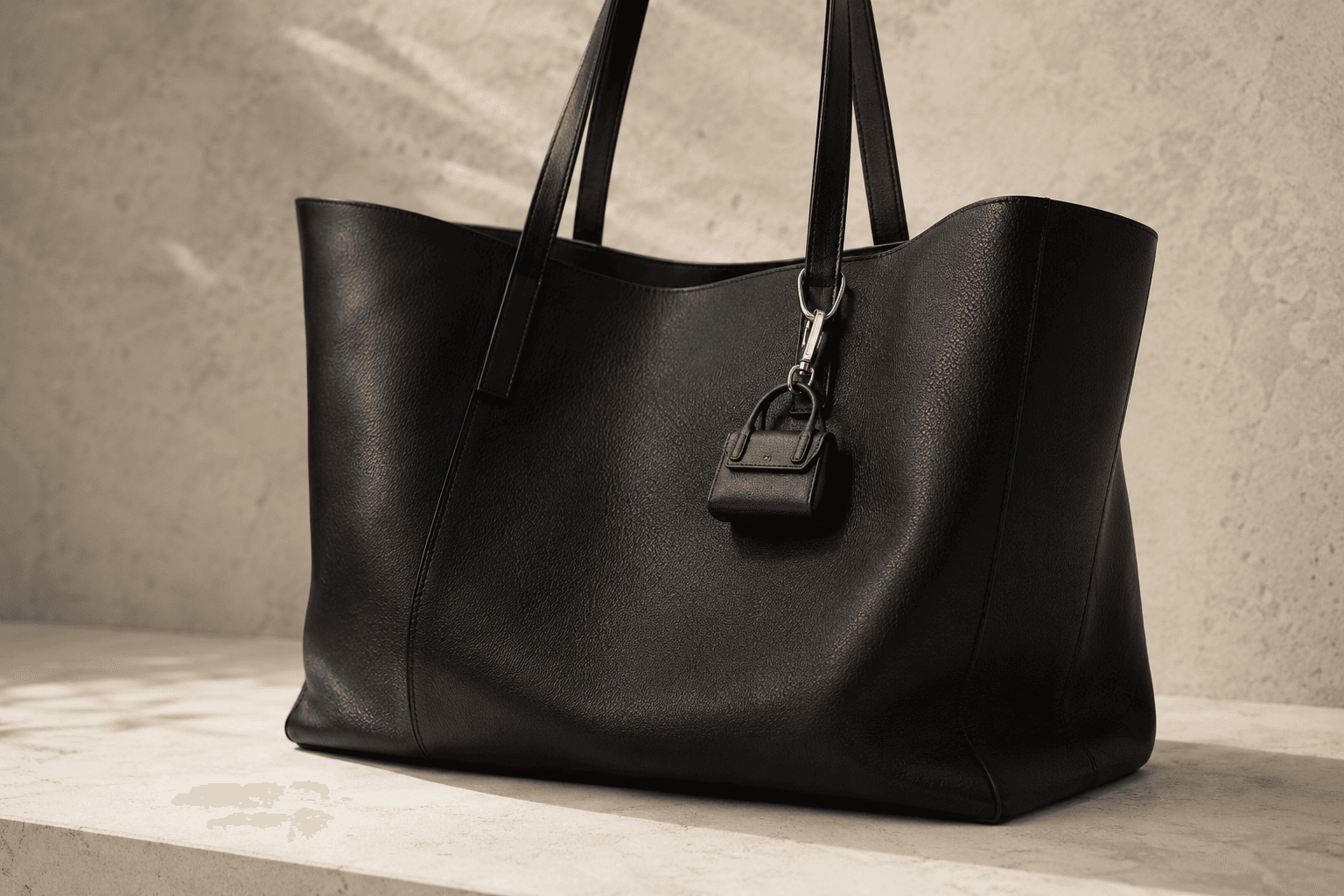
Telfar describes the charm as a four-by-three-inch offspring of its Shopper. The official page lists a zip closure, two card pockets on the back and a karabiner hand strap that can attach to another bag or a belt loop. It can also be carried in hand as an intentionally tiny tote. The brand presents fourteen colors. PAUSE independently reports the same number of colorways and identifies the object as a reduced version of the Shopping Bag. These details matter because they show that the item is not only decorative. It translates recognizable bag functions into a smaller, playful format.
Scale creates the visual hook, but function prevents the object from becoming a flat souvenir. A zipper implies custody, card pockets imply use and the clip defines how it joins an existing wardrobe. The charm therefore sits between accessory, small leather good and brand token. That ambiguity is commercially useful because different customers can justify it differently. One may want color on a neutral tote, another may want a compact card holder, and another may simply enjoy the miniature. VJOURNAL's reading is that the launch expands the Shopping Bag language without requiring a customer to replace the full-size bag they already own.
The announcement used tension without losing the reveal
HelloBeautiful reports that the initial slides presented a faux news story about Telfar scaling back, using the pressures of tariffs, shrinkflation and weaker support for Black-owned businesses as part of the setup. The full caption eventually disclosed the practical joke and the bag charm. That sequence borrowed the visual grammar of corporate bad news, then redirected it toward product. The tactic was risky because the opening touched real anxieties. Its coherence depended on a prompt resolution, a product that literally fulfilled the language and an audience already familiar with the brand's unconventional communication.
This is not a universal formula for fashion launches. Manufactured alarm can erode trust when the subject and the payoff are unrelated, when clarification arrives too slowly or when the joke asks customers to dismiss genuine hardship. Telfar's execution is more specific. The reveal does not deny the meaning of downsizing; it changes its scale. The copy reportedly extends the conceit through ideas such as reduced capacity, one physical closure and card-pocket liquidity, each mapping business vocabulary onto bag construction. VJOURNAL sees the discipline in that continuity. Every line returns to a feature instead of leaving the product behind.
A brand voice strong enough to carry the product
Fashion marketing often treats tone as decoration applied after photography, pricing and distribution have been decided. This launch shows a stronger model: voice can operate as product architecture. Telfar has built public recognition around direct language, cultural fluency and formats that do not behave like conventional luxury announcements. HelloBeautiful places the stunt within that longer pattern, mentioning the brand's past live-selling experiments and unexpected partnerships. The Baby Bag Charm benefits from that history. Its audience can read exaggeration as part of a known relationship rather than as an isolated attempt to imitate internet humor.
Consistency does not mean repetition. A recognizable voice needs rules, not a fixed set of phrases. In this case the rules appear to include accessibility, participation, self-awareness and a willingness to make the business mechanism visible. The customer is invited to understand how the joke works, then to share it. Premium positioning emerges from authorship rather than distance. That is a useful distinction for independent brands. Cultural authority is difficult to manufacture with immaculate images alone. It grows when product decisions and communication feel as though they come from the same point of view.
Miniature scale creates a lower-friction brand entry
A miniature version of an established object can change the route into a brand. It preserves silhouette and color recognition while reducing physical commitment, storage needs and styling risk. It can also live on a bag from another label, which turns the charm into a portable point of contact rather than a closed uniform. Telfar's fourteen-color offer strengthens that logic: the decision can begin with mood or contrast rather than with a single hero shade. This is VJOURNAL analysis of the assortment, not evidence about sales or customer demographics, which the available sources do not provide.
The strongest entry products do more than display a logo at a lower threshold. They teach the larger system. Here the miniature repeats the Shopping Bag's broad identity while introducing closure, pockets and attachment hardware suited to its own scale. The buyer receives a usable object and a compact lesson in the brand's visual language. For an existing customer, it becomes a layer rather than a replacement. For a new customer, it can function as a first purchase with enough character to stand alone. That dual role makes the charm relevant to both retention and discovery without requiring separate stories.
The bag charm trend is context, not the entire idea
HelloBeautiful situates the release inside a wider appetite for bag decoration and miniature accessories. That context helps explain why the product is legible now: customers already understand a tote as a surface for personal composition. Yet trend participation alone would not distinguish Telfar. The launch becomes specific because the charm is a scaled relative of an established product and because the downsizing language could only resolve through that scale. A generic trinket attached to the same campaign would have broken the logic. Product lineage turns a broad accessory movement into a brand-owned proposition.
This distinction matters for trend-led product teams. The question is not only whether a category is growing in cultural visibility, but whether the brand has a credible reason to enter it. That reason may be material, archive, craft, community behavior or an existing silhouette. Telfar chose silhouette and voice. The object can participate in current styling while remaining intelligible after the loudest moment passes. VJOURNAL's practical test is simple: remove the trend label and ask whether the item still explains something distinctive about the brand. The Baby Bag Charm continues to explain scale, access and the Shopper's recognizable form.
What premium teams can learn from the launch
The first lesson is alignment. A strong concept should connect the announcement, product form, feature language, imagery and purchase page. The second is timing. If a campaign opens with uncertainty, the clarification must be easy to find before interpretation fragments across channels. The third is evidence. Product dimensions, materials, functions, colors and availability should remain explicit after the theatrical reveal. Telfar's official page performs that grounding role by describing what the object does. Editorial coverage then supplies a separate record of how the announcement unfolded. Together they let readers distinguish the object from the campaign around it.
The fourth lesson is proportionality. Not every accessory needs a manifesto, and not every brand has earned permission to turn business anxiety into humor. Teams should assess audience expectations, possible misreading and the cost of delayed clarity before borrowing the tactic. A useful launch checklist asks whether the payoff rewards attention, whether every dramatic phrase maps to a real feature, whether the product page can stand without the stunt and whether customer support has one accurate explanation. Creativity becomes premium when operational details remain calm beneath the spectacle. That balance is more durable than reach pursued without control.
Conclusion: the Telfar Baby Bag Charm makes scale the message
The confirmed release is concise. Telfar offers a miniature Shopper-derived charm with a zipper, two rear card pockets, an attachment strap and fourteen color options. HelloBeautiful records the July seventeenth reveal through the brand's social announcement, and PAUSE follows with independent product coverage. No available source establishes sales performance or long-term demand, so this story makes no such claim. What can be evaluated is the construction of the launch: one word moved from corporate language to physical scale, and the product rewarded the audience for following that change.
The Telfar Baby Bag Charm is a useful fashion-marketing case because its smallest object carries a complete idea. The charm extends an existing silhouette, enters a visible accessories habit and gives loyal and new customers different reasons to participate. More importantly, the campaign remains attached to the product all the way down to its closure and pockets. That is the standard worth keeping after the joke fades. Attention is only the opening asset. A premium launch turns attention into understanding, and understanding into a product relationship that still makes sense when the social post is no longer new.
Practical checklist
- Confirm that a launch concept maps directly to the product rather than merely surrounding it.
- Make dimensions, functions, colors and availability easy to find after the reveal.
- Test dramatic copy for possible misreading before publishing across channels.
- Give customer service and retail teams one accurate explanation of the campaign.
- Check whether a trend-led product still expresses a distinctive brand idea without the trend label.
- Separate observed attention from unsupported assumptions about sales or long-term demand.
Questions and answers
What is the Telfar Baby Bag Charm?
It is a miniature Shopping Bag-derived accessory measuring four by three inches, with a zipper, two rear card pockets and a karabiner attachment strap.
How many colors does Telfar offer?
Telfar's official product description presents the Baby Bag Charm in fourteen colors, allowing it to work as either a tonal or contrasting accessory.
Why did the downsizing announcement attract attention?
It initially used the language of corporate contraction, then revealed that downsizing referred literally to a miniature version of the brand's familiar bag.
Is the charm only decorative?
No. The official page describes a zip closure, two card pockets and several ways to attach or carry it, giving the miniature object practical functions.
What is the main marketing lesson from the launch?
The campaign works because its central word, product scale, feature copy and reveal all express the same idea while the product page restores practical clarity.