
Answer in brief
Brief, script, shoot, assembly, grade, sound, export — the seven stages every video passes through. Here is what happens at each one, who owns it, and how the list lets you see what a quote has quietly left out.
What you are buying when you buy a video
A video is not one service. It is a chain of stages — brief, script, shoot, assembly, grade, sound, export — and every one of them has somebody doing it and somebody paying for it. A line that reads simply “video production” tells you none of that.
Two quotes with the same number at the bottom usually differ in stages rather than in craft. One covers a shoot day and a music licence; the other starts from footage you already own. Until you split a quote into stages, the totals are not comparable at all.
The rest of this article walks each stage in order: what happens there, who owns it, and what breaks when it is skipped. With that list in hand, a supplier's price sheet turns back into a description of work rather than a figure.
Our own video packages are written on the same principle: each one names its timeline, its number of revision rounds, and what it leaves out. The service page is linked at the end, where every one of those terms appears in full.
The brief: deciding what the video has to do
The brief belongs to the buyer, not to the supplier. It records who the video is for, where it will run, what action it should trigger, and how you will know it worked. Without those four answers an editor guesses, and guesses get paid for in revision rounds.
A usable brief fits on one page and stays concrete: product, audience, placement, length, mandatory elements such as the logo or a legal line. It also states what must not appear, and that negative list often saves more time than the list of wishes does.
Ownership sits with the business owner or the marketer on their side. A supplier can offer structure and ask uncomfortable questions, but decisions about the product and the promise are not theirs to make. Hand the whole brief over and you receive someone else's idea of your product.
Briefing rarely appears as its own line in a quote, and that is fine. What to check instead is whether a call is scheduled before work starts, and whether it leaves behind a document both sides will treat as the reference at handover.
The script: wording, shot order and running time
The script turns the brief into a sequence: what is said, what is shown, in what order, and for how long. For a short vertical piece that may be half a page of table, but it still has to exist, or the shot order gets decided during the edit.
This is where the opening frame is settled. A viewer in a feed makes up their mind quickly, so the promise of the video belongs at the front rather than being saved for the finish. The ending carries the call to action and a clear next step.
Scripting can sit with the supplier, an in-house marketer, or the owner. What matters is that it is assigned before work begins. The Single Reel package does not include scripting: like shooting and actors, it is separate work with its own owner.
When no script exists, the editor quietly inherits the job and builds a story out of whatever the footage allows. The result can be tidy, yet it answers the question of what was filmed rather than what the business needed to say.
The shoot: whose stage it is and what it costs
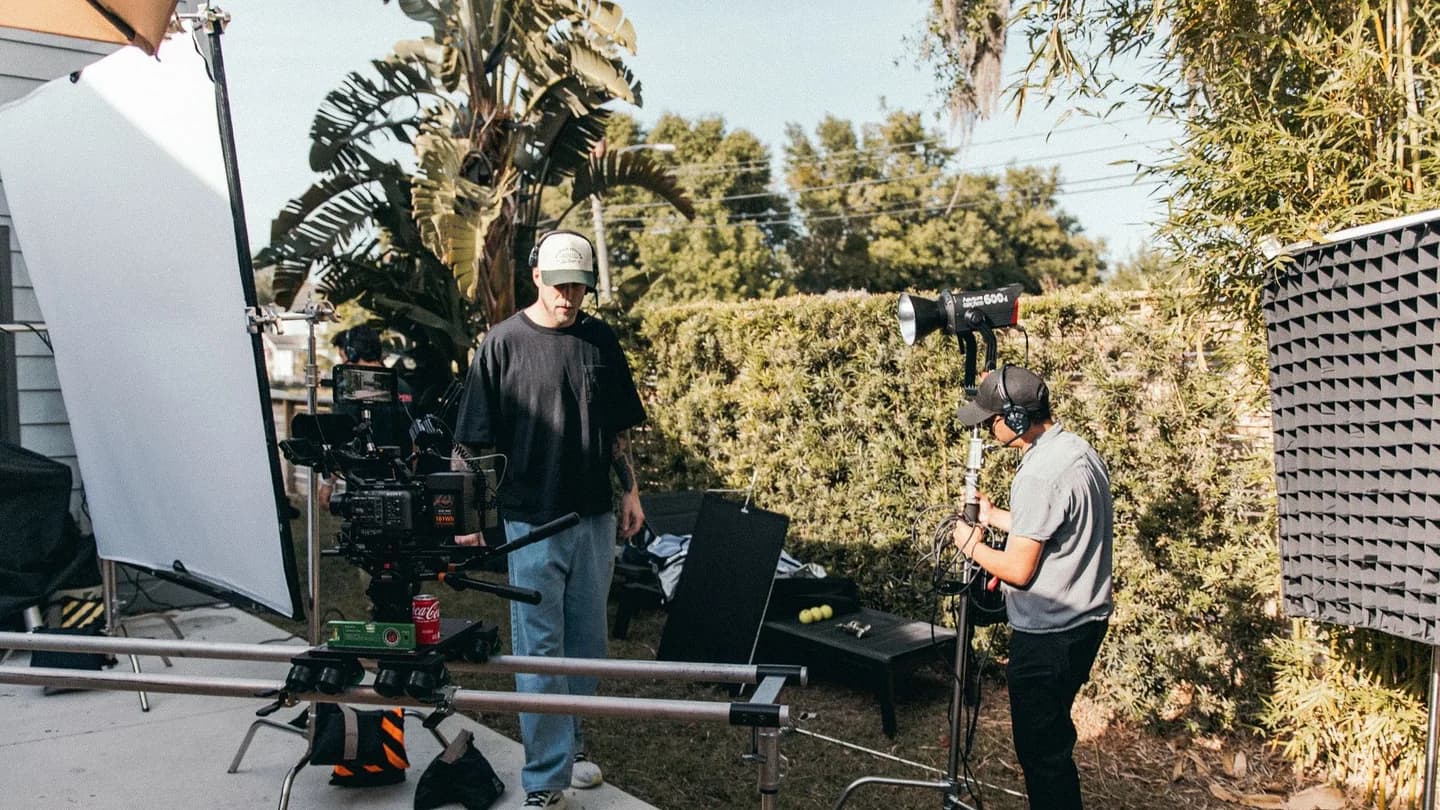
Shooting is the stage with heavy logistics: people, a location, lighting, gear, hours. It introduces costs that appear at no other point — rental, travel, fees, permission to be on site. That is why it is almost always priced apart from the edit.
Footage can also arrive without a crew: a phone in a staff member's hand, clips from the workshop floor, an archive from an earlier shoot. That works on two conditions — the frames are shot in the orientation you need, and there is enough variety among them.
None of our packages include shooting. Reels Pack is built explicitly around footage you supply, and its timeline of 1-2 working days from footage delivery is counted from the moment the files land, not from the moment the order is agreed.
The practical test when reading a quote: find the word “shoot” and look for a number of shooting days beside it. No days and a low price usually means you are buying post-production, and the material is something you will have to organise yourself.
The assembly: turning footage into a cut
The edit is where selected frames become a version you can show. Choosing takes, setting the rhythm, cutting, adding titles, trimming to a placement's length: this is the stage people usually mean when they say “make us a video”.
Its size is not measured in the finished minute. It is measured in how much raw footage came in and how many versions go out. One vertical cut from an hour of material is one job; five cuts from that same hour is another, and it prices differently.
Our packages differ along exactly that axis. Single Reel is $70 and delivers one edit with captions, a licensed track, and exports for every vertical placement. Reels Pack is $90 and covers up to 5 edits built from footage you provide.
For work that cannot wait there is Reels Pack Express at $150: 1 working day, a 24-hour turnaround from footage, and 1 round of revisions. Shooting sits outside it, and so does licensing beyond the supplied track.
Colour: why the grade is its own line
The grade matches shots to one another and gives the picture a consistent character. Without it, a video assembled from several days of filming reads as borrowed fragments: the temperature shifts, the brightness jumps, and skin tones stop agreeing between neighbouring shots.
Two different amounts of work hide behind one word. The first is technical normalisation so the shots agree with each other. The second is an authored look built for the brand. The first is needed almost every time; the second earns its place where the image itself sells.
In a quote the grade is sometimes folded into the edit and sometimes broken out. Campaign Edit separates it far enough to give it its own feedback: 2 rounds on the cut, 1 on the grade. That split keeps colour notes away from story notes.
The thing worth settling here is who approves colour, and on which screen. One person judging from a phone and another from an uncalibrated laptop turns a measurable stage into an argument about taste, and it consumes a revision round on the way.
Sound: voice, music and the licence behind it
Sound is several layers: dialogue or voice-over, music, effects, and overall loudness. They are mixed so that speech stays intelligible and music sits underneath it rather than on top. It is its own craft, and its absence is audible within the first seconds.
Music is a legal question before it is a matter of taste. Every track has a rights holder and terms: commercial use or not, which platforms, for how long. Platforms detect music automatically, and the consequences land on whoever the account belongs to.
Packages differ here, and the difference cannot be generalised. Single Reel includes a licensed track. Campaign Edit does not include licensed music: the licence is purchased by you. Reels Pack Express excludes licensing beyond the supplied track.
In someone else's quote, do not search for the word “music”. Search for “licence” and for the name it is issued to. A track bought in the supplier's name does not travel to you with the exported file, and that tends to surface late.
Captions and on-screen text
Feeds start video muted by default, so your first contact with a viewer happens in silence. Captions, product labels and the closing call-to-action card all have to work for someone who never turned the volume up at any point.
There is a standards side to this as well. WCAG 2.2 lists Captions (Prerecorded) as a Level A success criterion for prerecorded video with audio. For a company site that is a target worth building in from the start rather than retrofitting later.
Technically, captions burned into the image and a separate caption track are different things. Burned-in text looks identical in any feed; a separate file can be corrected or translated without re-exporting. Social usually takes the first route, a website the second.
Single Reel includes captions. It is worth confirming separately in any quote, because captions on five edits mean five proofread scripts rather than one automatic button, particularly when product names and people's names are spoken on camera.
Export: formats, containers and placements
A finished video is not one file but a set. Placements differ in aspect ratio, in length and in weight. The same cut goes out vertical for the feed, and square or horizontal for a website and for whatever gets shown in a meeting room.
Container and codec are different things. A container such as MP4 is the wrapper holding video and audio tracks in their own codecs; MDN documents the container formats and where they are supported. MP4 remains the practical choice for broad compatibility.
The web also has WebM, which carries newer codecs. A workable approach stays simple: MP4 as the primary file, WebM as an additional option where page weight matters, and a poster frame so the player shows something before playback starts.
Single Reel includes exports for every vertical placement. Campaign Edit is built differently: a hero cut plus short derivatives drawn from it. The question to put to a supplier is not how many files, but which ratios and which durations.
Revisions: what counts as one round
A round of revisions is one consolidated list of notes, not one note. You watch the version, gather everything into a single document with timecodes, and send it once. The supplier applies the changes and returns the next version. That is a round.
Trouble starts when notes trickle in one message at a time across an afternoon. Each message reopens the project, and the round's budget goes on switching context instead of editing. Agreeing how feedback arrives saves more than negotiating the price does.
Our packages name their rounds outright. Single Reel has 1 round. Reels Pack has 2 rounds on the edit. Campaign Edit has 2 rounds on the cut and 1 on the grade. Reels Pack Express has 1 round.
Separate a revision from a change of task. Reordering scenes is a revision. Reshooting a scene or rewriting the voice-over is new work, because it sends the project back to an earlier stage and forces everything downstream to be repeated.
How to read a quote and find the holes in it: Brief, script, shoot, assembly, grade, sound, export —…
Take the list of stages from this article and walk down someone's proposal with it. Against each stage write one of three words: included, excluded, unstated. The third column is where the surprises are stored, and it is the one to talk through.
Then pin down three things about time: which event starts the clock, what unit it is counted in, and what stops it. The wording varies — Reels Pack says 1-2 working days from footage delivery, while Campaign Edit says 3-5 days.
Next check rights: to the music, to stock footage, to filming identifiable people. Monthly Content Engine, for instance, excludes filming days and paid stock, and it says so in words rather than leaving it to be assumed halfway through.
The last question is what you physically receive. Finished files, the edit project, separate audio stems, links to the licences. Get that answered before you pay, not on the day you need the video updated for a new campaign.
One video or a running stream of them
A one-off and a continuous programme are costed differently. For a single video, a package with a fixed timeline and a defined scope is the sane choice. For a continuous feed, cadence matters more: how many pieces a month, and who plans them in advance.
Monthly Content Engine is $290/mo and runs on a monthly cycle: the volume is agreed at the start of each cycle, and stopping requires 30 days notice. Filming days and paid stock sit outside that package.
The choice between the two models depends less on budget than on whether you have a supply of footage. If filming already happens inside the business, a steady editing pipeline pays for itself. If material appears once a quarter, single packages are more honest.
Whichever you pick, decide from the stage list rather than the total at the bottom. A quote where all seven stages are visible and each one carries a named owner can be compared against any other quote in five minutes.
Practical checklist
- List the seven stages and mark each one included, excluded or unstated.
- Confirm which event starts the clock and what unit the timeline is counted in.
- Ask who purchases the music licence and whose name it is issued in.
- Appoint one person to consolidate feedback into a single timecoded list.
- Decide in advance which screen colour is approved on and who signs it off.
- Request the delivery list: aspect ratios, durations and what ships alongside the files.
Questions and answers
What does the phrase video production actually cover?
A chain of stages: brief, script, shoot, assembly, grade, sound and export. Any given proposal may leave some of them out, which is why a quote is read stage by stage rather than by the total at the bottom.
What does editing one vertical video cost?
The Single Reel package is $70: one edit with captions, a licensed track and exports for every vertical placement, delivered in 1-2 working days with 1 round of revisions. Shooting, scripting and actors are not included.
Is shooting included in your packages?
No, shooting is not included in any package — you supply the footage. Reels Pack runs to 1-2 working days from footage delivery, so the clock starts when the files arrive, not when the order is agreed.
Who buys the music licence?
It depends on the package. Single Reel includes a licensed track. Campaign Edit does not include licensed music: the licence is purchased by you. Reels Pack Express excludes licensing beyond the supplied track.
What counts as one round of revisions?
One consolidated list of timecoded notes sent in a single pass, and one new version in return. Reshooting a scene or rewriting the voice-over is not a revision — it returns the project to an earlier stage.