What Gaurav Gupta Light Song establishes
Gaurav Gupta Light Song arrived in Mumbai as a couture proposition built around convergence rather than conflict. Hindustan Times reports that the collection was presented on July seventeenth after six months of development, with more than seventy looks spanning bridal, cocktail and occasion dressing as well as menswear. The house's official channel frames the work through solar and lunar energies, while Fortune India independently confirms the presentation and its broad celestial premise. Those are the reported facts and the designer's stated framework. The reading of proportion, luxury and cultural position that follows is VJOURNAL analysis.
The distinction matters because a runway narrative can easily become a cloud of poetic vocabulary. Here, the useful question is how an abstract idea reaches cloth. Light Song does not ask viewers to choose between darkness and brightness, softness and structure, or tradition and experimentation. It places those qualities in one visual system and lets their tension create movement. That makes the collection relevant beyond a single show. It proposes that contemporary Indian couture can be ceremonial without becoming static, globally legible without flattening its references, and spectacular without treating craftsmanship as invisible technical support.
The solar-lunar story becomes a design tool
In the Hindustan Times interview, Gupta describes a progression from cool lunar tones through warmer solar shades toward a final state of union. Powder and midnight blues, silver and ivory establish reflection; gold and warmer metallic color bring expansion and ceremony. This information comes directly from the designer and should be understood as his intended sequence. VJOURNAL's observation is that the palette works because it does more than illustrate a theme. Temperature becomes pacing. A cooler surface allows drape and shadow to register quietly, while warmer light draws attention to volume, embroidery and the social presence of a garment.
That progression also resists the easiest version of celestial fashion. There is no need for literal stars, printed constellations or theatrical props when light can alter the reading of material itself. Silver can appear disciplined or liquid depending on fold and illumination. Gold can suggest heritage, heat or futurity without changing its basic hue. The collection's strongest idea is therefore relational: each color acquires meaning through what surrounds it. For a wearer, this translates into a more nuanced approach to occasion dressing. Impact can come from controlled contrast, not only from surface density or an ever-larger silhouette.
Why Mumbai changes the meaning of the show
Gupta told Hindustan Times that Mumbai was important because the collection is rooted in Indian philosophy, ceremony and craftsmanship. After presenting internationally, choosing India for this chapter places the people and cultural references behind the clothes closer to the center of the event. That is the designer's explanation. The editorial significance is broader. Location changes who is presumed to understand the work without translation. It changes which audience is treated as primary, which forms of expertise enter the room, and whether Indian couture is framed as an export arriving elsewhere or as a living design language speaking from its own context.
Mumbai also prevents the collection's modernity from being measured only against a European runway calendar. The city brings cinema, commerce, craft networks, nightlife and formal celebration into immediate proximity. A couture show staged there can address international visibility while remaining connected to how clothes circulate through Indian public life. This is not an argument for cultural isolation; it is an argument for a more balanced center of gravity. Global fashion becomes richer when a house can travel without making departure the proof of ambition, and when returning home is treated as a creative decision rather than a retreat from prestige.
Craft is visible in the textile language
Hindustan Times reports a team of more than two hundred artisans and thousands of hours of work across the collection. In the same interview, Gupta identifies custom jacquards, metallic brocades, kaleidoscopic embroideries and layered floral construction as areas of technical focus. The exact labor figures belong to the publication's reporting and the house's account; the visible editorial lesson lies in the choice of techniques. Weaving a motif into cloth creates depth before embellishment is added. Brocade carries structure and light simultaneously. Embroidery can direct the eye along the body instead of functioning as a uniform field of decoration.
This matters because couture craft is often communicated through totals that turn patience into spectacle. Numbers can signal scale, but they do not explain why a garment feels resolved. Light Song is more instructive when read through placement: where a textile holds its form, where a pleat releases, where shine intensifies, and where an edge allows the body to move. Craftsmanship becomes design intelligence rather than endurance alone. The wearer encounters it through balance, touch, weight and the confidence of a seam. Luxury is most persuasive when labor is not merely accumulated but edited into a clear physical experience.
Fluidity needs structure to remain precise
The collection is described by its sources through fluid forms, sculptural drape and a shift toward richer textile development. Those ideas may sound contradictory, yet the clothes depend on their coexistence. Fabric cannot appear to float unless something controls its path. A wrapped bodice needs an internal logic; an extended train needs weight distribution; a pleated surface needs disciplined intervals. VJOURNAL reads the apparent ease as evidence of construction, not its absence. The more spontaneous a couture silhouette looks in motion, the more carefully its anchors, grain, tension and release usually have to be considered.
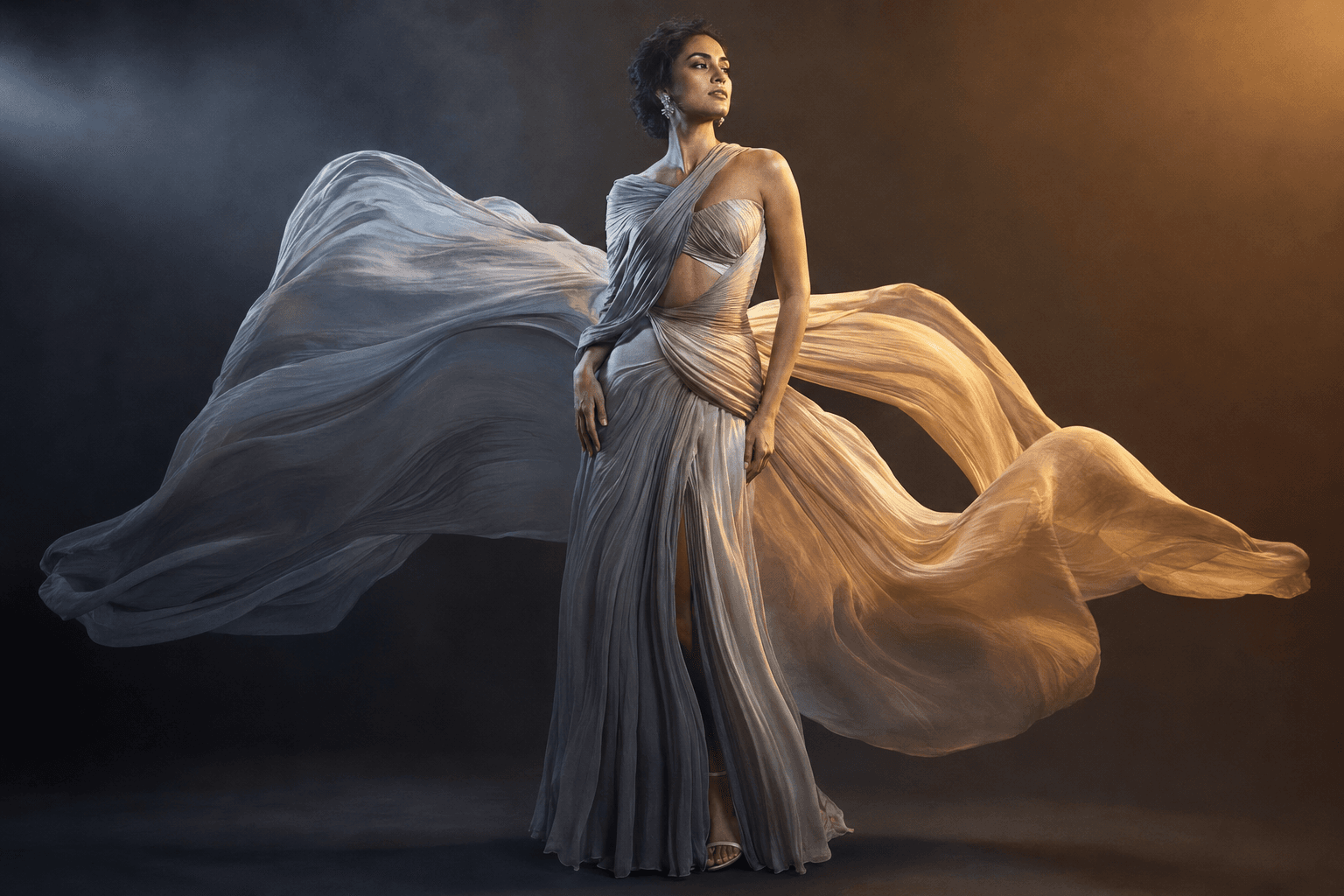
The supplied VJOURNAL cover interprets that principle without copying a runway look. An anonymous adult model stands between cool and warm light while original silver drapery moves across the frame. The garment is a visual metaphor, not a representation of a Gaurav Gupta design. Its wide movement makes the article's argument immediately legible: lunar restraint and solar warmth can inhabit the same composition. Keeping the image independent protects the difference between editorial response and campaign reproduction, while giving readers a tactile entrance into the collection's discussion of motion, balance and light.
From bridal ceremony to menswear structure
Light Song ranges across bridal couture, evening categories and menswear, according to both Hindustan Times and Fortune India. Gupta explains that the core philosophy remains consistent while its expression changes: bridal work leans into ceremony, emotion and surface development, whereas menswear translates the idea through tailoring, textile and structure. This is a useful refusal of the assumption that one theme must produce one silhouette. A collection becomes coherent through relationships among color, material and attitude, not by repeating the same outline on every body. Consistency can be rhythmic rather than literal.
For personal style, the distinction offers a practical way to read runway work. A viewer does not need a couture gown to use its thinking. Lunar restraint might become a charcoal suit with a softly reflective shirt; solar energy might appear as a controlled metallic accessory or warm brocade jacket. Bridal inspiration can be separated from bridal convention by focusing on movement, proportion and meaningful surface detail. The point is not to imitate the show. It is to identify a design principle and translate it at an appropriate scale, allowing ceremony and everyday identity to meet without costume.
A modern house needs narrative discipline
The designer told Hindustan Times that he begins with emotion and narrative, allowing silhouette, embroidery, textile and performance to develop around that foundation. This method explains the collection's breadth, but it also creates a communication challenge. When a house uses cosmology, philosophy and personal feeling, every layer of language must remain precise enough to support the clothes. The strongest presentation gives viewers an entry point without prescribing one correct response. It names the creative architecture, then leaves room for material, movement and individual memory to produce meanings the press notes did not anticipate.
Fashion brands can learn from that balance. A campaign should not force craft to serve as proof of a grand claim; nor should a product page strip a complex garment down to color and price. Editorial images, runway film, close details and atelier context each answer different questions. Used together, they can show both emotion and construction. Used carelessly, they repeat the same mood until the object disappears. Light Song succeeds as a case study because its narrative is visible in sequence and material. The story points toward the garment, then the garment carries the argument.
Conclusion: Gaurav Gupta Light Song after the runway
The verified event is clear: Gaurav Gupta presented a wide couture collection in Mumbai, the house described it through solar and lunar energies, and independent reporting documented its range, craft focus and movement between bridal, occasion and menswear. VJOURNAL's analysis is that its importance lies less in celestial imagery than in how the collection organizes opposites. Cool and warm tones, drape and tailoring, ceremony and modernity are not resolved by erasing their differences. They remain distinct enough to create rhythm, yet connected enough to form a coherent wardrobe and show.
Gaurav Gupta Light Song ultimately offers a calm argument for the future of Indian couture. Cultural rootedness does not require formal nostalgia, and international ambition does not require distance from home. Craft can be technically extravagant while the design idea remains lucid. A client or reader can take the same discipline into personal style: choose one governing relationship, let material carry meaning, and edit every detail until movement looks inevitable. That is the collection's most durable light — not a decorative glow, but a way of seeing structure, emotion and identity as parts of one composition.
Practical checklist
- Read the collection through relationships between color temperature, texture and movement.
- Distinguish the designer's stated solar-lunar narrative from independent editorial interpretation.
- Look beyond labor totals to the placement, balance and physical purpose of craft.
- Translate runway principles into personal style instead of copying a complete couture look.
- Assess how location changes the cultural authority and intended audience of a show.
- Use metallic surfaces selectively so that light supports proportion rather than overwhelming it.
FAQ
What is Gaurav Gupta Light Song?
It is a couture collection presented in Mumbai that explores the relationship between solar and lunar energies across bridal, occasion and menswear looks.
Where and when was the collection presented?
Hindustan Times reports that Gaurav Gupta presented Light Song in Mumbai on July seventeenth, with later coverage and official imagery released online.
Which techniques define the collection?
The designer and independent reporting highlight custom jacquards, metallic brocades, embroidery, layered floral work, sculptural drape and structured tailoring.
Why are solar and lunar ideas important to the show?
They organize the palette and emotional pace, moving from cool reflective tones toward warmer ceremonial color before bringing both directions together.
Does the VJOURNAL cover reproduce a runway look?
No. The supplied cover is an original editorial metaphor using an anonymous adult model, independent styling and contrasting light without copying the collection or campaign.