
Answer in brief
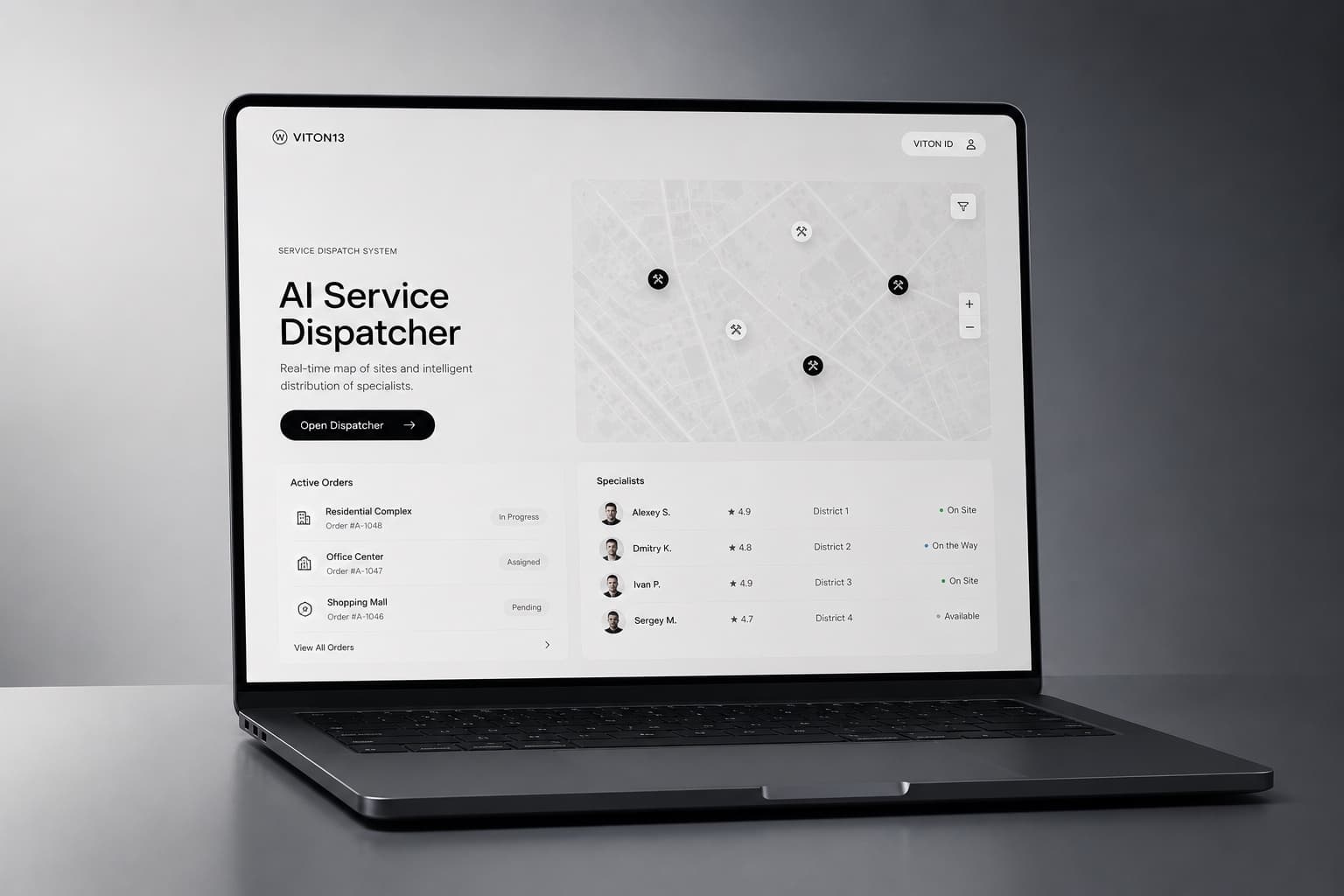
AI Service Dispatcher помогает сервисным организациям принять обращение, оценить срочность, подобрать мастера и сохранить доказуемую историю ремонта.
Dispatching Shapes Service Quality Before the Technician Arrives
Customers judge a service company from the very first contact. If an operator asks repetitive questions, misunderstands urgency, or cannot provide an arrival window, trust diminishes before the repair even begins. Inside the company, dispatchers simultaneously manage the asset map, technician contacts, skills, SLAs, access protocols, and parts availability. As request volume grows, professional memory becomes a centralized coordination system.
Automation of field technician dispatching is not about rendering a nice route on a screen. Its goal is to make quality decisions under constraints: understand the request, assess risk, assign an employee with appropriate clearance, provide context, and notify the client. Errors in any factor can cause repeat visits, SLA breaches, or safety risks, so simply choosing the nearest specialist is insufficient.
AI Service Dispatcher establishes a unified and controlled workflow. It collects requests from phones, emails, forms, and sensors; links them to assets and equipment; suggests priority and executor; then tracks work until confirmed closure. Dispatchers see the logic behind recommendations and intervene in exceptions. AI helps maintain scale while accountability and emergency procedures remain with the organization.
This approach is especially valuable where service is distributed across many sites: engineering departments, climate control equipment, elevators, production lines, security, commercial real estate. Different industries require custom rules, but the structure repeats: signal, context, decision, assignment, dispatch, result, and updated asset history.
A Good Request Contains Asset, Symptom, Impact, and Client Promise
Customer descriptions often sound like “it stopped working” or “please send a technician urgently.” AI Service Dispatcher extracts address, contact, equipment, symptom, time of occurrence, and impact on operations. If a parameter is missing, it asks the next useful question rather than launching a lengthy generic survey. For leaks, zone and intensity matter; for climate systems — temperature and error codes; for access — failure scope and alternatives.
The request card links contract and history. Dispatchers see equipment models, prior repairs, applicable SLA, special access rules, and open tickets. Repeat symptoms may signal unresolved root causes but the system does not auto-diagnose solely by word matches. It shows similar cases, parts used, and outcomes, leaving the technical solution to specialists.
Channels are unified without losing originals. Calls, emails, photos, and telemetry signals remain attachments to one unified ticket. If a client adds info later, the version updates and important changes are highlighted. This prevents situations where a technician departed with minimal info while detailed photos remained with operators in separate chat threads.
Input quality is measured. Companies see which data frequently lacks, which forms cause errors, and how many requests needed follow-up after assignment. These insights improve operator scripts, client portals, and sensor configurations. AI evolves from pure text processing to a tool for progressively enhancing inbound request quality.
Triage and Prioritization Should Follow Regulations, Not Emotional Messages
Clients define urgency differently, but service companies must apply consistent criteria. The system matches symptoms with impact, asset type, contract, and hazard signs. Total failure of critical systems receives one priority; local discomfort another; planned notes yet another. If data is insufficient, requests route to operators rather than being auto-classified confidently.
Emergency signs trigger separate workflows. The product can display safe wait instructions and alert on-call teams but does not replace official procedures or emergency services. Communications text is pre-approved so the AI does not improvise in high-risk situations. All automated messages are logged and can be promptly revoked by responsible staff.
Priority also depends on accumulated risk. Multiple low-grade requests on one component may indicate degradation, and repeat tickets after recent repairs require management attention. AI Service Dispatcher detects links and proposes combined analysis. This shifts focus from symptom firefighting to equipment reliability management.
Dispatchers see an explanation for the assessment: recognized symptom, applied SLA rule, data that increased risk. They may change the class with mandatory rationale. Such adjustments become calibration material. If experienced staff regularly override a rule, the issue lies in the process model rather than worker discipline.
Assigning a Technician Is a Compatibility Problem, Not Just Finding the Nearest Point
An optimal technician must have competencies, certifications, tools, parts, and time. Zone, site schedule, expected job duration, current orders, and promised windows are also considered. AI Service Dispatcher excludes incompatible options, ranks remainder, and explains the selection. Dispatchers can compare scenarios: fastest arrival, highest chance of first-time fix, or minimal disruption to subsequent schedule.
The skills matrix requires an active owner. It records equipment types, complexity levels, certifications, and validity periods. Work history may hint at experience but should not secretly evaluate employees or substitute official qualification. Workers know used data for assignment and can report profile errors.
Parts availability often matters more than distance. If the nearest technician lacks required modules, a fast visit turns into two trips. The system matches probable faults, vehicle kits, warehouses, and part transfers. Where confidence is low, it suggests diagnostic visits with the right equipment rather than promising unjustifiable completions to clients.
Manual reassignment is preserved as a documented decision, not erased from stats. Causes may be technician familiarity, client restrictions, fatigue after complex jobs, or local road events. These factors help improve planning but remain human context. A good system supports dispatchers without forcing battles with formal optimums.
Routes and Arrival Windows Must Stay Realistic When the Day Changes
Static morning routes become obsolete quickly. Urgent requests, site delays, access issues, and traffic jams alter sequences. AI Service Dispatcher recalculates scenarios on significant events and shows consequences: which client gets new windows, which SLAs break, and which technician can accept the task. Replanning is not silent if it impacts promises or labor conditions.
Arrival windows include buffers for work type and local variability. Too precise promises cause more frustration than honest ranges. Upon changes, the system informs clients clearly and offers communication channels. If timing is uncertain, automation should not invent precision; it reports state and next update times.
Geolocation use is proportional to the task. Pilots often suffice with statuses “dispatched,” “on site,” and “completed,” plus service zones. Continuous tracking requires legal foundation, access policies, and employee acknowledgment. Technical feasibility is not automatic permission to maximal data collection.
After the day ends, routes are analyzed not for blame but to improve norms. Planned vs. actual durations, delay reasons, and extra transfers are compared. Regularly longer job types update standards, improving future promises and easing dispatcher and technician pressure.
Diagnostic Tips Are Useful Only with Source and Constraint
Before dispatch, technicians receive a brief: symptom, history, likely causes, checks, and related instructions. Every hint is based on manuals, knowledge bases, or confirmed company cases. Hypotheses without sources are clearly marked. For critical equipment, procedures do not exceed technician’s certifications.
On-site, technicians record facts in a convenient order. Voice notes may turn into structured reports, photo of markings into models and serial numbers, measurements into equipment map fields. Before saving, specialists verify extracted values. Report automation does not replace measuring tools or technician signatures.
Deviations from initial hypotheses send valuable signals. The system stores actual causes, performed work, parts used, and result verification. Later similar tickets receive richer context. The knowledge base grows from confirmed repairs, not endless raw correspondence.
Repeat visits are treated as separate quality events. Causes may be wrong diagnosis, missing parts, incomplete access, or new faults. Classification helps distinguish process defects from objective work continuation. Managers see where in the workflow success probability could improve to achieve first-visit fixes.
Equipment History Turns Reactive Service into Managed Maintenance
Closed tickets update digital asset histories. They record symptom, diagnosis, job, parts used, measurements, photos, and recommendations. Entries link to specific equipment and locations, not just customers. On new requests, dispatchers and technicians gain context instantly without rehashing old repairs.
Accumulated data reveals recurring failures, nodes with rising ticket frequency, and patterns needing special spare stock. AI Service Dispatcher can trigger signals for planned maintenance, but decisions consider cost, criticality, and manufacturer advice. Predictive analytics without enough history is experimental, not authoritative forecasting.
ISO defines facility management as a function linking people, place, and processes; ISO 41001 sets a system approach to delivering services efficiently. For the product, this means requests are inseparable from assets and client objectives. Repair quality measures are function restorations and commitments met, not just ticket closure.
History assists staff changes. Knowledge does not disappear with personal notes of experienced technicians. At the same time, the system restricts access by roles and contracts. Clients see statuses and confirmed reports, technicians see technical contexts, managers get analytics, and sensitive commercial terms remain confidential.
Dispatch Metrics Reflect Quality of Recovery, Not Speed of Closure
Basic metrics include time to acceptance, assignment, arrival, and recovery. These are distinct since different owners control delays. Fast assignments to unqualified techs don’t signify success. Hence, rates of first-time fixes, repeat calls, reschedules, and window changes are tracked simultaneously.
SLA compliance is contextualized by priority and contract. The system shows risks in advance, not just post-fact violations. Managers see causes: lack of free staff, insufficient data, part delays, or denied access. This guides resource models and contractual promises, beyond just speeding up ticket closures.
Customer metrics count contacts for one problem, need to repeat info, and timeliness of updates. Some repairs take physical time, but transparent communication preserves trust. AI Service Dispatcher reduces uncertainty by auto-reporting confirmed statuses and involving operators when reliable answers fail.
Economic calculations factor dispatcher hours recovered, reduced repeat visits, denser scheduling, and avoided SLA breaches. Promising exact savings before auditing is unwise. Variables include volumes, specialist costs, geography, seasonality, and integrations. Pilots demonstrate achievable effects in selected request classes.
Security, Employee Data, and AI Governance Require Separate Frameworks
Service requests often include addresses, phones, access codes, premises photos, and equipment data. Companies classify such info, constrain visibility, and set retention periods. Contractors see only necessary context; clients know what data is used. Exporting entire histories externally without this model poses unacceptable risks.
Employee data demands transparency too. Geolocation, ratings, and assignment histories must not become covert surveillance. Organizations define lawful purposes, minimal data sets, access controls, and correction procedures. Algorithms avoid inference about individuals from unrelated signs irrelevant to safe, quality work.
NIST AI Risk Management Framework advocates lifecycle risk control. For dispatching, this means testing rare emergency wording, monitoring incorrect priorities, logging reassignments, and immediate fallback to manual mode. Models, routes, and skills catalogs evolve; quality control is a continuous product owner responsibility.
Interfaces clearly separate recommendations from orders. Employees see algorithm proposals, confirmers, and used data. This protects clients, technicians, and companies. Trust arises not from smart claims but from the ability to verify decisions and promptly fix them before harm.
AI Service Dispatcher Pilot Starts with a Narrow Request Category
For the first cycle, select a frequent and sufficiently clear request type: for example, climate equipment within a family or planned work in commercial properties. Historical tickets, actual assignments, timelines, and results are gathered. Experts create reference samples and outline cases requiring special qualifications or manual escalation.
In shadow mode, the system classifies new requests and suggests executors alongside human dispatchers. Not mere matches but arguments and outcomes are compared. Divergences are logged with reasons: missing data, skill matrix errors, SLA rules, or human context. This improves the process before enabling auto notifications.
After thresholds, the product prepares assignments confirmed by dispatchers. Then client messages and mobile reporting are integrated. Each new feature has metrics and rollback paths. The pilot excludes emergencies until normal flow proves reliable and staff learn system limits.
Upon completion, companies gain scale decisions, integration maps, and operational support models. If effects fall short, reasons emerge: insufficient volume, lack of data, weak parts linkage, or excessive variability. Such insights protect budgets and guide realistic improvement priorities.
Next Step for Service Companies — Audit One Complete Cycle
AI Service Dispatcher suits organizations with multiple dispatchers and field staff operating by repeatable rules, where quality depends on rapid context transfer. It is especially useful with many sites, skill matrices, contract SLAs, and repeated repairs. Small teams can start if coordination already burdens technical leaders.
Do not try optimizing entire fleets or all work types at once. Choose one full cycle from request to confirmed fix, measure it, and track each manual intervention. Assess availability of equipment, skills, and parts data. This map shows which features yield effects and which yield confident but weak recommendations.
VITON13 performs operational audits, designs data models, and limited pilots with human oversight. The product connects to existing channels and systems just enough to validate hypotheses. After measurement, companies decide on expanding zones, types, and automation.
The ultimate value is not dispatcher elimination. On the contrary, their professional attention focuses on complex cases while the system handles facts, rules, routines. Clients get predictable service, technicians receive prepared dispatches, and managers obtain objective pictures of where processes perform well and where improvements are needed.
Practical checklist
- Classify requests into emergency, urgent, and planned according to company regulations.
- Create a skills, access, territory, and schedule matrix for field technicians.
- Link typical faults with mandatory questions, tools, and spare parts.
- Measure current response, arrival, recovery times and frequency of repeat visits.
- Document escalation rules and cases where automatic assignment is forbidden.
- Conduct a shadow mode pilot and compare recommendations with decisions from experienced dispatchers.
Questions and answers
Can the system itself determine the cause of a malfunction?
It can generate probable hypotheses based on descriptions, telemetry, and equipment history, but the final diagnosis must be confirmed by a qualified specialist. Critical recommendations should refer to data and regulations.
How does AI Service Dispatcher select a technician?
The algorithm considers competencies, certifications, current workload, territory, time window promised to the client, needed parts, and expected duration. The company sets weights and mandatory constraints, and the dispatcher can view the rationale behind the recommendation.
Does the product function without GPS tracking of employees?
Yes. For the initial pilot, assigned zones, scheduled addresses, and work statuses can be used. Geolocation is enabled only when there is a legal basis, clear policy, and genuine operational need.
Is it possible to automate client notifications?
Yes, confirmations, arrival windows, and status changes can be sent per approved rules. When timing is uncertain or during emergencies, communication must be cautious and allow quick human intervention.
How do you know if a dispatch pilot is successful?
Compare assignment time, SLA compliance, share of first-visit solutions, mileage, downtime, and manual reassignments while ensuring safety and repair quality.