
Answer in brief
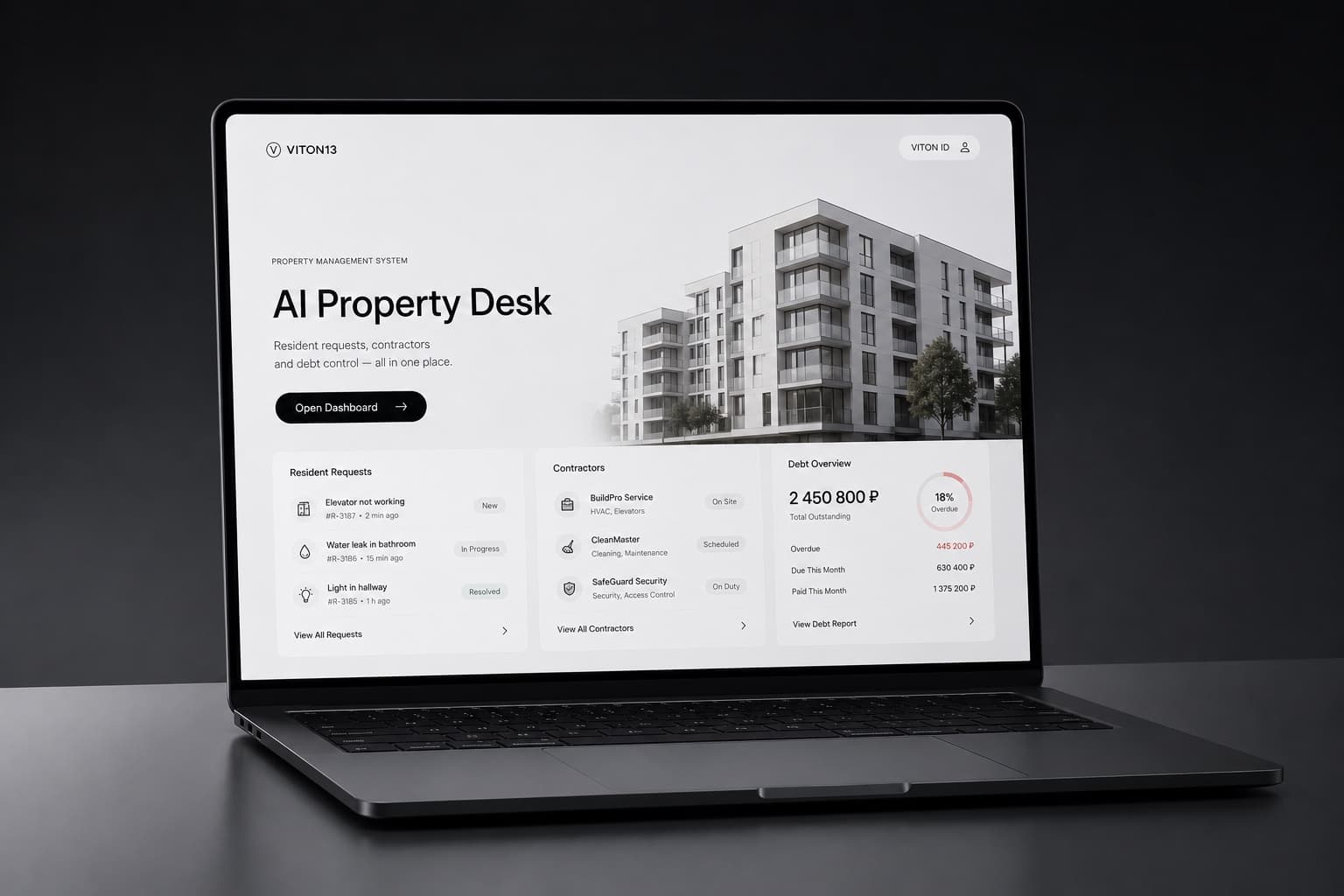
AI Property Desk формирует единый контур для обращений жителей, работ подрядчиков, отчётности и коммуникации по задолженности в управлении недвижимостью.
Property management starts with trust in commitments, not the number of channels
Residents can contact the company via app, messenger, email, phone dispatcher, or in person. While many channels create an impression of availability, they don't guarantee manageability. One problem may receive multiple tickets, clarifications happen in separate chats, the performer may not see a photo, and the resident repeats their story to each new participant. Dissatisfaction arises not only from the malfunction but also from the lack of a unified memory.
Automation of resident requests in property management should begin with a common operational loop. AI Property Desk accepts messages, identifies the property and category, detects possible duplicates, assigns an owner, and links the work to a contractor or internal service. Residents get confirmed status, staff gain full context, and managers receive an overview of deadlines and recurring reasons.
AI here does not replace property management responsibilities nor make legally binding decisions. It accelerates parsing of unstructured messages, helps find history, and prepares communication following approved rules. Emergency signals, conflicts, disputes about charges, or personal situations are forwarded to a human. The clearer the boundaries are set, the higher the trust in the product and the lower the risk of automated injustice.
VITON13 markets AI Property Desk as an industry solution for property managers and real estate operators. It connects the resident, property, equipment, performer, document, and financial record. Such design allows handling daily requests while accumulating verified data for prevention, reporting, and planning.
A unified request ticket eliminates repeated information
The system extracts from messages the address, premises, contact, description, time, photo, and preferred contact method. If the resident writes through an authorized account, some fields are pre-known; if calling, the operator confirms them during conversation. The original message is saved so staff can check context and are not reliant on paraphrasing by the model.
Classification relies on the building structure and contracts. A leak in an apartment, main pipe, or basement can have different workflows, so one keyword is insufficient. AI Property Desk links the request to a responsible area, equipment, and ongoing work. If uncertain, it asks a brief clarifying question or sends the ticket to a dispatcher.
Duplicates are suggested by the system. Multiple residents reporting an elevator outage or water loss are grouped under a common incident, keeping each resident for notifications. Operators confirm the linkage. This reduces workload and enables centralized communication but does not merge different problems just because they occurred in the same entrance.
The ticket contains a commitment: next update deadline, assigned performer, and current stage. If exact repair time is unknown, the resident is informed of the time for the next update, not a fabricated date. Predictable communication reduces repeated calls and builds trust even when physical repair takes time.
Request priority is based on impact, safety, and obligation
Emotional wording doesn’t always reflect technical risk but should not be ignored. The system matches descriptions with emergency signs, impact scale, and property specifics. Safety threats or damage receive immediate routing, critical function failures are high priority, and domestic remarks are planned. Uncertain cases go to a dispatcher.
Rules must align with applicable requirements, contracts, and internal regulations. AI Property Desk shows which rule triggered and the deadline used. Employees can raise priority specifying reason. Automatic downgrading of critical class without verification is prohibited since missed risk costs outweigh queue reduction benefits.
Related signals improve assessment quality. A series of requests, sensor data, and unresolved contractor tasks can indicate a common incident. The system presents these links and suggests creating a coordination case. This helps managers see not just a list of complaints but the overall state of the building and impact on residents.
The resident does not necessarily see an internal priority code. They get clear actions: registered, sent to emergency service, scheduled for inspection, or included in the plan. The language avoids technical promises not yet confirmed. Communication becomes part of operations, not a separate call center function.
Contractors must receive precise tasks and return verifiable outcomes
External performers get a limited packet: location, description, access contact, deadline, safety requirements, and completion criteria. They do not see the resident's entire history or financial data unless necessary. Assignments have versions, so later clarifications aren’t lost in correspondence, and scope changes require approval.
Each work type has proof requirements: before-and-after photos, measurements, material lists, acts, or signatures. AI assists in verifying completeness and recognizing fields but does not approve work solely on image presence. Responsible staff evaluate quality and contract compliance, especially for hidden or critical work.
If contractors find additional problems, they create change requests with reasons and impacts on cost or timing. AI Property Desk links these to the original request and sends them to authorized staff. Work does not expand secretly. Upon approval, residents get permissible updates, and budgets and reports hold unified history.
Contractor ratings rely on transparent operational metrics: deadline compliance, proof completeness, returns, and recurring requests. It should not be an automatic decision without assessing complexity. Managers compare contractors on similar work types and see causes of deviations.
Reporting becomes a natural byproduct of properly collected work
Many organizations create reports after the fact, gathering data from logs, tables, and emails. AI Property Desk builds reports from process events. It shows counts of requests by property and category, response times, unfinished work, expenses, and confirmations. Each figure links back to source tickets, ensuring verifiability.
For owners and residents, not all internal analytics are helpful, but a clear picture is: what happened, what was done, planned work, and why. The product drafts human-language reports excluding personal and commercially sensitive data. Responsible staff approve publications and explain deviations rather than just showing closure percentages.
Regular request categories become management signals. Repeated leaks, access failures, or cleaning complaints link to equipment, zones, and contractors. The system helps identify where patch repairs don’t address root causes and lays grounds for scheduled work or contract renewal.
ISO’s facility management approach unites people, place, and process for life quality and productivity. For property managers, reporting shouldn’t be separate from resident outcomes. A beautiful dashboard is useless if the resident repeats the problem and doesn’t understand the status.
Debt management demands data accuracy and respectful communication
The financial component starts with source verification. Charges, payments, recalculations, benefits, and disputes must have dates and status. The system does not send messages based on outdated data or link people on approximate matches. Before communication, AI Property Desk checks conditions and shows discrepancies to staff.
AI can prepare clear notices, explain sum structures, and suggest authorized communication channels. Tone stays neutral, without pressure or assumptions about reasons for nonpayment. If the resident contests charges, the case transfers to a human specialist, and automated sequences pause until resolution.
Segmentation is based on operational debt status, not hidden personality judgments. New charges, technical errors, agreed schedules, and long-term debts require different processes. Any legal-impact decisions are made by authorized staff per applicable rules.
Metrics include not only receipts but mistaken notifications, dispute resolution times, and repeat contacts. Aggressive automation can temporarily spike activity while damaging trust. Thus financial effects are evaluated alongside data quality and complaints.
Property data form a basis for prevention but don't replace engineering fixes
Every confirmed work updates the history of elements: elevator, pump, door, riser, or common area. Events include symptom, cause, action, materials, and outcome. Over time, frequency, cost, and intervals emerge, aiding inspection and budgeting without waiting for complaints.
AI Property Desk can detect changes in request frequency or link complaints to sensor data. Such signals prompt checks but don’t substitute diagnoses. Engineers assess conditions and decide on repair or replacement. The system helps gather evidence and model scenarios.
Stable identifiers are crucial for portfolios. If one piece of equipment has varied names across estimates, requests, and acts, the history fragments. Pilots often start with normalizing structure: property, building, entrance, room, system, and equipment unit. This background work prevents analytics from conflating different entities.
Prevention impact is measured by reduced emergencies, repeat work, and unplanned costs, though it takes time. Initial pilots don't promise full prediction but demonstrate that events are gathered correctly, enabling earlier risk detection for selected properties.
Resident privacy and access control are designed before launch
Requests may include address, phone, apartment images, health, and conflict data. The company decides which data are truly needed, who sees them, and when they are deleted. Contractors do not get unnecessary correspondence. Anonymized or specially prepared data sets are used for training and testing unless justified otherwise.
Residents should understand automation status and have human contact paths. If a system-generated answer follows an approved script, it should not create the false impression of personal review. For complaints, disputes, or sensitive situations, human access is part of service quality, not a digital process exception.
NIST AI Risk Management Framework supports continuous control: defining context and potential harm, measuring errors, tracking incidents, and managing changes. For Property Desk, critical risks are missed emergencies, wrong merging of requests, data leaks, and incorrect financial communication. Each risk requires an owner and stop scenarios.
Access is role-based. Dispatchers see requests, technicians see equipment, finance staff see charges, contractors see tasks, and managers see aggregated views. Combination occurs only where needed to solve problems. This architecture reduces risks while simplifying interfaces.
AI Property Desk economics derive from eliminated repetition
Before pilot launch, measure times for registration, classification, history search, assignment, and report preparation. Count repeat contacts, duplicates, contractor delays, and tickets closed without sufficient evidence. These metrics reveal administrative burdens and gaps where lack of context spawns extra work.
After launching, compare time to first substantive response, share of automatic routing, manual fixes, deadline compliance, and resident satisfaction. Balance matters: quick ticket closure is no improvement if residents call again. The key metric is confirmed resolution and clear communication.
Financial impact includes reclaimed dispatcher hours, fewer repeat visits, contractor work control, and timely systemic problem detection. The model considers integrations, object structure clean-up, training, and support. Effects vary by building; the calculator defines scenarios and audits verify volumes.
Managers gain added value: the ability to scale portfolios without losing transparency. When processes, roles, and evidence unify, new properties connect through configured structures, not informal staff memory. This is not instant saving but a crucial asset for real estate operators.
A pilot on one building demonstrates process quality without portfolio risk
Select initial properties with sufficient request flow and team readiness. Include several common categories but avoid automating emergencies, financial disputes, and all contractor processes immediately. Collect history, describe rules, and create a standard sample of experienced dispatcher decisions.
In shadow mode, the system classifies and merges requests alongside current workflows. Teams check errors and adjust building structure. Then AI Property Desk begins drafting responses and tasks confirmed by staff. Every step has metrics and fallback to manual processes.
Contractors join after intake stabilizes. Simple mobile workflows and proof requirements are designed for them. Test edge cases: no access, scope changes, material shortages, resident disagreement with closure. The system preserves history and flags exceptions to owners.
Outcomes inform decisions about broader rollout and finance modules. Successful pilots have owners, regular quality control, and support budgets. Lack of results produces maps of data and process gaps rather than scaling ineffective demonstrations.
Practical start: trace a single request to outcome through the resident’s eyes
AI Property Desk suits property management firms, developer operators, rental buildings, and commercial real estate services. Key readiness marker is a recurring request stream and the ability to assign data, service, and contractor owners. Portfolio size is less important than willingness to test solutions on real cases.
Begin with simple observation. Take ten requests and track their journey: how many times residents repeated information, priority changes, who saw photos, on what basis work closed. Simultaneously measure staff hours. This diagnosis usually reveals bottlenecks suitable for limited product pilots.
VITON13 designs the system around existing company responsibilities. Audits identify channels, property structures, rules, and integrations. Pilots connect only necessary elements and retain human confirmation. After impact measurement, next features are chosen: contractors, reporting, prevention, or financial communication.
A helpful result feels calm: residents understand what's happening; dispatchers handle exceptions; contractors receive precise tasks; managers see causes, deadlines, and evidence. AI is not an obscure new player but supports a unified process where promises are verifiable from first message to actual outcome.
Before scaling, conduct joint reviews with dispatch, technical, finance, and customer service teams. The same status may mean different things to each. Shared definitions, visible exceptions, and assigned owners transform local automation into a sustainable management system—not a separate digital channel that reverts to manual handling after months.
Practical checklist
- Collect resident requests from all channels and detect duplicates relating to the same issue.
- Record emergency signs, regulatory deadlines, contractual obligations, and escalation rules.
- Link entrances, premises, equipment, and contracts with stable identifiers.
- Set photo, act, and confirmation requirements for every type of contractor work.
- Verify sources and update frequency of charges and payments data.
- Measure first response time, repeat contacts, overdue tasks, and proportion of requests with confirmed resolution.
Questions and answers
Can AI Property Desk automatically respond to residents?
Yes, it can automatically confirm registration, provide status updates, and deliver standard instructions per approved scenarios. Emergency, conflictual, or legally significant situations are escalated to staff, and the system does not invent deadlines.
How does the system consolidate repeated requests about the same problem?
It compares property, location, time, category, and description, then suggests linking to an existing incident. An operator confirms the merge to avoid combining distinct issues under one ticket.
Is it possible to monitor external contractors through the product?
Contractors receive limited access to assignment details, deadlines, and confirmation requirements. Commercial and personal data are shared only as necessary, and approval of completed work remains with the property management company.
Does AI assist in debt collection?
The product verifies data, segments permissible communication scenarios, and drafts messages. Decisions with legal impact are made by humans according to applicable policies.
Where is the best place to start implementing this in a property management company?
Usually, start with one building and two to three common request categories where deadlines, performers, and proof of completion are clear. This allows testing processes without risking the entire portfolio.