
Answer in brief
Filming is in none of the five VITON13 packages, so the day is yours to arrange. This is an hour-by-hour account of how a shoot runs and a plain list of what the client supplies: access, samples, people who can approve, and a clean handoff to the edit.
What a shoot day is, hour by hour
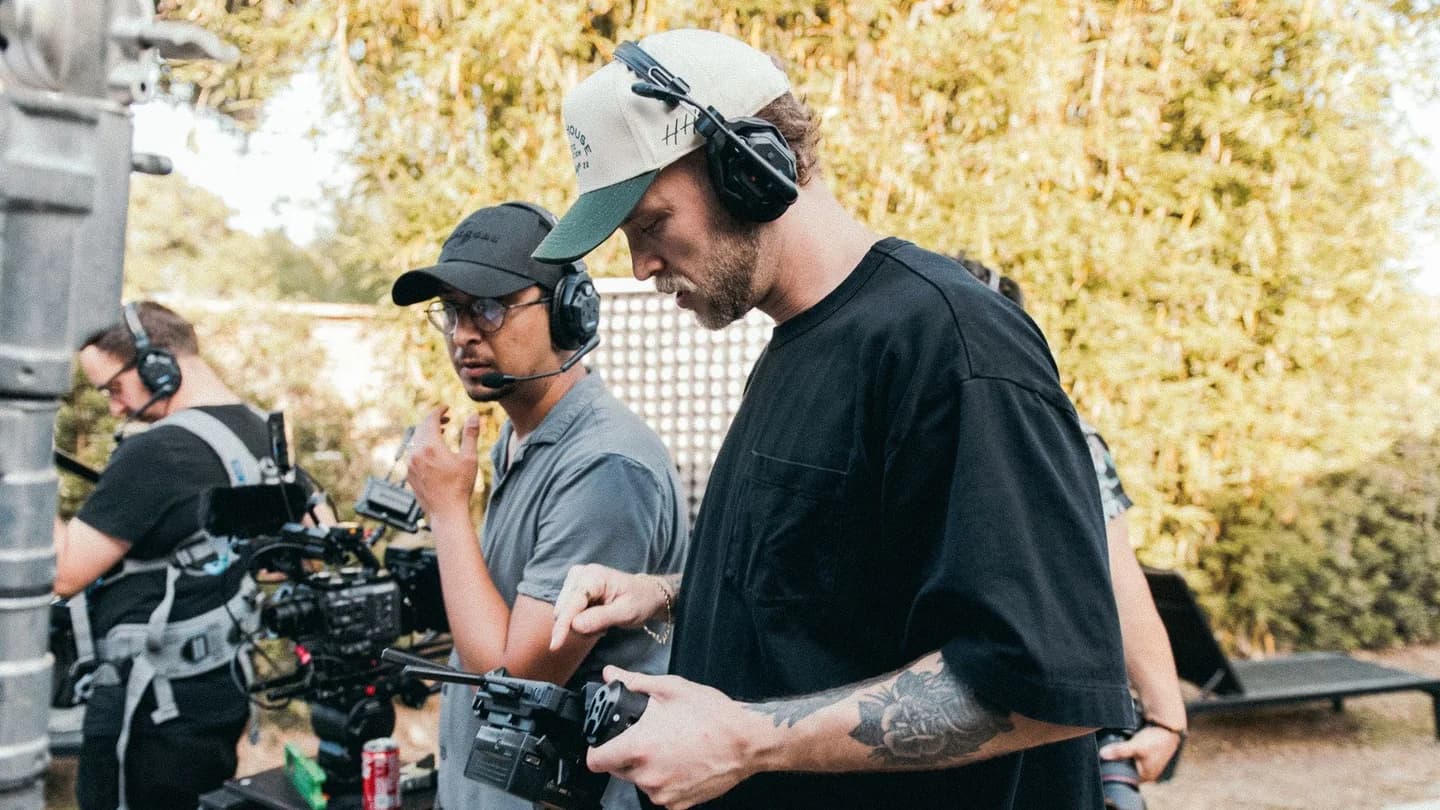
A shoot day is one continuous block of hours in which every frame for a run of videos gets captured. It breaks into four stretches: getting in and loading, setting light and sound, the priority shots before the break, and coverage after it. Everything else is preparation before and editing after.
The hour is a working unit here, not a figure of speech. Every location change, every lighting move and every product reset eats time that will not exist at six in the evening. That is why the day opens with a shot list rather than with a camera, and the list decides what gets filmed first.
Three things belong to the client, and without them the crew stands still: physical access to the space during the agreed hours, product samples in sellable condition, and one person who can approve a frame on the spot. None of the three can be solved by phone mid-shoot.
VITON13 sits after the camera in this chain. We turn the footage you deliver into finished cuts: editing, captions and exports for vertical placements. The package terms and timelines live on /services/video-production, and they are worth reading before you commit to a date.
Why no VITON13 package includes filming
Say it plainly: filming is in none of the five packages. Single Reel at $70 does not include shooting, scripting or actors. Reels Pack at $90 does not include filming — you supply the footage. Monthly Content Engine at $290/mo does not include filming days and paid stock.
Campaign Edit at $180 does not include licensed music; that licence is purchased by you. Reels Pack Express at $150 does not include shooting, or licensing beyond the supplied track. The exclusions differ from package to package, so read the line that belongs to yours rather than assuming.
The practical consequence is simple. You arrange the day — yourself, with your own team, or through a separate camera operator. Our work begins where files already exist. That is not a limitation for its own sake: a shooting crew and an edit suite are different production cycles carrying different liabilities.
Hence the shape of this article. What follows is an hour-by-hour account of a shoot day, written not to turn you into a director but to tell you what to agree with whoever holds the camera, and what has to arrive in the edit at the end of it.
07:00–09:00: access to the location and load-in
The day starts at a door, not at a camera. Somebody has to let the crew in, point at the sockets, explain where noise is tolerated, and name the hour after which the room is spoken for. In a retail space, the question of pre-opening hours is settled a week out, not that morning.
Loading the gear in takes longer than it looks from outside. Tripods, lights, stands and cases have to come up, be unpacked and be laid out without blocking the walkways. Lifts, parking and building security can hold the start back by an hour when nobody arranged them in advance.
Check the electricity separately. Lighting units draw real current, and old wiring in an office or a showroom may not carry it. The question of how many sockets there are and on which circuits sounds dull right up to the moment a breaker trips in the middle of a take.
By nine the space should be clear of everything that does not belong: stray boxes, a competitor's signage, staff coats and lunches. Clearing it is the client's job, done before the crew arrives, because tidying a frame during the working hours of the day is paid for in hours of the day.
09:00–10:30: light, sound and the first blocking
The first ninety minutes go into setup. Light is built for a specific frame rather than for the room: direction, softness, background, and no glare across packaging. Every later change of angle will need adjusting, which is why the first position is chosen more slowly than the ones that follow.
Sound is checked on its own, even when the video is planned without speech. Air conditioning, a fridge, ventilation and building work behind the wall all land on the track and fight the edit later. Switching the ventilation off for two hours is the client's decision, not the operator's.
Framing is settled here too. If the footage is heading for vertical feeds, the composition is built vertical from the start: subject centred, air above and below, nothing important against the edges. Recropping a wide frame into a vertical one does not always survive the loss.
Ninety minutes of setup looks expensive until you price a reshoot against it. Light placed calmly once holds all day; light placed in a hurry gets repaired in the grade instead, and Campaign Edit carries one round of revisions on the grade rather than an open-ended fix.
10:30–13:00: the priority shots go first
The middle stretch belongs to the frames without which there is no video at all. The reasoning is direct: the crew is fresh, the light already stands, and there is still slack in the schedule. If the afternoon collapses, you are left holding the essentials rather than a pile of cutaways.
The shot list is written before the day and printed on paper. It states what is being filmed, from which angle, how many takes, and what has to appear in frame. A verbal understanding that the product should be a bit bigger turns into a twenty-minute argument on set.
Takes are counted out loud. Three or four passes at the same action give the editor a choice of pace and a clean movement to cut on; a single take removes that choice completely. This is not perfectionism — a cut needs material it can genuinely be assembled from.
Before the break it pays to review the footage on a proper screen rather than on the camera display. A soft focus, a tripod reflected in the shop window, dust across the packaging: all of it is visible on a monitor and none of it is visible on a three-inch panel.
Product samples: what to bring to the set
Samples come from the client, and preparing them is a task in itself. The product has to be in the condition a buyer will see: no price stickers, no warehouse labels, no dented box. A camera resolves detail that the eye walks straight past in a shop.
Bring more than one of each item. Cosmetics run out, fabric creases, food loses its look within half an hour under lights, and packaging gets opened for the shot that shows it opening. A second and third unit is insurance against the day stopping, not extravagance.
Prepare everything that will sit beside the product in frame as well: branded bags, tags, documents, backdrops. If the brand has rules about colour and the mark, bring them to the set in print, otherwise they get remembered during the revision round instead of before it.
Settle the legal side in advance. Third-party logos, music playing in the room, recognisable interiors and the faces of passers-by are all decided before the camera rolls. Removing them in the edit is not always possible, and covering half the frame with a blur is a poor answer.
People: who has to be there and who approves
The day needs one person on the client's side who can say yes and no with finality. Not an observer and not an assistant, but somebody whose decision will not be overturned that evening. Otherwise the day ends with footage that nobody is willing to sign off.
Approval by message thread in the middle of a shoot does not work. While the frame stands, the lights burn and people wait, the sentence about checking with the director costs real money. It is easier to agree the boundaries up front: what gets settled on set, and what genuinely warrants a pause.
If staff appear on camera, tell them beforehand and take written consent for filming and for use. The same applies to customers who wander into frame in a retail space. The subject deserves its own conversation, but the minimum is consent before, not after.
It helps to name a second person as well, the one who handles logistics: keys, water, access to the stockroom, contact with building security. The role looks clerical, and it is precisely the one that keeps the schedule intact when something goes sideways.
13:00–14:00: the break is part of the schedule
The break goes into the plan rather than being left to chance. A crew working eight hours without a pause shoots worse by the evening, and it shows in the footage: soft movement, missed focus, props left where they do not belong.
An hour of pause is useful for more than food. Batteries get recharged, memory cards get copied to a second drive, somebody confirms the sound actually recorded, and the shot list gets revised against what the morning genuinely produced rather than what it promised.
Copying the cards is not a formality. While the footage exists in one place only, the entire day hangs on a single card. The second copy happens at lunch and the third in the evening; both are cheaper than booking the space and the crew again.
It is also a sensible point for an honest conversation about the schedule. Half the list done by lunch means the other half has to shrink. Deciding what gets cut is the client's call, and it lands better at one in the afternoon than at six.
14:00–17:00: b-roll and vertical placements
The afternoon goes to coverage: details, hands, textures, walk-throughs and short camera moves. In the edit these carry the cuts and hold the pace. Without them a video falls apart into static frames with nothing to put between them.
If the footage is heading into vertical feeds, some shots are filmed vertically on purpose rather than cropped out of a wide frame. Single Reel includes exports for every vertical placement, but an export can only work with what was captured: the centre of the frame weighs more than its edges.
Leave margin at the edges. Platform interfaces cover the top and the bottom of the frame, and captions live in the lower third. A composition where the product runs right into the edge reads as cropped as soon as the interface sits on top of it.
Shoot with different durations in mind here too. The same action, captured with a little run-up and a little run-out, lets an editor build both a short cut and a longer one, and Campaign Edit is exactly a hero cut plus short derivatives.
17:00–18:00: wrap and handoff — containers and codecs
The day ends with a file transfer, not with the lights going off. It helps to separate container from codec: MP4 or MOV is a container, a wrapper holding video, audio and metadata tracks; the codec is what those tracks are encoded with inside it.
The practical point is that an identical file extension does not guarantee identical contents. The MDN guide to media container formats sets out which containers admit which tracks, and why compatibility is checked as a container-plus-codec pair rather than by the extension alone.
Agree in advance how the footage will arrive: whole camera originals or selected takes, audio as a separate track or already mixed, with a logarithmic colour profile or without one. Transcoding for convenience on the shooting side eats the latitude a grade needs later.
And confirm the copy finished before the crew drives away. Counting the files and opening a few at random costs five minutes on set, against a separate trip to collect a memory card two days later.
Captions and accessibility: what the shoot decides
Accessibility starts on set rather than in the edit. A line recorded over an air-conditioning hum cannot be rescued by captions, and a subject placed against a window turns into a silhouette whose lips nobody can read.
WCAG 2.2 asks for captions on prerecorded video with audio at Level A, and audio description at Level AA. This is a criterion rather than a matter of taste: a video sitting on your own website falls under the same requirements as the rest of the page around it.
Another criterion covers autoplay: when sound starts by itself and runs longer than three seconds, the user needs a way to stop it or to control the volume. Running videos muted with captions is the calmer path through that requirement.
Single Reel already includes captions and a licensed track. But the caption text has to fit somewhere: keep the lower third of the frame clear on the day itself, and avoid putting product detail there that the viewer needs to see.
After the shoot: what goes to the edit and on what timeline
The edit comes next, and its clock starts from footage delivery rather than from the shoot date. Reels Pack at $90 covers up to 5 edits, in 1-2 working days from footage delivery, with 2 rounds on the edit.
When the calendar is tight there is Reels Pack Express at $150: 1 working day, a 24-hour turnaround from footage, 1 round of revisions. It excludes shooting, and licensing beyond the supplied track, so the rights to any other music stay yours to clear.
Single Reel at $70 is one cut in 1-2 working days with 1 round, carrying captions, a licensed track and exports for every vertical placement. Campaign Edit at $180 runs 3-5 days and gives you 2 rounds on the cut and 1 on the grade.
Where shoot days repeat, Monthly Content Engine at $290/mo runs on a monthly cycle, with the volume agreed at the start of each cycle and 30 days notice to stop. Filming days and paid stock are not included. The package terms sit on /services/video-production.
Practical checklist
- Agree the access hours and building security arrangements a week before the day.
- Check how many sockets exist and what load the circuits carry before the lights arrive.
- Bring two or three units of every sample in sellable condition.
- Name one person who can approve a frame on set with finality.
- Keep the lower third of the frame clear for captions and platform interface.
- Copy the memory cards to a second drive before the crew leaves.
Questions and answers
Does any VITON13 package include filming?
No. Filming is in none of the five packages. Single Reel does not include shooting, scripting or actors; Reels Pack does not include filming, since you supply the footage; Monthly Content Engine does not include filming days and paid stock. You arrange the shoot, and we work from the footage.
What does the editing cost after a shoot day?
Single Reel is $70 for one cut in 1-2 working days with 1 round of revisions. Reels Pack is $90 for up to 5 edits, 1-2 working days from footage delivery, with 2 rounds on the edit. Campaign Edit is $180, runs 3-5 days, and carries 2 rounds on the cut and 1 on the grade.
What if the videos are needed the next day?
Reels Pack Express is $150: 1 working day, a 24-hour turnaround from footage, 1 round of revisions. It excludes shooting, and licensing beyond the supplied track, so the rights to any other music remain yours to clear before delivery.
Who has to be on set from the client's side?
One person who can approve a frame with finality, and where possible a second who handles logistics: keys, stockroom access, contact with building security. Approval by message thread mid-shoot stops the work and spends hours you have already paid for.
How should the footage be handed over to the edit?
Agree the container and the codec in advance. MP4 and MOV are containers holding video, audio and metadata tracks, while the codec is what those tracks are encoded with. Compatibility is checked as a container-plus-codec pair, and transcoding on the shooting side reduces the latitude available in the grade.