
Answer in brief
Mbappé’s diagonal runs are not dangerous because of speed alone. They combine blind-side timing, defender handoffs, passing angles and elite finishing into a problem that starts before the sprint.
The run attacks a relationship, not an empty patch
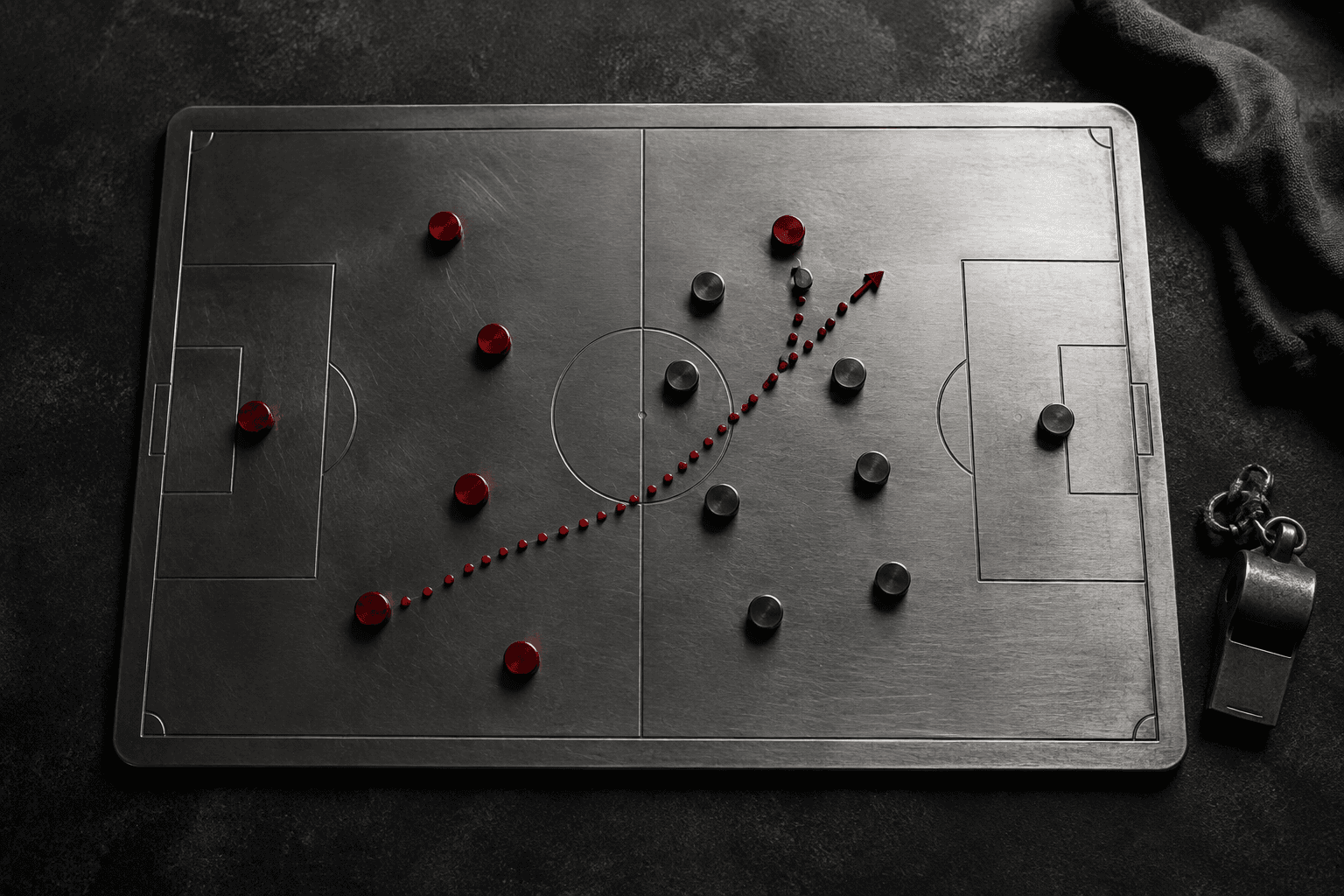
The difficult part of Kylian Mbappé’s diagonal run is not simply that he is fast. The movement attacks the relationship between two defenders. Starting from a wide or half-space position, he can curve or angle inward behind a full-back while moving toward the centre-back’s blind side. The defending pair must decide who tracks, who protects depth and who holds the line. That decision happens while the passer is also changing the angle of the ball, which compresses the time available to communicate.
FIFA’s technical analysis of inner-channel and in-behind movements describes the same structural problem: runs between the widest defender and the centre-back can exploit a seam, while out-to-in movement can attack the space behind a back line from a less visible starting point. Mbappé is especially dangerous in that geometry because the run ends in central scoring territory. The defender is not merely racing him toward the corner; the defender is trying to prevent an elite finisher from arriving behind the line with the goal opening in front of him.
Speed magnifies a timing problem
At elite level, defenders are already fast. The advantage comes from the attacker choosing when the race begins. Mbappé can remain relatively quiet, watch the passer’s body position and accelerate as the defensive line is stepping, turning or shifting laterally. A defender who reacts after the first explosive steps may be physically quick enough to recover some ground but still lose the critical lane. The diagonal path also means the defender often has to turn hips while the attacker is already moving toward goal.
This is a biomechanics problem as much as a tactical one. Sprint acceleration rewards force applied in the intended direction; a defender who must first decelerate, rotate and then accelerate has added mechanical tasks before the chase begins. The attacker’s curved approach can preserve options for staying onside while setting up a straighter final sprint. None of that makes Mbappé undefendable, but it explains why raw top-speed comparisons are incomplete. The relevant contest starts before both players are running at maximum velocity.
The passing lane and the running lane cross
A diagonal run is powerful because it can pair one type of movement with another type of ball. FIFA analysis notes that diagonal movements behind a line can be served by relatively straight passes, a combination that can make the runner harder to monitor. From the defender’s viewpoint, the eyes want to track both the ball and the attacker, but those references sit in different directions. Looking toward the passer can put the runner on the blind side; opening toward the runner can expose the defender to the ball arriving through the line.
For Mbappé, that crossing geometry creates multiple delivery options. A midfielder can slide a vertical pass into the channel, a wide player can play inside, or a deeper teammate can release the run over or through the line. The same initial movement can also create space without receiving the ball. If the centre-back follows, a central lane may open for a teammate; if the defender holds, Mbappé may continue into the gap. The run is therefore not valuable only when the final pass reaches him.
The threat is backed by elite end product
The defensive fear is rational because the movement belongs to a player who has converted huge volumes of high-level chances. Real Madrid’s official record shows Mbappé won the 2025/26 Pichichi with 25 league goals in 31 matches. UEFA recorded 15 goals in 11 Champions League appearances that season, including a record 13 in the league phase. Those numbers do not tell us which goals came from diagonal runs, but they establish the finishing consequence defenders must price into every depth decision.
UEFA’s broader Champions League record also shows how mature his scoring profile has become. By June 2026 he had reached 70 competition goals in 98 appearances, with the large majority scored with his right foot. The tactical implication is straightforward: allowing him a central or inside-right finishing lane is not a neutral concession. Defenders may therefore retreat earlier or narrow more aggressively than they would against a less productive runner. That anticipatory respect can create space elsewhere even before the decisive sprint occurs.
Starting wide creates an inside advantage
Mbappé does not need to begin as a classic centre-forward to attack the most valuable central spaces. A wider starting position can pull the opposing full-back outward and create a longer seam between full-back and centre-back. When he then moves infield, the centre-back sees him arriving from the side rather than standing directly in front. FIFA’s movement-to-receive framework classifies this kind of out-to-in movement as a way to attack space behind while changing the defender’s visual reference.
The left-sided start has another advantage for a right-footed finisher: the run can end with the body oriented toward the far side of goal. But the movement is not mechanically tied to one flank or one finishing pattern. Mbappé can run across the centre-back, stay outside and go beyond, or delay and receive between lines. The uncertainty matters. If every wide start produced the same diagonal sprint, defenders could pre-program the response. His threat is stronger because the diagonal run is one branch in a larger movement tree.
Teammate movement makes the seam bigger
The best diagonal run is rarely an isolated sprint. It is coordinated with a teammate who pins, vacates or distracts a defender. A central forward can occupy one centre-back, a winger can hold width, and a midfielder can approach the ball in a way that forces the back line to step. FIFA’s analysis of elite attacking patterns repeatedly emphasizes coordinated movements and counter-movements: one player’s action changes the space available to another.
That is why the same Mbappé run can look easier in one phase and impossible in another. If a teammate already occupies the full-back, the wide defender cannot simply pass the runner inside without consequence. If a central attacker pins the near centre-back, that defender may be reluctant to travel into the channel. The attacking team is trying to create a moment when every defender has a plausible reason not to follow. The runner then accelerates through the ambiguity before the line can redistribute responsibility.
Offside control becomes a precision contest
Holding a high line is one of the strongest ways to compress Mbappé’s space, but it creates a timing contest measured in fractions of a second. The attacker must coordinate acceleration with the passer’s release; the defenders must step together and avoid one player dropping. A curved or slightly delayed run can help the attacker stay level longer while still building momentum. The defender who watches the ball rather than the line can inadvertently keep the runner onside.
The alternative—dropping early—has a cost too. Retreating protects the space behind but gives the attacking team more room between midfield and defence. That can let Mbappé receive to feet, turn, combine or simply force the line closer to its own penalty area. The defending side is choosing which problem it prefers, not eliminating risk. Effective teams vary the height of the line, control pressure on the passer and use cover so that Mbappé cannot repeatedly time clean, unopposed releases.
What actually helps defenders
The first defensive tool is pressure on the ball. A perfectly timed run loses value if the passer cannot lift the head or play forward cleanly. The second is cover: the nearest defender may engage the run while a second defender protects the central lane. The third is body orientation. A defender who can see both ball and runner, even imperfectly, reduces the blind-side advantage and may begin moving before the pass is struck. Communication must specify responsibility before the sprint becomes a footrace.
Teams can also protect the seam structurally by narrowing the back four or five when the ball position makes an inside pass likely. But over-narrowing concedes the outside and can free other attackers. The defensive plan therefore has to be collective. “Stay with Mbappé” is not a sufficient instruction if the rest of the line is stretched or the passer is unpressured. The most robust answer is to reduce the quality of the pass, preserve cover behind the first defender and deny him a direct route into the highest-value central space.
How to watch the run in a match
The next time Mbappé threatens in behind, ignore the ball for a few seconds and watch his starting position. Note which defender can see him, where the nearest centre-back is looking, whether a teammate is pinning that centre-back and whether the passer is under pressure. Then watch the first three steps. The decisive advantage often appears before the broadcast viewer notices the pass: a defender is square, a line is staggered, or a gap opens between two players who both expect the other to own it.
Then separate the outcome from the quality of the action. An offside flag does not mean the idea was poor; a defender may have executed the line perfectly. A failed pass does not make the run useless if it forced the defence deeper or opened another lane. Mbappé’s diagonal runs are difficult to defend because they combine timing, acceleration, finishing threat and team spacing into one action. The sprint is spectacular, but the real damage comes from making several defenders solve different problems at the same instant.
Practical checklist
- Watch Mbappé’s starting position before the pass is played.
- Identify which defender can see both ball and runner.
- Note whether a teammate is pinning the full-back or centre-back.
- Check whether the passer is under pressure at the moment of the run.
- Judge the movement separately from whether the final pass succeeds.
Questions and answers
Why are diagonal runs harder to defend than straight runs?
A diagonal run changes both depth and horizontal position, so it often crosses responsibility between a full-back and a centre-back. The runner can begin outside a defender’s direct field of view and finish in a central scoring lane, while the pass may travel on a different angle from the run. That forces defenders to track the ball, the line and the runner simultaneously. A straight run can be just as dangerous, but the diagonal version often creates more ambiguity about who should follow and where cover should come from.
Is Mbappé’s speed the main reason the movement works?
Speed is a major amplifier, but timing and starting geometry are just as important. The attacker chooses when to accelerate, while a defender may first have to turn, decelerate or change direction. If the run begins from the defender’s blind side and the pass is released at the right moment, the defender can lose the lane before top speed is reached. Mbappé’s proven finishing record also changes behavior: defenders may drop or narrow early because the consequence of losing one run is unusually severe.
What is the best way for a team to defend Mbappé in behind?
There is no single solution. The strongest approach is collective: pressure the passer so the release is difficult, keep the defensive line coordinated, give the first defender cover and orient bodies so ball and runner can both be monitored. Dropping deeper protects space behind but creates room in front; holding a high line compresses space but raises the offside-timing risk. Teams therefore need to manage the whole attacking structure rather than treating the duel as one defender simply trying to outrun Mbappé.