
Answer in brief
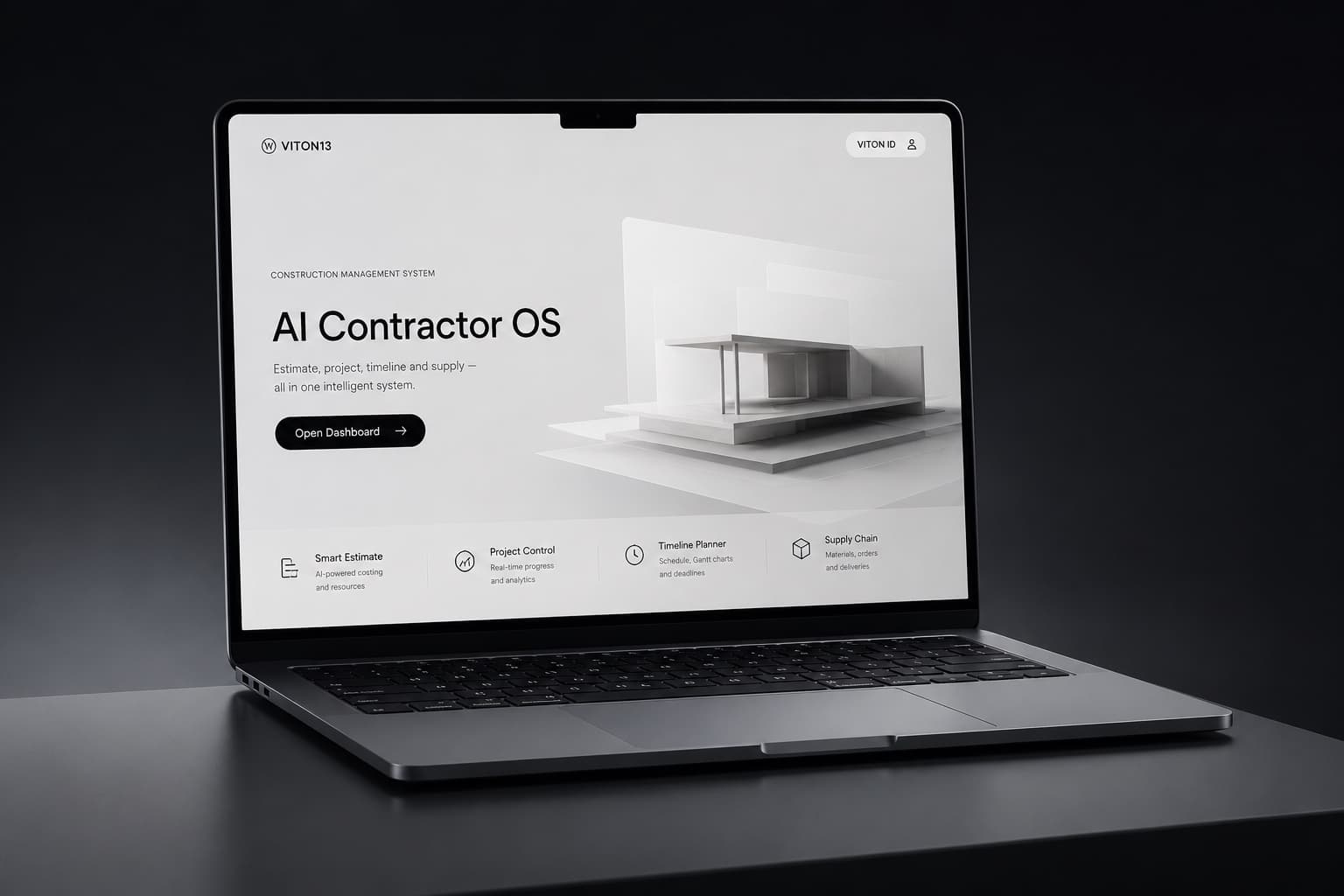
AI Contractor OS соединяет сметный расчёт, выезды, документы, снабжение и контроль исполнения в одном операционном контуре для строительных подрядчиков.
A Construction Company Loses Control Not on Site, but Between Systems
The contracting business operates across multiple realities simultaneously. Clients send requirements via messenger apps, estimators work in spreadsheets, foremen manage operational plans on their phones, procurement reconciles with accounting systems, and documents are collected in folders and emails. Each tool may handle its own task, but manual handovers occur between them. It is precisely in these transitions that changes disappear, purchases duplicate, and understanding of the current scope of work diverges.
Automation of a construction company using AI makes sense not as a separate chat tool for generating estimates. What is needed is an operational foundation linking requests, calculations, projects, personnel, materials, and confirmations. If a system speeds text creation but does not know which project version is active or who approved substitutions, it accelerates chaos rather than controls it. Therefore, AI Contractor OS starts with a process and permissions model before integrating intelligent functions.
VITON13 presents the product as an industry loop for contractors. It accepts requests and documents, assists estimating, generates survey tasks, synchronizes procurement, records changes, and assembles closing packages. Users see each value’s source and approval status. The goal is not to replace foremen or estimators but to free them from data transfers and provide everyone with a single, current view of the project.
This approach is especially important for companies that grew faster than their internal systems. While the number of projects is small, the owner personally connects departments and remembers agreements. As scale grows, this invisible work becomes a bottleneck. AI Contractor OS turns managerial memory into an auditable process: who made the decision, based on what data, which document changed, and what the next participant must now do.
From Request to Estimate: Intelligent Calculation Begins with Completeness of Initial Data
Incoming requests are rarely ready for immediate calculation. They may lack dimensions, work breakdown, material requirements, access conditions, or existing utility information. The system parses the message, technical assignments, specifications, and images, then forms a project structure. However, the primary result at this stage is not a final price but a list of confirmed data and gaps that must be closed before a responsible proposal.
AI Contractor OS links request items to corporate work templates, materials, and coefficients. For typical operations, it can suggest compositions and norms; for atypical ones, it finds similar completed projects and highlights differences. Historical estimates serve as a reference, not an absolute truth: old prices, different regions, or specific labor conditions should be visible factors rather than hidden elements of the automated result.
The estimator receives a draft with evidence. Volume entries show document pages or measurements; prices indicate source and date; material selections display chosen characteristics. If a value is changed manually, the reason and author are recorded. Such traceability helps verify calculations faster and gradually improve rules since the team sees not only errors but their origin.
In negotiations, scenarios are useful. The system can prepare a base option, a material alternative, and impact assessments on schedules. However, commercial discounts, risk reserves, and contractual responsibilities remain decisions of authorized personnel. Automation removes arithmetic and document assembly but should not turn complex construction uncertainty into artificially exact numbers.
Site Visits and Surveys Become a Continuation of the Digital Request
If on-site verification is needed for calculation, the project card turns into a task. It contains address, contacts, survey objectives, mandatory measurements, queries, and photo lists. The specialist doesn’t get a long thread without priorities; a mobile workflow guides them through checkpoints and lets them capture data even with unstable connectivity, linking each material to specific rooms, systems, or defects.
AI can recognize text on equipment, group photos, detect missing angles, and prepare preliminary summaries. Yet images do not prove hidden structural conditions, and recognized markings may be incomplete. Therefore, survey results separate observation, measurement, and interpretation. Engineers confirm facts, while assumptions remain flagged pending additional verification.
After site visits, data return to estimation without manual reassembly. New measurements update volumes, identified constraints generate work items, and photos attach to decisions. If changes affect the proposal, the system lists affected positions and requests re-approval. This prevents common scenarios where clarifications remain in voice messages, but the estimate proceeds as before.
For managers, site visits become a planned resource. They see how many requests await surveys, which specialists fit criteria by competence and location, and which data are most often recollected. Analytics help improve the request form and checklist rather than merely demanding more reports from staff after each project.
Schedules Must Consider Real Dependencies, Not Just Dates
Construction schedules fail not because they lack lines but because actual dependencies are omitted. Work may wait on materials, access, completion of related stages, system shutdowns, or client approvals. AI Contractor OS stores these conditions alongside each task. If a delivery is delayed, the system shows affected stages and suggests rescheduling scenarios without presenting them as automatically approved plans.
Daily updates come as brief factual reports: stage started, volume completed, an obstacle appeared, a decision is required. AI helps classify messages and align them with the plan. Photos and comments attach to tasks rather than lingering in general feeds. Foremen confirm statuses because formal markings without real understanding create a dangerous illusion of accuracy.
Warnings must appear before delays occur. If a confirmed material or access isn’t secured three days before work, the system raises risk alerts for the owner. Thresholds vary by criticality and response time. Too many alerts create noise, so projects configure escalation rules: what foremen resolve, what reaches project managers, and what requires official client notification.
Plan-versus-fact analysis becomes a learning tool. After stages complete, the team sees systematically underestimated work types, delay points, and forecast accuracy. This data feed back into estimating and planning templates. The operational system thus not only records history but improves subsequent calculations based on verified outcomes.
Procurement Links Specification, Budget, and Site Readiness
Material procurement should start from an approved need. AI Contractor OS generates procurement requests from estimates and schedules, preserving project, stage, quantity, allowable substitutions, and required date. This reduces manual copying and prevents mixing preliminary calculations with actual orders. Each quantity has a status: planned, approved, ordered, shipped, received, or used.
The system can compare supplier offers, check completeness, highlight price changes, and warn about deadlines. However, a low price is not always the best choice: compatibility, logistics, supplier reliability, and return conditions matter. The algorithm displays relevant factors and lets the company set priorities. The final decision is approved by a human within budget and authority limits.
Substitutions require special attention. When original materials are unavailable, AI Contractor OS searches for approved analogs by characteristics and past approvals. Differences are clearly shown, and decisions link to responsible persons and client documents if needed. Substitution updates specifications and consequence calculations only after confirmation, preventing gaps between procurement and as-built documentation.
Delivery control ties to work readiness. If materials arrive early and need storage, a task appears for acceptance and placement. If delivery lags, the risk reflects in schedules. Managers see not only order lists but procurement’s impact on cash flow and project stages, enabling decisions before crews arrive onsite without needed resources.
Documents and Changes Must Form Verifiable Project History
Each project has many versions: commercial offers, contracts, working documentation, tasks, approvals, letters, and photos. Properly named folders help but don’t answer which file is operative and why. AI Contractor OS links documents to stages and decisions, recording version, author, and date. Staff open projects to see current sets, not hunt for the last email attachment.
Changes follow a clear path. Initiators describe reasons and attach bases; the system identifies affected work, budgets, and deadlines, then routes requests to authorized participants. After approvals, the new version becomes active, and previous ones remain archived. AI helps summarize differences, but legally significant approvals occur per regulation.
At stage closeout, the system checks completeness: executed volumes, confirmations, photos, certificates, approvals, and remarks. It can assemble draft packages and highlight missing documents. This shifts control from last-night scrambling to the entire stage lifecycle. Errors are caught when correction is still feasible without reconstructing events from memory.
The openBIM approach, promoted by buildingSMART, emphasizes standard data descriptions and participant interaction. Small contractors may not implement full BIM loops, but principles apply: project, element, requirement, remark, and document should have stable connections. Such information discipline makes AI functions more reliable and eases data exchange among tools.
System Economics Are Measured by Rework and Delay Costs
Initial evaluation starts with team time. Metrics include estimate preparation, data transfer post-survey, procurement paperwork, document retrieval, and closing package assembly. Rework counts too: how often volumes recalc after lost clarifications, procurement requests redo after substitutions, or hours spent reconstructing history for disputes. These losses rarely fit one budget line but consume daily margins.
A second metric group covers timelines: days from request to proposal, frequency of work waiting for materials or decisions, and percentage of stages closed with complete documentation. An AI pilot should improve several indicators without increasing defects. Faster draft estimates with more hidden errors are not automation.
A third group reflects controllability: share of tasks with owners, number of changes without confirmation, catalog accuracy, and forecast precision. These metrics may not yield immediate direct savings but reduce reliance on individual memory and let companies handle more projects without proportional coordination growth. The ability to scale discipline is often the main benefit.
The financial model covers setup, integrations, data cleansing, mobile workflows, training, and support. Calculating ‘saved hours’ offers orientation but decisions rely on the full picture. For contractors, one prevented re-visit or timely approved substitution may outweigh hundreds of automated lines, so metrics must reflect the costs of real exceptions.
AI Risks in Construction Cannot Be Eliminated by a Single Final Check
Construction errors affect safety, costs, and contracts. The system classifies actions by risk. Extracting details allows quick checks; technical design changes need specialist reviews; critical recommendations should not automatically generate tasks without set approvals. Automation thresholds are defined by error consequences, not only average model accuracy.
The NIST AI Risk Management Framework offers a continuous governance model. For Contractor OS, context includes project type, input document quality, roles, rights, and potential damage. Monitoring uses test sets and incident logs; controls involve thresholds, action halts, and rule revisions. New models don’t roll out just because they perform better on demo queries.
Confidentiality risks are distinct. Project documents, addresses, personal data, and business terms require classification, access segregation, and clear retention policies. Contractors should know where data is processed and which is shared externally. Sensitive projects may need isolated environments or function restrictions.
Lastly, the interface must not obscure uncertainty. Users see confidence levels, sources, and escalation reasons. Frequent errors with certain drawing types become known limits, not individual staff experience. Transparent boundaries enable safe product expansion without turning trust into marketing hype.
A Ninety-Day Pilot Turns the Idea into an Auditable Operational Product
In the first weeks, the team selects one workflow—such as estimating and launching a typical repair. Completed cases are gathered, roles and baseline metrics fixed. Specialists record which decisions can’t be automated and which documents often arrive incomplete. The outcome is a process and data map, not a blanket digital transformation mandate.
The next phase runs in shadow mode. The system parses new requests, proposes estimates, and creates tasks, while staff continue usual work. Comparisons reveal real errors and time savings. After quality thresholds are met, AI Contractor OS assists on one stage while retaining mandatory approval. Disputed cases build an exceptions library.
In the final phase, limited integrations connect, users train, and stress tests run: volume changes, material delays, access losses, or substitutions occur. The pilot is assessed not by slick demos but by history preservation and timely notifications to responsible staff. Then decisions are made on expansion to other project types.
Failed pilots must also conclude outputs. Data may be insufficient, processes too variable, or integration costs outweigh effects. In such cases, the company receives a standardization plan, avoiding scaling risks. Successful pilots have owners, maintenance budgets, metrics, and clear improvement queues—not just an enthusiast’s experiment.
Which Contractors Need AI Contractor OS and How to Start Auditing
The product fits companies where estimating, surveying, purchasing, and documentation recur in recognizable patterns but links between them are maintained manually. This includes finishing contractors, engineering firms, installation organizations, and service-construction teams. Perfect data isn’t required, but business must provide real cases and assign specialists to verify solutions.
Poor candidates expect instant automatic estimates for any project without internal rule changes. Without reference owners, defined authorizations, and project uniqueness, the system won’t create order by itself. Start not by buying licenses but with one workflow: from incoming request to approved outcomes and complete evidence packages.
VITON13’s audit documents real flows, measures administrative load, assesses data, and selects minimal pilots. Architecture, role interfaces, and control loops then design. This stage is crucial since the ready product must match contractor responsibilities, not only technical model capabilities.
AI Contractor OS becomes useful when the project gains continuous digital history and specialists stop reconstructing it manually. Estimators see calculation bases, foremen the current plan, procurement the confirmed need, and managers risk and resolutions. AI operates within this discipline, accelerating repeatable tasks and leaving professional judgment where it truly counts.
Practical checklist
- Select a recurring project type and gather a complete set of documents from several completed projects.
- Identify roles responsible for approving volumes, prices, material substitutions, site visits, and schedule changes.
- Describe sources of price lists, standards, price catalogs, and inventory with update dates.
- Measure the time to prepare the initial estimate and the number of recalculations following client clarifications.
- Map document flow from incoming request to final acceptance and specify mandatory fields in each file.
- Launch a shadow pilot on new requests before authorizing the system to generate work orders.
Questions and answers
Can AI Contractor OS automatically create a construction estimate?
The system can extract volumes, match work and materials with approved reference data, and prepare a draft. The final estimate requires estimator verification, especially when technical specifications are incomplete, conditions are unusual, or contractual risks exist.
Is the product suitable for a small contractor with a few projects?
Yes, if repetitive administrative tasks already consume time of the owner, foreman, or estimator. The pilot can be limited to one service and simple integrations without creating a heavy corporate system.
Can the system integrate with existing CRM and accounting systems?
The architecture includes an integration layer, but specific implementation depends on APIs, quality of references, and access rules. Sometimes starting with controlled data exports and adding two-way synchronization after process validation is more reliable.
How does AI Contractor OS handle changes on site?
Each change links to the original requirement, author, date, confirmation, and cost or schedule impact. The system can prepare consequence calculations but should not silently replace contractual approvals.
Which metrics are important for a construction AI pilot?
Typically measured are calculation preparation time, share of manual corrections, number of lost changes, procurement approval duration, material-related delays, and completeness of documentation at stage closeout.