
Answer in brief
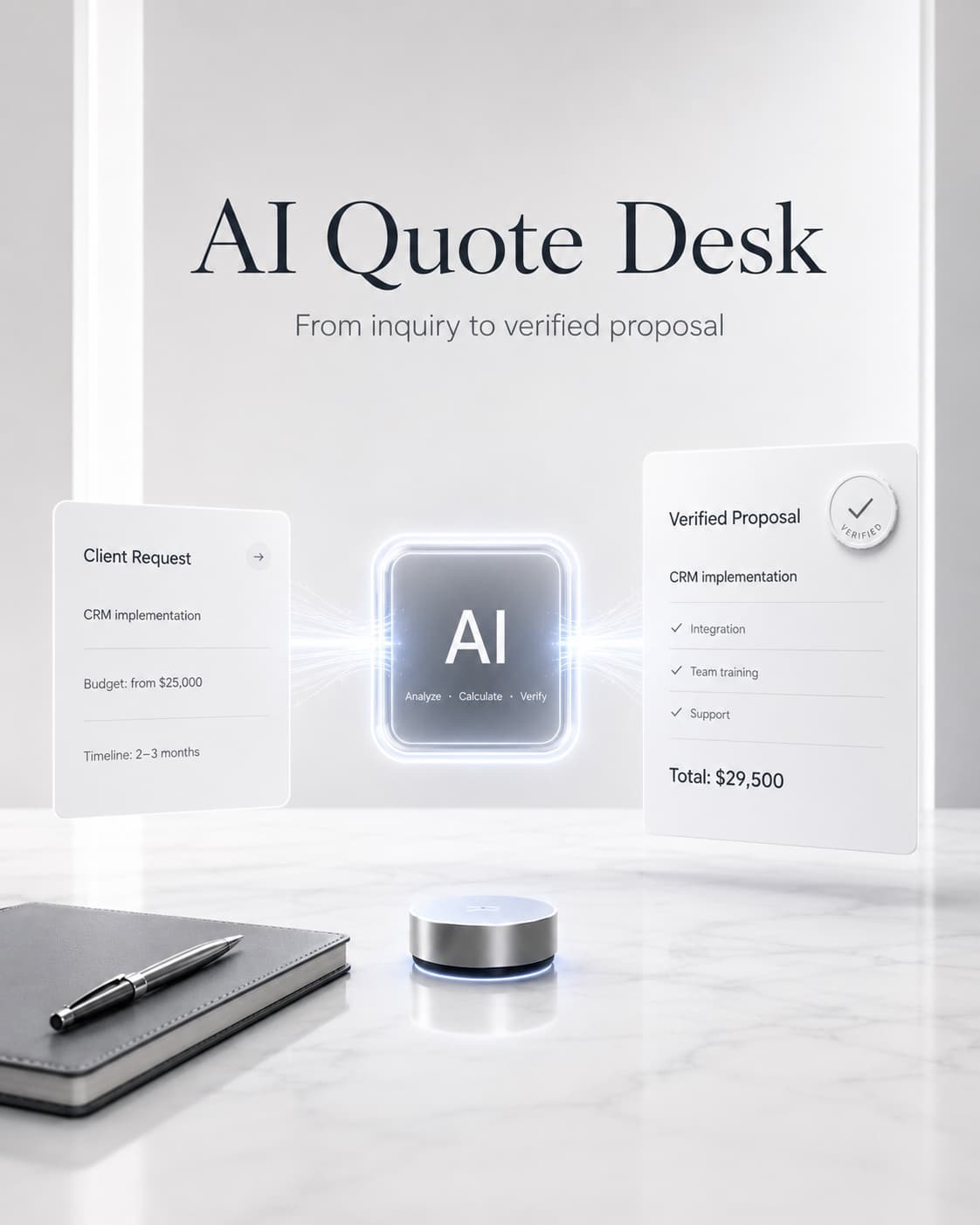
VITON13 представляет AI Quote Desk — управляемый контур для разбора входящих заявок, поиска позиций, подготовки коммерческих предложений и повторных продаж без потери человеческого контроля.
Why Speed in Proposal Preparation Has Become a Competitive Advantage
In industrial distribution, sales often begin not with a polished presentation but with an email, spreadsheet, or a photo of a nameplate. Clients list items using varied terms, omit specifications, and mix manufacturer SKUs with internal codes. The manager transforms this raw request into a commercial proposal: searching products, clarifying parameters, checking stock, agreeing on substitutions, calculating prices, and only then responding. As long as this process relies on a few skilled employees’ memories, company speed is limited by their availability.
This challenge is noticeable not only in peak seasons. Even moderate flows lead to requests bouncing among sales, procurement, technical specialists, and accounting. Each handoff creates queues and risks losing context. Clients assess suppliers simply by whether they understood the request and returned a clear offer before competitors. Thus, automating supplier commercial proposals is not just cosmetic text acceleration but a transformation of the entire decision-making chain.
AI Quote Desk is conceived as a managed workspace for this chain. It accepts inbound requests, breaks them into items and parameters, links to the catalog, suggests likely products or analogues, compiles calculations, and prepares a proposal draft. Managers see the data origin, confirm disputed choices, and are responsible for final sending. The goal is to eliminate mechanical data transfer while preserving commercial accountability within the company.
What AI Quote Desk Automates and What Remains Human
The first layer processes incoming channels. An email from a shared mailbox, an attached Excel file, a PDF spec, a website form, or call transcript become one unified card. AI extracts organization, contact, response deadline, delivery address, item list, quantities, units, and mentioned constraints. If a document contains conflicting table versions, the system does not silently pick one but flags the conflict to the operator.
The second layer links the request to nomenclature. Here value relies on company directories, not generic language model knowledge. AI Quote Desk compares the description with SKUs, synonyms, specs, and historical decisions, then ranks candidates. Exact matches may auto-fill, likely analogues require confirmation, and missing data generates queries. This confidence grading shields against plausible-looking but incorrect pick lists.
The third layer composes the commercial document per approved template. It can insert corporate details, delivery terms, taxes, payment rules, offer validity, and standard notes. But price, margin, non-standard discount, contract liability, and technical compatibility remain within company authority. The clearer the division, the more useful automation: the system speeds routine tasks, humans handle exceptions and negotiations.
Parsing Requests from Email, Excel, PDF, and Calls Without Losing Context
Good parsing starts by preserving the original. Alongside the structured item, managers can view the original table row, email fragment, or document page source. This allows quick verification of disputed values, preventing AI from becoming an opaque intermediary. File attachments’ version, receipt date, and linkage to correspondence are crucial: client clarifications later should not mistakenly apply to outdated specs.
Units require a dedicated model. Pieces, sets, meters, coils, packages, and weights often mix in one request, while the catalog’s sales unit may differ from client language. The system shows conversions, coefficients, and source rules. The same applies for designations: Latin letters might look like Cyrillic, hyphens replaced by spaces, SKUs with leading zeros. Normalization is useful only if the original value remains accessible for review.
After extraction, AI Quote Desk builds an uncertainty map listing missing characteristics, conflicts, unmatched items, and calculation-blocking queries. The manager receives an actionable queue: request voltage clarification, confirm execution, approve analogues. Automation reduces document reading time without masking data gaps behind polished text.
Product and Analog Selection Must Rely on Catalog, Not Model Guesswork
The riskiest part of any selection system is a plausible answer without product basis. A language model can explain a part’s function but lacks access to a supplier’s current product matrix, contractual limits, available brands, and specific warehouse stocks. Hence, AI Quote Desk builds around a controlled catalog. Every recommendation links to a product card, spec set, availability status, and data update date.
Search combines hard rules and semantic comparison. SKU and mandatory tech parameters are strictly verified; free-text description broadens candidates. For example, client phrases help find product family, but voltage, size, or protection class exclude incompatible options. Historical proposals add signal: if a similar wording was earlier engineer-approved, that option ranks higher with a link to past consent.
Analogues have separate policies. The company defines necessary matched parameters, allowable deviations, brand priorities, and who can approve substitutions. The system displays differences side-by-side, not buried in notes. The client may receive main and transparent alternative options with explanations. This turns selection into verifiable recommendation reducing the risk that accelerated sales cause costly claims post-delivery.
Price, Stock, Delivery, and Margin Form a Unified Commercial Circuit
An impeccably found item is not ready for sending until commercial terms are confirmed. Price depends on contract, volume, currency, warehouse, logistics, and payment terms. Stock levels update faster than data exports, and delivery times may be calculated. Thus, the product requires not one price file but a source map: where base price resides, which rules form the offer, and which values are final.
The interface should separate fact and calculation. Facts are prices from accounting systems at given time, confirmed stock, or supplier delivery times. Calculations cover discounts, planned logistics, margin reserves, or date forecasts. If managers manually adjust results, the system logs the reason and author. Such audit trails help analyze deviations, train newcomers, and improve rules without searching emails for explanations.
GS1 electronic data interchange standards demonstrate the value of agreed messages in order-to-cash and supply chains. AI Quote Desk doesn’t require immediate adoption of a unified international format but uses the same principle: order, product, quantity, price, and parties must have stable identifiers. Cleaner links reduce manual reconciliation and strengthen integration from request to proposal, order, and repeat sale.
Repeat Sales Start Not with Mailing but With Memory of Past Decisions
In many sales departments, info on past configurations stays inside proposal files. When clients return after six months, managers reconstruct logic: what was supplied, why that analogue was chosen, packaging, and changes made. AI Quote Desk turns approved proposals into structured histories linking needs, chosen items, exceptions, agreements, and final orders without mixing drafts with actual supply.
Based on this, useful signals for repeat demand arise. The system should not spam clients on a calendar. It might remind managers of probable purchase cycles, price expiration, previously scarce part availability, or new approved analogues. The seller who sees past context decides if contact brings real value.
For managers, this memory reveals lost opportunities. It shows which requests got estimates but no order, where responses delayed, and what groups require manual expertise. This informs assortment, catalog, and process improvements, not just manager activity evaluation. Repeat sales become a continuation of well-preserved decisions, not isolated marketing campaigns over fragmented histories.
Measuring Impact Without Promising Instant Savings
Before the pilot, establish baseline. For a request sample, measure time for initial parsing, product searching, clarifications, calculation, and final review. Separately, track calendar time to respond: ten minutes of work might stretch over two days due to interdepartmental queues. Also measure correction rates after internal review, missed requests, and percentage of meaningful responses within target deadlines.
During the pilot, compare metrics across similar categories. Reducing manual minutes is important but shouldn’t come at the expense of more errors. Useful metrics include extraction accuracy, accepted recommendations share, number of clarification queries, times to first draft and final sending. Commercial metrics—conversion and margin—are viewed later, as they depend on factors beyond the tool.
The calculator on the product page translates saved hours into approximate resource cost. This scenario aids discussion rather than guarantees savings. Real models consider integration costs, catalog cleanup, support, training, quality control, and seasonality. Pilots may reveal that main benefits lie not in staffing cuts but handling more requests with the same team and involving engineers earlier on truly complex requests.
Data, Security, and Human Approval Designed Before the Interface
Requests include prices, company details, tech specs, and personal contact data. Before connecting AI, companies define data classes, allowed storage locations, retention periods, and system lists for sharing. Access roles, action logs, and deletion procedures are needed. Demonstrations using random shared mailbox emails without such controls risk data leak before benefits are proven.
The NIST AI Risk Management Framework recommends managing, contextualizing, measuring, and treating risk as a continuous cycle. For Quote Desk, this means test sets of real exceptions, catalog version control, error logging, and regular confidence threshold reviews. Models update, assortments shift; thus quality can’t be validated once and forgotten. The responsible product owner monitors dynamics and can halt automation if needed.
Human approval is not a formal button but an attention guide. The interface directs focus to real changes: low confidence, margin deviations, spec mismatches, outdated prices. If managers see twenty identical warnings repeatedly, they stop reading them. Safe design is not maximum approvals but accurate exception routing to staff with proper authority.
AI Quote Desk Pilot: From Control Sample to Working Workflow
Phase one is a two-week process and data diagnosis. The team selects one category, collects historical requests and final proposals, describes price sources, and identifies critical errors. They may discover unstable SKUs, characteristics only in employees’ heads, or multiple client cards for one customer. This is not a stop signal but reason to narrow scope and plan directory work.
Phase two sets up shadow mode. AI Quote Desk analyzes requests and drafts in parallel to normal processing but sends nothing to clients. Experts mark correct matches, fix analogues, and classify error causes. After agreed quality is reached, the product shifts to assistant mode: managers use results and confirm every commercially significant action.
Phase three evaluates scaling. The team compares pilot metrics to baseline, tests integration loads, and support costs. Next category selection depends on process similarity and data availability, not request volume. Pilot failure is also useful: it shows where process standardization, directory improvement, or safe delegation are lacking.
How Daily Work Changes for Sales, Procurement, and Managers
Sales managers start with prioritized queues instead of manual shared mailbox review. Cards show response deadlines, data completeness, and blocking questions. Staff quickly judge which requests can be calculated immediately, which need client calls, and when to involve engineers. Freed time shifts from passive waiting to negotiations, objection handling, and relationship development beyond auto-filled documents.
Procurement receives normalized item requests with clear escalation reasons. Instead of full correspondence, they see specific tasks: confirm delivery time, request project pricing, or verify absence substitutions. Responses go into the same card, becoming decision history. This cuts repeated queries and lets procurement track problem categories with deficits or outdated terms.
Managers see not just proposal counts but operational backlog structure. Dashboards reveal requests awaiting data, delay stages, managers frequently changing recommendations, and product groups needing catalog updates. These insights guide investments: expand integration, revise pricing rules, or assign directory owners rather than buying stronger AI models.
To clients, good automation is almost invisible. They get faster, more accurate answers with clearly indicated alternatives and repeat information requests less often. If needed, conversations shift immediately to meaningful selections rather than file-opening checks or request ownership queries. This calm predictability—not the AI buzzword—is the strongest proof of supplier quality.
Who Benefits and What Next Steps Look Like
AI Quote Desk suits industrial suppliers or distributors with regular multi-item requests, recurring nomenclature, and multiple commercial data sources. Strong pilot candidates already store proposal histories and can appoint catalog, sales, and integration owners. Company size is secondary: small teams with costly engineering time may benefit more than large chaotic product bases.
The product does not replace commercial strategy or automatically fix outdated directories. If the company lacks clarity on analogue approval, pricing formation, and permissible client promises, AI only accelerates contradictions. The right start is mapping the entire flow from incoming email to sent proposal, noting manual decisions, and timing baseline. This reveals where automation creates provable value.
VITON13 offers AI Quote Desk as both an industry product and consulting workflow. First comes process audit, then design of limited pilot, integrations, and human control rules. Commercial scaling decisions rely on pilot data. This approach is slower than flashy demos but faster in delivering a system sales teams truly trust and can maintain after launch.
Practical checklist
- Export at least one typical set of requests along with original emails, attachments, and final commercial proposals.
- Assign a catalog owner and document where current prices, stocks, delivery times, and permitted analogues are stored.
- Separate decisions the system can suggest from those requiring mandatory manager approval.
- Measure median time from receiving the request to sending the first substantive response to the client.
- List exceptions: non-standard units, project pricing, sanctions restrictions, special contractual terms.
- Define pilot criteria: accuracy of item extraction, share of accepted recommendations, number of corrections returned.
Questions and answers
Can AI Quote Desk handle unstructured requests?
Yes, the pilot can be configured for emails, spreadsheets, PDFs, forms, and call transcripts. However, the system should not guess missing parameters but explicitly highlight gaps and generate clarifying questions for managers or clients.
Is it necessary to change the existing CRM or accounting system?
Usually not. AI Quote Desk is designed as an operational layer between incoming inquiry channels, catalog, CRM, and accounting systems. The integration method is determined after auditing APIs, data exports, and access rules.
Who is responsible for the final price and terms of the commercial proposal?
The company employee remains responsible. AI can compile calculation, apply approved rules, and highlight deviations, but non-standard discounts, item substitutions, or contractual obligations must go through established approval workflows.
How to evaluate the economic impact of automation?
Compare manual processing time, monthly request volume, team hourly cost, first response speed, win rate, and rework volume. The financial model should include integration, support, and exception handling costs.
Which product category is best for starting a pilot?
Suitable categories have a sufficient number of recurring requests, relatively stable nomenclature, and available historical proposals. Complex project-based groups are rarely good first points, even if they seem most valuable.