
Answer in brief
No universal item count exists for a capsule wardrobe. You count the outfits your week demands and translate them into garments afterwards. This piece covers the arithmetic of combinations, the lower and upper bounds, and the $70 Capsule Wardrobe package.
The answer: there is no fixed number, you count outfits
The short answer is that no universal item count exists for a capsule wardrobe, and any figure quoted without reference to your calendar is describing somebody else's week. What you count is not hangers but the number of finished outfits your working and personal schedule actually demands.
An outfit here means something you could walk out of the door in with no further work: a top and a bottom or a dress, shoes that suit the route, a layer that suits the weather, and a level of formality that suits the occasion. An unfinished set does not count.
That definition also sets the order of work. First you record how many distinct types of day repeat across a fortnight. Then you decide how many outfits each of those types needs. Only at the end do you translate the outfits into a list of individual garments.
The same order changes the money conversation. A business owner deciding whether to hire a stylist is not buying hangers; they are buying a predictable morning, in which every commitment already sitting in the calendar is matched to an outfit that has been assembled and checked in advance.
Why a round number from someone else's wardrobe does not transfer
Round figures travel well because they are easy to remember and easy to audit: count the hangers and you feel you have followed the method. But an item count is the output of somebody else's calculation, and it arrives carrying their climate, their dress code and their weekly rhythm.
Compare two people with similar jobs. One spends four days a week in negotiations and on shoots, and three in transit and at a warehouse. The other works in a single register all week. At an identical item count, the first runs short of outfits while the second accumulates untouched shelves.
There is a mirror-image error: assuming that more garments automatically means more choice. A wardrobe built from pieces that do not talk to each other yields plenty of hangers and very few finished exits. The number rises while the set of decisions available to you in the morning stays flat.
This article therefore prints no recommended figure. It prints a method for producing yours: list the occasions, assign outfits to them, subtract what the wardrobe already covers, and read off what is missing. The number arrives at the end as a result, not at the start as a rule.
Start from the week, not from the shelf
Open the last two weeks of your calendar, the actual ones rather than an idealised version. Write down the types of day that repeat: studio or office, client meetings, shoots, travel, training, evening events, weekends with family. A fortnight gives you enough repetition to separate the routine from the one-off.
Beside each type, write how many times it occurred across those two weeks. That figure carries more weight than your self-image: wardrobes are often built around the rare, photogenic occasion, but they wear out on the routine days you have just listed.
Record the hard constraints separately: a client's dress code, the temperature range you dress for, hours spent standing, a trip restricted to carry-on. Those conditions will later remove some of the arithmetic combinations, and it helps to know about them before you start counting rather than after you have bought.
The output of this step is a two-column table: type of day, and number of days. It contains no garments at all. That is exactly right, because the garment list is a translation of the table and cannot be written before the table exists.
The unit of counting is the outfit, not the garment
An outfit qualifies when nothing in it is missing: everything coordinates, everything fits, the shoes work for the route and the outer layer works for the forecast. A set that is one item short of being wearable is a plan rather than an outfit, and it does not enter the count.
Now assign outfits to the types of day. A type that recurs needs several distinct outfits, or you will wear the same thing to two consecutive meetings. A type that occurs rarely usually needs one, but it has to exist in full rather than as an intention to shop later.
Add up the assigned outfits and you have your brief. It is denominated in exits rather than hangers, and it can be checked: every day in the table points to a described set, not to a general confidence that something will turn up.
Only now does the question about garments become meaningful, and it takes a specific form: which list of items covers these outfits without needless duplication. That is a combinatorics problem, and it follows rules worth stating plainly.
The arithmetic: combinations grow faster than the list
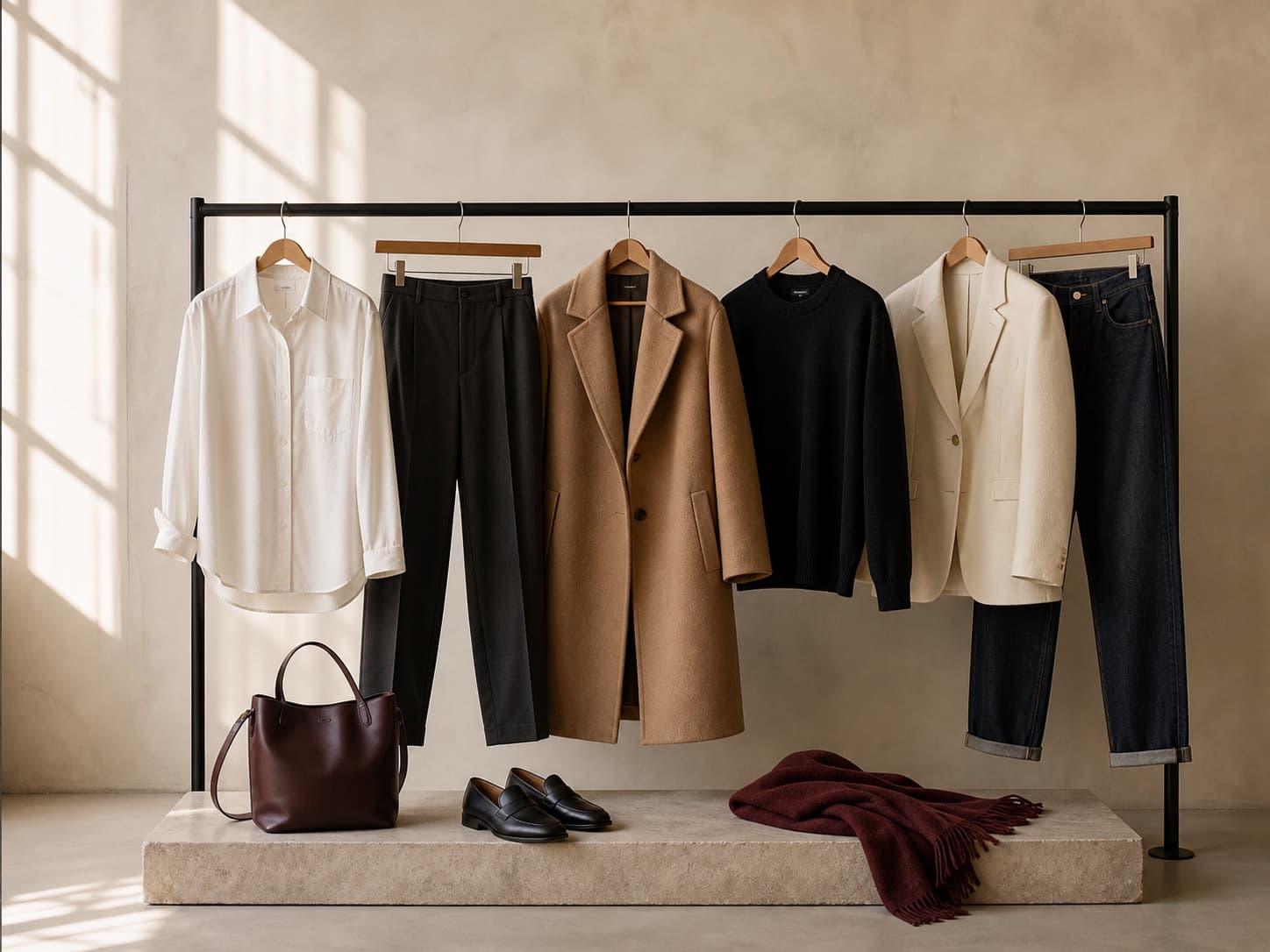
Take a simple case: five tops and three bottoms. The number of top-and-bottom pairings is fifteen, a product rather than a sum. The list has grown to eight items while the formal pairings have grown to fifteen. That gap is the entire economic argument for a capsule.
Add shoes and an outer layer, a jacket or a cardigan or a coat, and the product multiplies again. Two jackets turn fifteen pairings into thirty silhouette options. This is where the familiar impression comes from that a small, deliberate set goes further than a wardrobe stuffed with singletons.
It matters to be precise about what is growing. What grows is the count of theoretical combinations. The count of outfits you will genuinely wear is always lower, because occasion, colour, proportion and season all subtract from the product. The sections that follow deal with that subtraction.
Even after the subtraction the conclusion holds: you do not extend the list linearly, one purchase per occasion. You extend it at the points where a single item enters several outfits at once. That is the arithmetic core of the capsule idea.
Where to add a piece so that it yields more outfits
The product implies a simple rule. With five tops and three bottoms, a new top adds three pairings, one for each bottom. A new bottom adds five, one for each top. The gain from any addition equals the size of the opposite category.
All else being equal, then, it pays to top up the category you hold fewer of, because it multiplies against the larger one. This runs against the habit of anyone who buys tops: tops are quicker to try on and more visible in photographs, while bottoms accumulate slowly.
The rule works in reverse as well. An item that coordinates with only one other piece adds a single option while occupying the space, the budget and the care time of a full unit. Purchases like that are what turn a large wardrobe into a collection of singletons.
So the pre-purchase test has two parts: how many pieces I already own does this combine with, and which types of day from my table does it serve. An honest answer of “one piece, one rare occasion” means an event purchase rather than a capsule component.
Why theoretical combinations overstate the result
Fifteen pairings on paper are not fifteen exits. Formality removes some: the trousers that work at a warehouse do not work in a negotiation. Season removes others: a linen top is not an option at minus ten. Proportion and colour remove more, where a pairing is technically possible but reads as careless.
A working capsule is therefore easier to manage with two numbers instead of one. The first is theoretical combinations, which describes the potential of the set. The second is confirmed outfits: the ones you or a stylist have assembled, seen as a whole, and accepted for a named type of day.
The gap between those two numbers is the diagnostic. Many theoretical combinations alongside few confirmed outfits does not point to a shortage of garments; it points to palette, fit and formality pulling in different directions, so the product never converts into exits.
This is why a list of combinations is a deliverable in its own right rather than an appendix to a shopping list. Until the combinations are written down, their number remains a guess, and the item count for the capsule can be neither justified nor checked.
Laundry and repetition set the lower bound
The outfit count has a hard floor, and domestic logistics set it. If you launder once a week, any garment you intend to wear twice within that week has to survive two outings before washing. Where it cannot, the second outfit exists on paper only.
That has a direct consequence for base layers. Shirts, t-shirts and underwear are counted against the number of days between washes rather than against the number of outfits, because they rarely take a repeat. Jackets, trousers and outerwear behave differently and carry several consecutive exits.
The second constraint is your tolerance for visible repetition. In some environments the same outfit at two consecutive meetings passes without comment; in others it is noticed. That tolerance translates directly into how many distinct outfits a recurring type of day requires.
The third is a margin for failure: a stain, a delayed wash, a split seam, a forecast that changes overnight. One spare outfit per recurring type of day usually covers it. The spare does not decorate the calculation; without it the capsule breaks on its first bad day.
The upper bound: what surplus pieces cost you
The ceiling is set by attention rather than logistics. Every additional unit joins the morning decision, occupies space and asks for care. Once you hold more garments than you hold scenarios, some of them stop appearing in outfits altogether and turn into background.
The symptom is visible without arithmetic: you keep returning to the same handful of exits while the rest hangs untouched. That means money went into units which never entered a combination, and another purchase of the same kind will not change the situation.
There is a subtler cost as well. A large, uncoordinated set makes it harder to see what is genuinely missing: a shortage of one bottom hides behind an abundance of tops, so you buy another top. Counting by outfits exposes gaps like that, because it shows the empty cells in the table.
A workable guide is to keep the capsule at a level where every unit appears in at least two confirmed outfits. That is not a dogma and not a garment count; it is a selection rule, and it behaves the same way at ten items as at forty.
The count starts with what you already own
You almost never count from zero. Garments that already serve the types of day in your table are sitting in the wardrobe, and the job is to establish which outfits they close today and which cells stay empty. That is audit work, not a trip to the shops.
At VITON13 that step is the Look Audit at $30, with a timeline of 1 working day. It covers a review of the current wardrobe, image notes and priority recommendations, plus 1 round on the written notes. The clothing budget itself is not included in the price.
The audit is useful precisely because it comes before the arithmetic. It separates the pieces that work from the pieces that only take up space, and it converts a vague “nothing to wear” into a list of specific gaps. After it, the shopping list gets shorter and easier to defend.
The audit and the capsule are different deliverables. The Look Audit answers what you own and what should be done with it; the Capsule Wardrobe package returns a capsule structure, a shopping list and look combinations. Running the inventory first simply keeps the purchases modest.
What the Capsule Wardrobe package actually delivers
The Capsule Wardrobe package is $70 with a timeline of 1-2 working days. Three things come back: a capsule structure, a shopping list, and look combinations. It includes 2 rounds on the capsule list. The clothing budget and any tailoring are not part of the price.
The look combinations are what make the number checkable. The structure explains which categories the set is built from and why; the shopping list closes the gaps; the combinations show which outfits assemble out of the result. Without that third element a capsule stays a list rather than a calculation.
The two rounds are not a formality. The first usually goes on agreeing the structure and the priorities. The second lands after you have tried part of the list and learned what you actually reach for. Those rounds apply to the capsule list and to nothing else.
The boundaries are worth naming outright: VITON13 does not buy clothing on a client's behalf and does not carry out alterations or repairs. That is not a quirk of this package but a constant across the styling service, and it belongs in your budget and your timeline from the start.
Where this article stops, and what to do next
The neighbouring VJOURNAL pieces on capsules answer different questions: one deals with a capsule for changing weather, the other with a week of clothing carried in hand luggage alone. This one is about arithmetic: how the number is produced and how it can be checked.
When the task is a single occasion rather than a capsule, it has its own package. Event Look is $55 over 2 working days with 1 round: one complete look for a named occasion, built from your own wardrobe first, plus a shopping list with links and sizes. Purchases, alterations and on-the-day dressing are not included.
For occasion styling, look planning and visual continuity there is the Styling Day at $120: one session, scheduled within 3 days, remote by default, with travel agreed and quoted separately. Styling Day Express is $180 for 1 working day, booked within 48 hours, with 1 round and a same-day written follow-up; purchases and alterations are not included.
Re-check the number a month later. Mark what you actually wore and recount the empty cells in the table. Items that never entered an outfit are a reason to rebuild combinations rather than to buy more. The figure in a capsule should be the output of the calculation, never its premise.
Practical checklist
- List the types of day from the last two weeks and how often each recurred.
- Assign every type of day the number of finished outfits it needs.
- Mark the items without which a set never becomes wearable as a whole.
- Count how many pieces you already own each planned purchase combines with.
- Add one spare outfit per recurring type of day and check the plan against your laundry cycle.
- Log what you actually wore after a month and rebuild combinations for the empty cells.
Questions and answers
How many items should a capsule wardrobe have?
There is no fixed number. Count outfits rather than garments: list the types of day across a fortnight, assign each one the number of finished outfits it needs, and only then translate those into a list of items. The garment count arrives at the end, as the result of the calculation.
What does the Capsule Wardrobe package cost and what does it include?
The Capsule Wardrobe package is $70 with a timeline of 1-2 working days. It includes a capsule structure, a shopping list and look combinations, plus 2 rounds on the capsule list. The clothing budget and any tailoring are not part of the price.
Do shoes and outerwear count alongside everything else?
They are counted as separate categories, because they multiply the number of combinations while being limited by season and occasion. A pair of shoes or a jacket that works with several tops and bottoms yields more outfits than another item in a category you have already filled.
Where should I start if the wardrobe is already large?
With a review of what is there. The Look Audit is $30 with a timeline of 1 working day: a review of the current wardrobe, image notes and priority recommendations, plus 1 round on the written notes. The clothing budget itself is not included.
Does VITON13 buy the clothes or handle alterations?
No. VITON13 does not buy clothing on a client's behalf and does not carry out alterations or repairs. The work covers the review, the structure, shopping lists with links and sizes, and look combinations; the purchases and the tailor stay with the client.