
Answer in brief
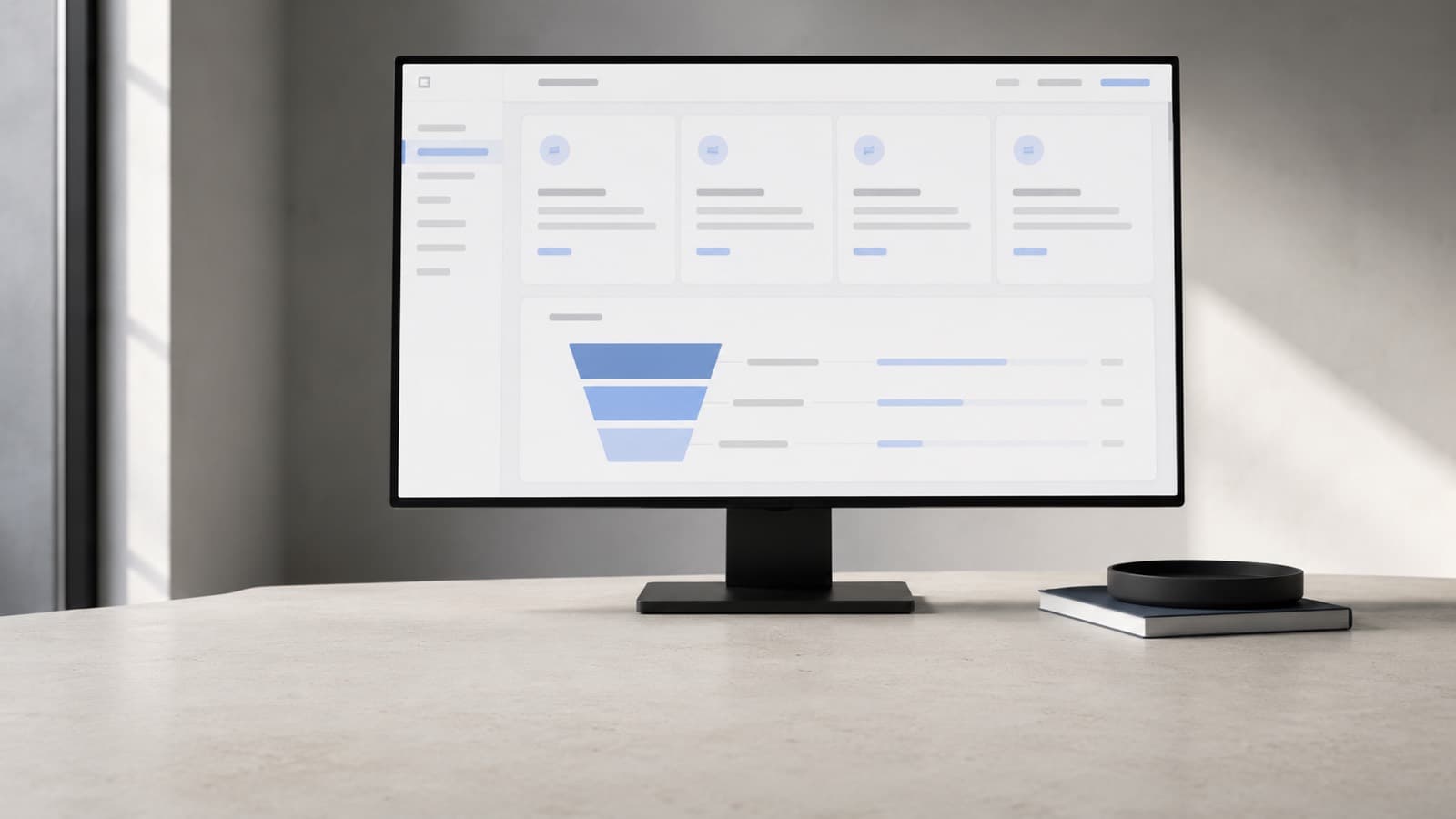
A funnel is not a diagram, it is a list of the moments a person can stop. Five stages, the question each one has to answer, and the arithmetic that tells you which stage is losing people before you spend anything on the others.
A funnel is a list of stopping points
The word suggests a shape, which is unhelpful. How to build a sales funnel is really a question about listing the moments at which a person can stop, and the value is entirely in whether those moments are named specifically enough to be counted.
For most small businesses there are five: not knowing you exist, arriving without understanding what you sell, understanding but not trusting it enough to act, deciding but finding it awkward to ask, and asking but never hearing back.
Each of those loses people, and each has a different fix. Treating them as one thing produces the most common and expensive response to a disappointing month, which is to buy more traffic.
What follows is the question each stage has to answer, the arithmetic that shows which one is leaking, and where a funnel map sits among packages that state their price and their exclusions.
Stage one: they do not know you exist
The question this stage answers is whether the people who would buy from you ever encounter you at all. It is the only stage where the answer is genuinely about distribution.
It is also the stage everyone assumes is the problem, because it is the only one that is invisible from the inside. You cannot see the people who never arrived, so the imagination fills the gap.
Before funding it, check whether the demand exists in a form you can meet. If people already search for what you sell, being findable is cheaper than interrupting; if they do not, you are creating demand and the budget behaves differently.
Google's Search Essentials sets out what has to be true for a page to be eligible in search at all, which is worth confirming before concluding that the problem is competitive rather than technical.
Stage two: they arrive and do not understand the offer
The question here is whether a stranger can say what you sell after a few seconds. Not whether they are impressed — whether they can repeat it.
This stage fails quietly. The visit is recorded, the time on page looks acceptable, and nothing in the analytics says the person left confused rather than uninterested.
The test is to hand your page to someone outside the business and ask what you sell and what it costs. Their hesitation is the finding, and it is usually about a missing sentence rather than a missing design.
Guidance from Google on creating helpful, people-first content makes a related point: material written to answer the reader's actual question behaves differently from material assembled around a phrase.
Stage three: they understand and do not believe it
The question is whether there is enough on the page to make the claim checkable. A price or a price logic, what is included, what is not, a timeline with its unit.
Exclusions do more work here than promises. Naming what you do not do makes everything else more believable, and it prevents the enquiries that waste a conversation before turning out to be unsuitable.
Specifics beat adjectives. "1-2 working days" is checkable; "fast turnaround" is a claim the reader has to take on trust, and trust is exactly what is missing at this stage.
This is also where the price question belongs. Leaving it out moves the whole qualifying conversation onto a call, which costs your time and loses the people who were not going to call.
Stage four: they decide and cannot easily ask
The question is whether asking is easy at the moment of deciding. A request button below several screens of content is a decision that expires while the reader scrolls.
Check this on a phone at the size most readers see. A form that requires pinching, or a button that has to be hunted for, loses people who had already decided to act.
Check it by keyboard as well. The W3C's WCAG 2.2 quick reference is the practical list, and a field that cannot be reached without a mouse produces a loss that appears in no report.
Reduce what you ask for. Every additional required field is another chance to stop, and most of what businesses collect on a first form could be asked in the reply instead.
Stage five: they ask and hear nothing
The stage after the enquiry is the one most often left out of a funnel, and it loses people at a rate nobody records, because analytics stops at submission and the loss happens in an inbox.
Two failures live here. The technical one is a form that accepts, thanks the visitor and delivers nowhere. The human one is a reply that arrives three days later, by which time the person has asked someone else.
Test the technical failure yourself by submitting a real enquiry and confirming it arrives everywhere it should: the inbox, the CRM, the notification channel. Repeat after any change to the site.
For the human one, agree a response time and measure it. It is the cheapest improvement available in most small businesses, and it requires no budget at all.
The arithmetic that finds the leak
Count the transitions rather than the totals. How many arrived, how many read past the first screen, how many started the form, how many finished it, how many received a reply within your agreed time.
Then look at proportions rather than absolute numbers. A stage that loses most of the people who reach it is the leak, regardless of whether the number in front of it is large or small.
The result is frequently surprising. Businesses that were sure the problem was traffic often find the largest drop between starting and finishing a form, which is a fix rather than a budget.
Write the counts down before you change anything. Without a baseline you cannot tell whether a fix worked, and you will end up arguing about impressions.
Why fixing the leak beats adding traffic
Adding traffic to a leaking funnel multiplies the loss and costs money doing it. Fixing the leak improves the return on every visitor you already have and on every one you buy afterwards.
The fixes at the middle stages are also unusually cheap. Adding a price, naming exclusions, moving a button, shortening a form: none of these costs anything on any platform.
This is the argument for diagnosing before spending, and it is why the smallest package in the ladder produces a document rather than a campaign.
Search Snapshot is priced at $70 over 1-2 working days and covers a visibility check on your top queries, three competitors side by side and one page of findings with no deck, with one clarification round. Implementation, content and ad spend are excluded.
Building the map rather than the diagram
A funnel map is useful when it names, per stage, what a visitor meets, what they are asked to do, and what is said to the ones who do not do it. A shape on a slide names none of those.
The third of those is the part most often missing. Most businesses have nothing at all for the person who read everything and did not act, which is usually the largest group at every stage.
Growth Sprint is priced at $230 over 5-8 working days and covers a funnel map, a messaging system and a growth action plan, with two rounds of revisions on the creative set. Ad spend is excluded and is paid by you to the platform. The article applies that principle to a defined result: A funnel is not a diagram, it is a list of the moments a person can stop. Five stages, the question each one has to answer,…
Growth Sprint Express is $360 and delivers that same scope on a priority schedule over 3 working days with daily written updates, carrying one round of revisions, with ad spend and production excluded. For this case, the decision criterion is specific: A funnel is not a diagram, it is a list of the moments a person can stop. Five stages, the question each one has to answer,…
What a funnel cannot tell you
It cannot tell you why someone left, only where. The reason lives in a conversation, which is why asking every enquiry how they found you and what nearly stopped them is worth more than another dashboard.
It cannot see the people who decided over several visits across weeks, which in longer sales cycles is most of them. A funnel drawn as a single session flatters short cycles and misreads long ones.
It cannot separate a message problem from a price problem without asking. Both look identical in the numbers: people arrive, read and do not act.
Treat it as a way to narrow the question rather than to answer it. Its job is to tell you which stage to go and investigate, not to conclude the investigation.
Keeping the funnel honest over time
Recount after every change, on the same stage definitions. Changing what a stage means between counts is the fastest way to produce a chart showing something that did not happen.
Recheck the plumbing after any redesign. Form submissions and click-to-call are usually page-specific code, and page-specific code is what a rebuild rewrites without telling anyone.
Review the stage-five response time monthly, because it drifts. It is the stage most affected by how busy the business is and the least likely to appear in a report.
Where the work becomes continuous, the Monthly Growth Retainer is $330 per month on a monthly cycle with 30 days notice to stop, covering monthly planning, a reporting rhythm and channel optimisation, with channels and volume agreed each cycle and ad spend and third-party tool subscriptions excluded.
A one-week version you can run yourself
Write your five stages in your own words. Count the transitions for one week, however roughly. Mark the largest proportional drop.
Fix the one thing at that stage that costs nothing: a missing price, a missing exclusion, a button too far down, a form with three fields too many, a reply that takes too long.
Recount the following week against the same definitions and write down what changed and when.
That is a funnel exercise in full, it costs an afternoon plus attention, and it will tell you whether the paid version has anything left to find — which is the question worth answering before commissioning one.
Practical checklist
- Write the five stages as moments a person can stop, in your own words.
- Write the one question each stage has to answer for a visitor.
- Count how many people move from each stage to the next.
- Fix the widest drop first, before adding anything at the top.
- Test the enquiry form yourself on a phone and confirm it arrives.
- Re-count after the fix, on the same definition, before doing anything else.
Questions and answers
What is a sales funnel in practical terms?
A list of the moments at which a person can stop: not knowing you exist, arriving without understanding the offer, understanding but not trusting it, deciding but not being able to ask easily, and asking but never hearing back. Each of those is a stage, and each loses people.
What does a funnel map cost?
Growth Sprint is $230 over 5-8 working days and includes a funnel map alongside a messaging system and a growth action plan, with two rounds of revisions on the creative set. Growth Sprint Express is $360 for the same scope over 3 working days with one round. Ad spend is excluded from both and paid by you to the platform.
How do I find where my funnel leaks?
Count the transitions rather than the totals. How many arrived, how many read past the first screen, how many started the form, how many finished it, how many got a reply. The largest proportional drop is the leak, and it is usually not where people assume.
Should I fix the funnel or buy more traffic?
Fix the funnel first if any stage is losing most of the people who reach it. Adding traffic to a leaking funnel multiplies the loss and costs money at the same time, whereas the fix is usually a page change that costs nothing on any platform.
How many stages should a funnel have?
As many as there are real moments where someone can stop in your business, which is usually four to six. A twelve-stage funnel is normally a diagram rather than a description, and the extra stages have no number attached to them.